The future of BPO is intelligent, multilingual, and fully integrated. Uncover the trends powering growth for next-gen outsourcing providers.
10 November 2025
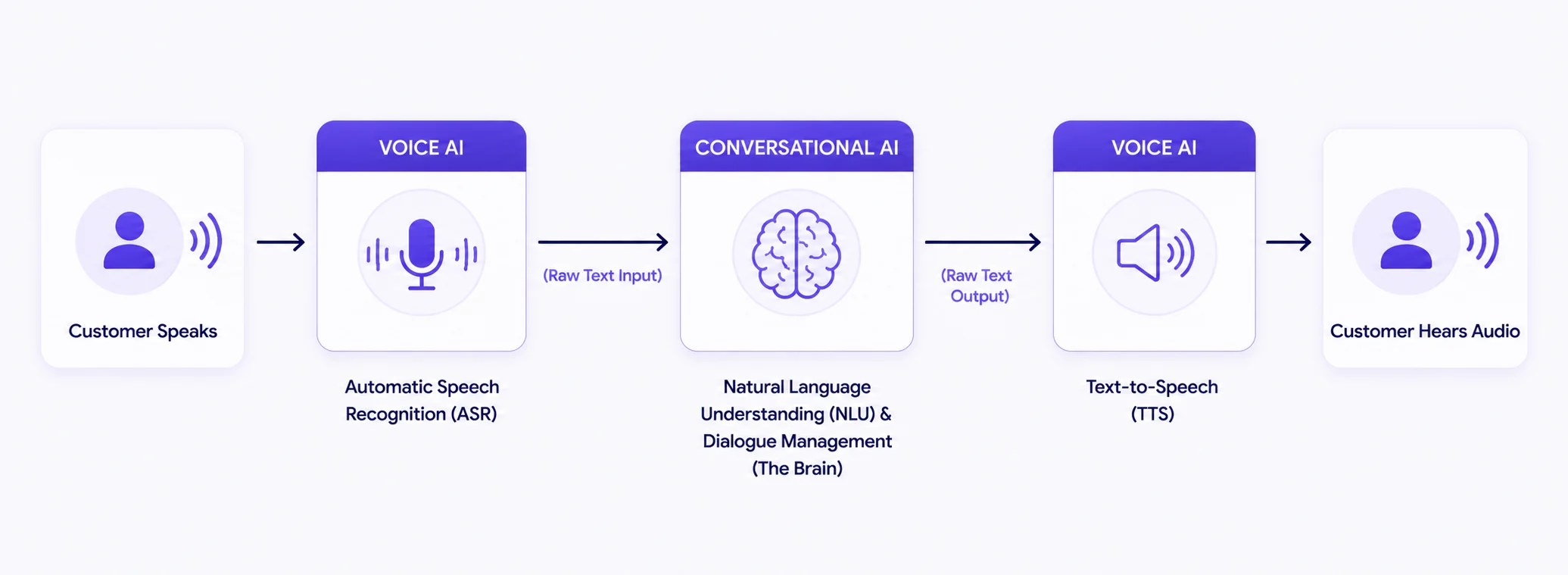
The distinction between conversational AI and voice AI is a matter of software architecture versus the user interface. Conversational AI acts as the underlying cognitive framework. It deciphers human intent, manages long-term context, and orchestrates backend business workflows across text, chat, or audio. Voice AI is the specific auditory delivery mechanism. It translates spoken acoustic waves into machine-readable text and converts text back into synthetic speech. For businesses evaluating automation platforms, the choice is not mutually exclusive. A modern, high-performance automated telephone ecosystem relies on voice AI to manage the sound of the interaction, while relying on conversational AI to handle the actual thinking.
Walk into any enterprise technology summit or read through modern vendor proposals, and you will notice a frustrating trend. Product teams and marketers use “Conversational AI” and “Voice AI” as if they mean the exact same thing.
This linguistic shorthand creates severe issues when non-technical business leaders try to procure automation software. A company might purchase a voice interface thinking it will automate complex client support issues, only to discover they bought a gloriously smooth voice synthesizer that cannot track a shifting conversation or handle basic contextual logic.
To clear the confusion and build a roadmap that scales, you have to look past the marketing gloss and separate the cognitive layer from the communication medium.
Also read: Voice AI Platform vs Chatbot: Which One Should Your Support Team Deploy?
For an enterprise agent to function correctly, these two distinct systems must be tightly integrated. They are not competing products; they are sequential layers in a production environment.
When a business uses text-only support channels, like WhatsApp automation or web-based chatbots, they deploy conversational AI by itself. The text input is already clean and structured, so there is no need for acoustic processing.
However, when you move your operations to the phone lines, standalone speech tools fall short. If your voice AI lacks a deep conversational AI core, you end up with nothing more than an expensive, legacy Interactive Voice Response (IVR) menu that recognizes words but fails to comprehend the customer’s actual problem.
Choosing where to invest depends entirely on where your customer friction points sit and which communication channels your target audience prefers. Use this simple matrix to guide your technical roadmap.
| High volumes of website support tickets, long queues on digital help desks, and a preference for chat or SMS. | Conversational AI | Digital channels do not need acoustic translation. You need to focus heavily on intent matching and rapid, multi-turn text resolution. |
| Flooded telephone lines, high call drop rates, massive spending on inbound call centers, and a hands-free consumer base. | Voice AI + Conversational AI | You must use speech recognition to open the phone channel, backed by deep dialogue management to handle actual issues without human intervention. |
| Need for automated data entry, transcribing recorded meetings, or building voice-controlled internal equipment interfaces. | Voice AI Only (Simple Speech-to-Text) | If the goal is purely passive transcription or executing rigid, single-word commands, you do not need complex dialogue management or conversational reasoning. |
Not necessarily. They simply solve completely different engineering problems. Conversational AI is more advanced in terms of business logic, contextual memory, and cross-channel workflow execution. It handles the structural reasoning required to guide a customer through a multi-step account validation process.
Voice AI, on the other hand, faces incredible engineering hurdles related to real-time execution and audio processing. A text chatbot can take two full seconds to respond without ruining the user experience, but a voice system that pauses for two seconds feels completely broken. Voice AI must handle extreme latency constraints, background noise reduction, and natural speech rhythms, making it highly sophisticated from a purely infrastructure-focused perspective.
Yes, but only for highly restrictive, non-conversational tasks. If your goal is simply to transcribe audio recordings into written text logs, or if you want to let a field technician check off a digital inspection list by speaking single words like “Pass” or “Fail,” you are using standalone voice AI. In these specific scenarios, the system does not need to understand long-term context or maintain a fluid, back-and-forth dialogue. However, if you want that system to answer an open-ended customer phone call and solve a multi-step logistics issue, it will fail without a conversational AI brain underneath it.
Rootle unifies both technologies into a single, cohesive engine designed specifically for outbound sales and customer engagement. Instead of forcing enterprises to buy separate speech-to-text tools, dialogue managers, and text-to-speech synthesizers, Rootle packages these complex systems into an out-of-the-box solution. The platform uses advanced voice AI to ensure near-zero latency and incredibly human-like audio delivery over standard phone connections, while running a robust conversational AI layer underneath to manage the flow of the sales call, handle unexpected objections, and update records within your CRM in real time.
Building a custom voice automation system requires stitching together separate vendor APIs for speech transcription, large language model orchestration, dialogue state tracking, and voice synthesis. This fragmented architecture creates massive latency penalties as data travels across different servers, resulting in clunky, mechanical phone conversations that prompt prospects to hang up. Rootle eliminates this integration friction by handling the entire pipeline natively. This allows sales teams to launch automated voice workflows that sound entirely natural, move at human speed, and convert leads without requiring months of dedicated software engineering.
For more details, read this blog: Build vs Buy: Should You Build Your Own Voice AI System or Use a Voice AI Platform?
Legacy IVR systems are rigid, menu-driven trees that force callers to press plastic buttons or speak exact, pre-defined phrases like “billing” or “technical support.” They are notoriously frustrating because they cannot handle context shifts, interruptions, or natural human phrasing. Modern voice automation replaces these static scripts with dynamic, open-ended conversation. Callers can speak casually, ask compound questions, interrupt the agent to clarify a point, and change their minds mid-call. The system listens, adapts, and resolves the issue exactly like an experienced human representative.