The future of BPO is intelligent, multilingual, and fully integrated. Uncover the trends powering growth for next-gen outsourcing providers.
10 November 2025
While Voice AI holds incredible promise for transforming customer experience, businesses transitioning from prototypes to production often encounter significant operational hurdles. These limitations—ranging from unnatural latency and background noise susceptibility to rigid conversational flows and complex CRM integration—can easily derail user trust if left unaddressed. By understanding these six core challenges and implementing strategic workarounds, enterprises can design resilient, highly accurate voice systems that feel natural, keep data secure, and seamlessly blend automated efficiency with human oversight.
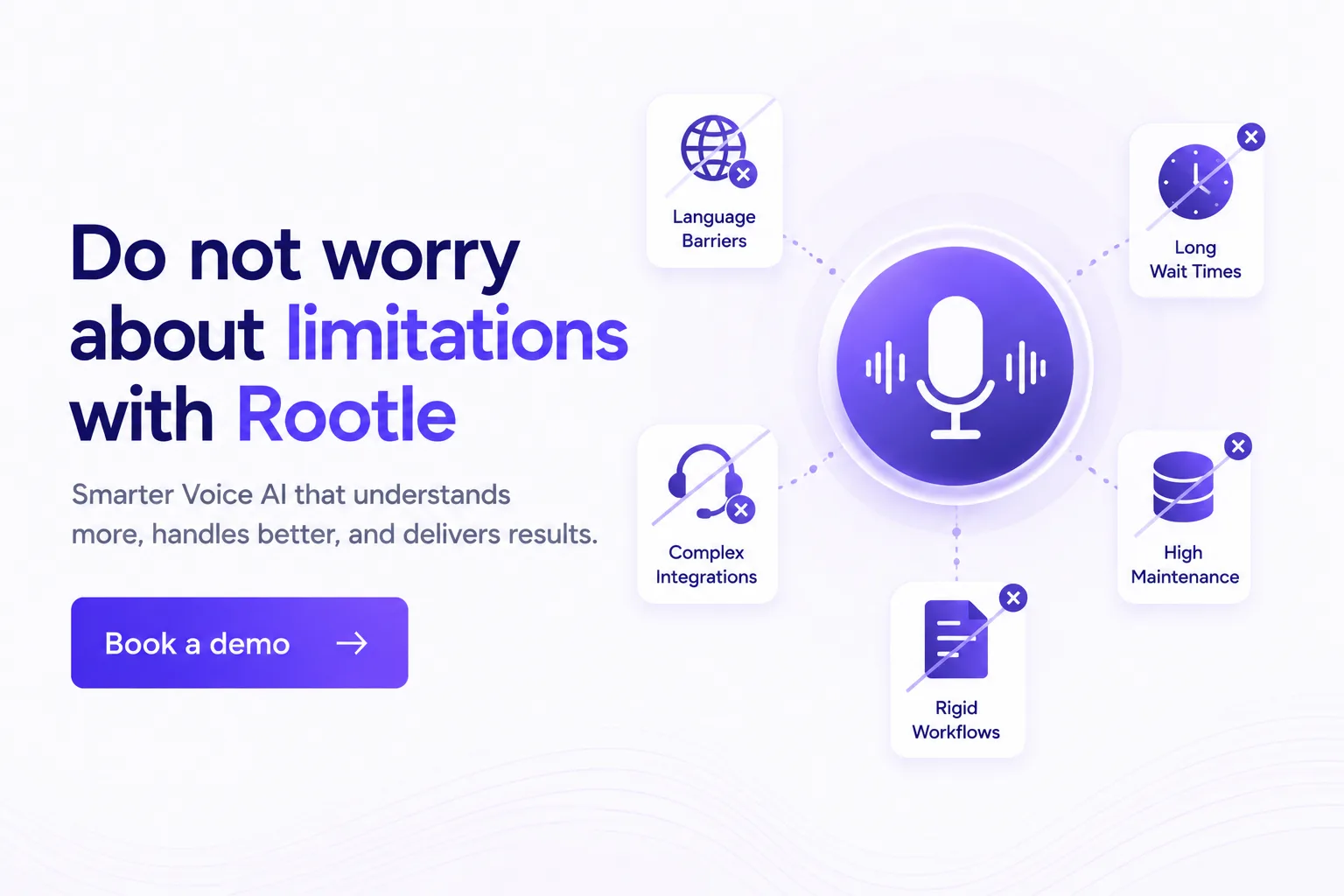
Voice AI has officially crossed the threshold from a futuristic novelty into an active business priority. Yet, any engineering lead or customer support director who has tried to move a voice bot from a sandbox demo to a live phone queue will tell you the same thing: it is incredibly easy to build a prototype that works, and exceptionally difficult to deploy one that doesn’t frustrate actual customers.
When real users talk to an AI, they don’t follow a script. They interrupt, they mumble, they use slang, they call from noisy coffee shops, and they expect the system to respond with the same speed and social awareness as a live human agent.
To build a voice channel that actually contains calls, deflects costs, and satisfies users, you have to be honest about where the technology struggles. Here are six very real limitations of modern Voice AI systems, and exactly how you can engineer around them.
Standard Speech-to-Text models are usually trained on clean, clear studio recordings of standard accents. When a caller introduces background noise (like wind, passing cars, or echoes) or speaks with a heavy regional accent, the audio waveform deviates significantly from the model’s training data. This results in a high word error rate, which cascades down the system and causes the LLM to misunderstand the user’s intent. Solving this requires advanced noise suppression, specialized acoustic modeling, and custom phonetic dictionaries.
To mimic human-to-human communication, the target round-trip latency—the time between when a user stops talking and the AI begins to speak—should be under 1 second, with the sweet spot being around 600 to 800 milliseconds. Once latency exceeds 1.5 seconds, the conversation starts to feel disjointed, often leading to customers interrupting the AI or assuming the system has crashed and hanging up.
Yes. Rootle is engineered from the ground up with a security-first posture to meet the strictest enterprise compliance standards. The platform features built-in, real-time redacting, end-to-end data encryption, and full compliance with major regulatory frameworks including TRAI, RBI, and DPDPA, ensuring that sensitive customer conversations and voice data are always fully protected.
Rootle utilizes a contextual human-handoff protocol. When the platform detects a complex query, high-friction sentiment, or a request that requires human empathy, it seamlessly routes the caller to a live customer support representative. Crucially, Rootle passes the entire conversation transcript and context to the live agent, ensuring the customer doesn’t have to repeat their issue from the beginning.
While building a basic custom voice bot from scratch can take months of complex orchestration, API tuning, and telephony integration, platforms like Rootle drastically compress this timeline. Using Rootle’s pre-configured compliance templates, secure native APIs, and robust integration layer, most enterprises can deploy a fully functioning, custom-tuned voice agent into production in just a few weeks.