Skip to content

How Fast Can You Deploy Voice AI? What to Expect

Featured Image

Executive Summary

The timeline for deploying voice AI depends heavily on whether an enterprise chooses to build a custom infrastructure or adopt a fully managed, no-code platform. While building a voice stack from scratch using raw APIs typically requires six to twelve months of engineering and deep integration work, ready-to-deploy enterprise solutions compress this timeline down to mere days. This guide breaks down the core phases of voice AI implementation, the hidden technical bottlenecks that delay production, and how modern platforms eliminate development overhead to deliver immediate operational value.

The initial appeal of voice AI often hits a wall when a company tries to move from a striking demo to a live production environment. In a controlled environment, setting up an AI agent that listens, processes text, and speaks back takes less than an hour. However, launching that same agent into a live enterprise contact center, where it must handle overlapping intents, manage complex backend integrations, and scale across thousands of concurrent calls, is a completely different challenge.

When planning an implementation, the deployment timeline depends entirely on whether a business chooses to build a custom stack using raw APIs or adopt a fully managed enterprise platform.

Marketing hero: 'Scale calls. Never compromise on quality.' with a central purple microphone icon and surrounding circular icons, plus a purple 'Book a demo' button.

The Realistic Architecture Blueprint

Building a voice AI solution independently requires managing a complex, multi-layered infrastructure. The stack demands perfect orchestration between separate technologies: automatic speech recognition (ASR) to handle diverse regional accents, large language models (LLMs) optimized for speed and reasoning, text-to-speech (TTS) engines that generate natural human inflection, and robust telephony infrastructure to manage SIP trunking.

If an enterprise chooses to stitch these components together manually, engineering teams must dedicate six to twelve months to development. The bulk of this time is consumed by fine-tuning latency down to sub-second levels, building custom integration pipelines for legacy CRMs, and designing complex conversation trees that can handle unexpected user interruptions without crashing the call.

The Phased Production Timeline

For businesses choosing a more structured path, standard enterprise deployment typically follows a disciplined 12-week framework. This timeline balances speed with rigorous quality safeguards.

Implementation roadmap

From scoping to full production in 12 weeks

  • Step 01 Weeks 1–2

    Scoping & Compliance Blueprint

    Teams map out specific user conversation pathways, define required data schemas, and conduct initial security reviews to ensure alignment with data privacy regulations.

  • Step 02 Weeks 3–5

    Integration & Workflow Engineering

    Developers connect the conversation layer to core business platforms, linking live API webhooks to systems like Salesforce or HubSpot to pull customer context in real time.

  • Step 03 Week 6

    Internal UAT & System Testing

    Internal teams run thousands of simulated conversations to stress-test the system, ensuring the AI handles background noise and sudden conversational pivots smoothly.

  • Step 04 Weeks 7–8

    Compliance Sign-off & Soft Launch

    Legal and security teams grant final approval, allowing the enterprise to open the voice AI system to a small subset of live customer traffic (typically 5% to 10%).

  • Step 05 Weeks 9–12

    Optimization & Full Production Ramp

    Engineers analyze performance data from the soft launch, fine-tune response latencies, expand localized vocabulary, and scale system capacity to handle 100% of live call volumes.

Overcoming the Hidden Pitfalls of Production

The gap between a successful prototype and a stable production deployment is wide. While an engineering team can build a functional demo over a weekend, a live environment introduces chaotic variables that frequently delay timelines.

• Acoustic Noise and Accents: Live customer calls rarely happen in quiet rooms. Systems must interpret speech through speakerphones, cellular distortion, and dozens of regional dialects.

• Multi-Intent Conversations: Real users do not follow clean, scripted paths. A customer might check an order status, change an address, and log a complaint within a single conversational turn, forcing the AI to manage multiple intents simultaneously.

• System Latency Under Load: High call volumes can cause individual components to lag. If response times stretch past 1.5 seconds, the conversation feels mechanical and frustrating, leading to higher abandonment rates.

Bypassing Development Friction with Rootle

To avoid months of infrastructure development and integration delays, modern enterprises rely on ready-to-deploy conversational platforms. Rootle bypasses the traditional development cycle entirely by offering a fully managed, no-code stack designed for rapid implementation.

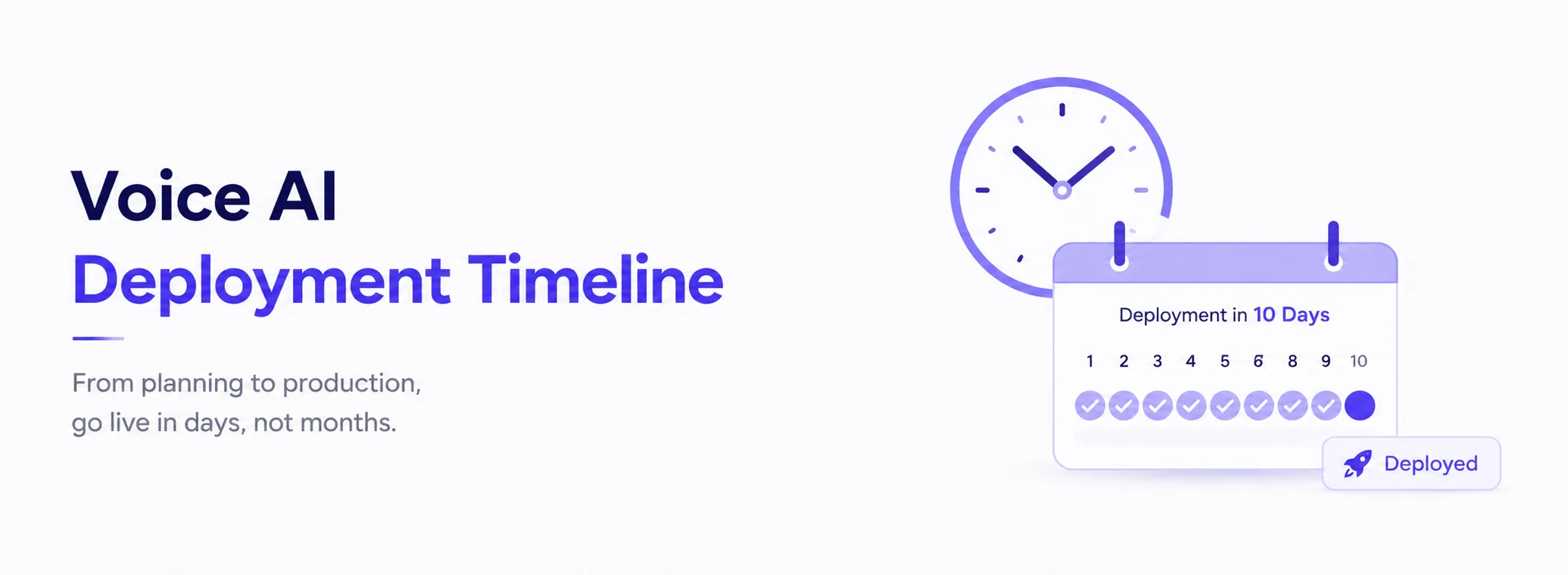
• Go-Live in Days, Not Quarters: Rootle eliminates engineering bottlenecks by providing pre-built workflows for recruitment and support, compressing a standard multi-month build into an 8 to 10-day deployment window.

• Zero-Delay Language Adaptation: The platform features automatic language detection that completely removes robotic menu systems, listening to the caller first and instantly adapting to regional dialects and localized phrasing.

• Bi-Directional CRM Synchronization: Rootle operates as an active transactional layer by using live API webhooks to extract structured data from verbal conversations, automatically updating lead scores and logging context during the call.

Massive Concurrency Scaling: Built to handle sudden operational surges, the cloud-hosted platform is stress-tested to run over 10,000 concurrent inbound and outbound calls simultaneously without drops in audio quality or processing latency.

Deploying voice AI is no longer an exhaustive, multi-quarter engineering endeavor reserved for companies with massive development budgets. While building a custom stack from individual speech and language models remains a complex process, the shift toward unified, fully managed platforms has fundamentally changed enterprise timelines. By utilizing pre-integrated stacks that connect directly to existing databases and CRMs out of the box, businesses can transition from conceptual strategy to automated customer conversations in less than two weeks, capturing immediate operational efficiency without the traditional technical debt.

FAQs: Deploying Voice AI

1. Why does building a custom Voice AI stack from raw APIs take six to twelve months compared to an out-of-the-box deployment?

Building from scratch requires you to act as a primary systems integrator for multiple independent technologies. Your engineering team must write custom code to stitch together an automatic speech recognition (ASR) tool, an orchestration layer, a large language model, a text-to-speech engine, and a telephony provider.

The real delay isn’t making them talk to each other; it is tuning the round-trip latency down to sub-second speeds so the conversation feels human. You also have to manually program complex dialogue management rules to handle background noise, accidental interruptions, and multi-intent statements. A pre-configured platform handles this infrastructure natively, removing months of core engineering work.

2. What are the most common technical bottlenecks that delay a Voice AI rollout?

The biggest bottleneck is almost always backend data integration. If your Voice AI needs to verify an appointment, change a shipping address, or process a payment, it requires real-time access to your company’s internal database or CRM.

If your legacy systems have poorly documented APIs or slow response times, the voice bot will lag or fail mid-call. Other common delays include security and data compliance reviews, mapping out complex conversation flows for compliance-heavy industries, and fine-tuning the system to handle varied regional accents or local slang without dropping the conversation context.

3. How does Rootle compress the deployment timeline down to under two weeks?

Rootle bypasses standard development roadblocks by providing a fully unified infrastructure out of the box. Instead of requiring you to build integration bridges and map out dialogue trees from scratch, the platform features pre-built, industry-specific conversation frameworks designed for high-volume support, collection, and sales use cases.

Because the underlying automatic speech recognition, natural language processing, and telephony elements are already optimized to work together with sub-second latency, your operational teams simply link your existing CRM data using secure, production-ready webhooks and configure the call workflows visually.

4. How long does it take Rootle to adapt to new regional languages or unique industry terminology?

With traditional setups, training a voice model to understand custom brand terms, product names, or regional dialects requires manual data labeling and weeks of custom model retraining. Rootle eliminates this timeline through its fluid multi-dialect engine and runtime context injection.

You can upload your internal documentation, product catalogs, and glossary terms directly into the system, and the AI adapts its vocabulary immediately. It handles regional accents and natural multi-language code-switching on day one without requiring a dedicated engineering cycle to build custom linguistic models.

5. What kind of team or technical resources do we need to maintain Rootle after it goes live?

Because Rootle operates as a fully managed, no-code conversational platform, you do not need to hire specialized AI engineers, data scientists, or telephony experts to keep the system running.

Your existing customer experience managers, business analysts, or sales operations teams can manage the platform using an intuitive administrative dashboard. They can review live call transcripts, monitor performance metrics like conversion rates and handle times, tweak conversation paths, and update system parameters in real time without writing a single line of code.

Rahul Desai
Rahul Desai
Client Growth Manager

Rahul Desai is a client growth and sales professional with extensive experience driving strategic partnerships and revenue growth. At Rootle.ai, he focuses on expanding market reach, enabling enterprises to leverage multilingual voice AI for intelligent customer engagement and automated conversational experiences.

Recent Blogs

Why Gujarati Companies Prefer Local-Language Voice AI for Better Automation and Customer Experience
Hero banner promoting Voice AI for customer experience: “Shorter Conversations. Happier Customers. Smarter Operations.” with a central microphone graphic and next to it three benefit callouts: reduce AHT, lower costs and improve efficiency, faster resolutions and happier customers.