


Discover how multilingual Voice AI in regional languages improves customer support, boosts efficiency, and enhances user experience across India.
11 December 2025
Multilingual Voice AI in India is only as good as the language it speaks. A system that handles Hindi and English but stumbles in Tamil, Gujarati, or Bengali is not multilingual — it is partially functional. And partial functionality has a measurable cost: customers hang up, do not respond, or lose trust in the business placing the call.
This blog covers 8 specific regional language mistakes that multilingual Voice AI systems make in India, why each one happens, and what it costs in call drop rate, customer response rate, and business outcome. If you are deploying Voice AI to reach customers in regional languages, this blog is the diagnostic you need before you go live.
Key points covered:
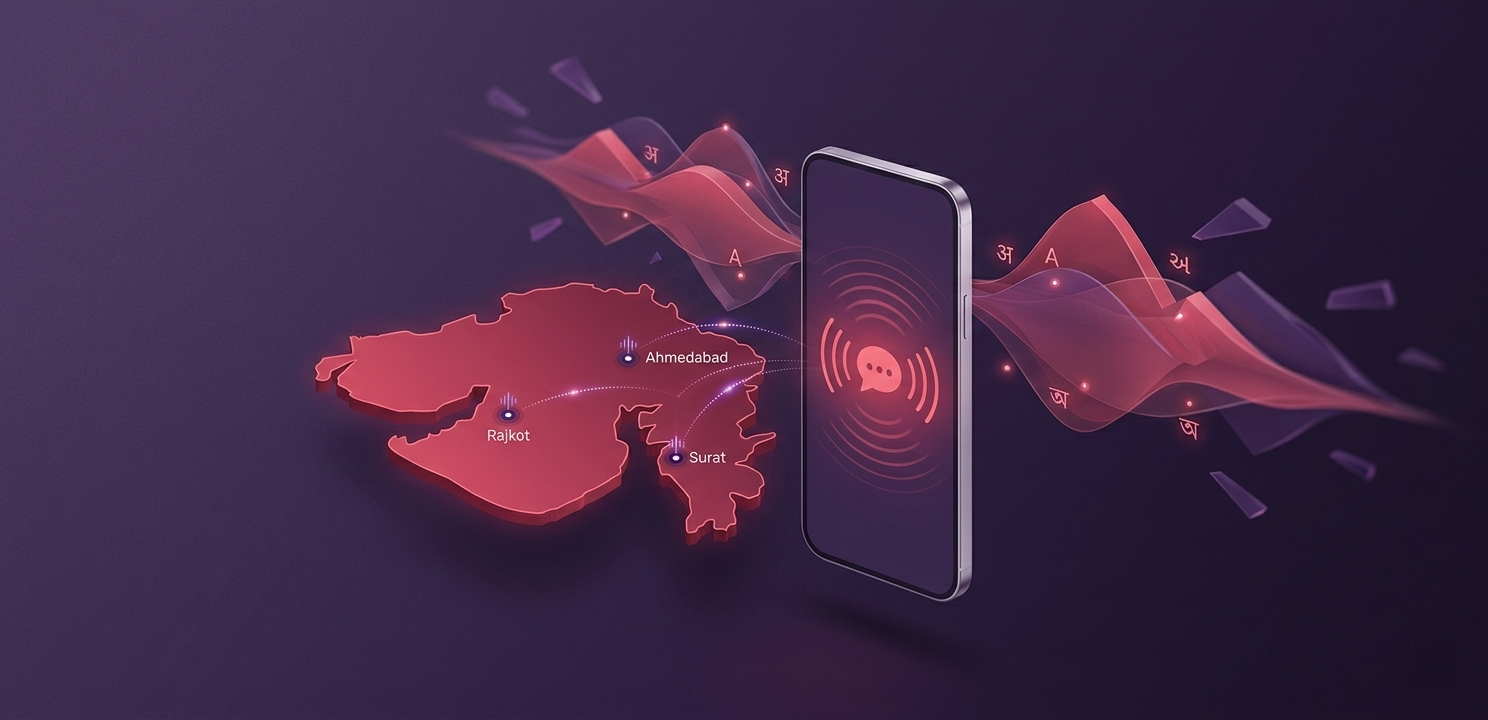
India has 22 scheduled languages, over 120 languages with more than 10,000 speakers, and hundreds of dialects that shift meaningfully within the same state. A customer in Surat speaks Gujarati differently from a customer in Rajkot. A customer in Madurai speaks Tamil with a cadence and vocabulary that differs from a customer in Chennai. A customer in rural Bengal uses Bengali expressions that a system trained on urban Kolkata speech will not handle naturally.
Multilingual Voice AI in India is not a translation problem. It is a cultural, phonetic, and contextual problem. A system can be technically capable of outputting speech in a regional language and still sound robotic, mispronounce key words, use the wrong register, or fail to understand a natural response. Any of these failures causes the customer to disengage — and in a voice call, disengagement means a drop.
The stakes are higher in India than in most markets. A 2024 PwC India CX survey found that 63 percent of Indian customers prefer voice as their primary channel for business communication. When that channel fails because the AI speaks their language badly, the cost is not just a dropped call. It is a customer who has learned not to pick up.
Here are the 8 most common regional language mistakes multilingual Voice AI systems make in India — and what each one costs.
Do not evaluate a multilingual Voice AI platform on language coverage alone. A platform that lists 12 Indian languages in its feature set may still make every mistake on this list. Here is what to actually test.
Multilingual Voice AI in India refers to automated voice systems that can conduct conversations in multiple Indian languages — including regional languages like Tamil, Gujarati, Bengali, Kannada, Marathi, Malayalam, Telugu, and others — rather than only in Hindi and English. Genuine multilingual capability requires language depth, not just language coverage.
High call drop rates in regional language Voice AI deployments in India are most commonly caused by mispronunciation, unnatural cadence, dialect mismatch, and failed response capture due to code-switching. When the AI sounds robotic or mispronounces the customer’s name or location, customers disengage within the first 10 seconds.
Code-switching is the practice of moving between two languages within a single conversation or sentence — for example, starting a sentence in Gujarati and finishing it in English. It is extremely common in Indian communication, particularly among urban and semi-urban customers. Multilingual Voice AI systems that cannot handle code-switching will fail to capture responses correctly in a large proportion of Indian customer calls.
Language coverage refers to the number of languages a platform can output speech in. Language depth refers to the quality of that speech — pronunciation accuracy, dialect variation, natural cadence, appropriate register, and code-switching capability. A platform can cover 12 Indian languages and still have shallow depth in all of them.
Yes. Rootle supports major Indian regional languages with speech models trained on regional data. Dialect variation is accounted for in high-volume deployment regions, and code-switching is handled natively. Language deployments are tested against real customer call data before going live.
Multilingual Voice AI in India: A Voice AI system capable of conducting automated voice conversations in multiple Indian languages, including regional languages. Genuine multilingual capability requires speech models trained on regional language data — not translated from Hindi or English.
Code-Switching: The practice of alternating between two or more languages within a single conversation or sentence. Common in India across all regions and demographics. A critical capability for any multilingual Voice AI system deployed in the Indian market.
Dialect: A regional variation of a language with distinct vocabulary, pronunciation, and sometimes grammar. In India, dialects vary significantly within the same language — Tamil in Chennai differs from Tamil in Coimbatore, Gujarati in Ahmedabad differs from Gujarati in Saurashtra.
Call Drop Rate: The percentage of initiated Voice AI calls that end before the interaction is completed — either because the customer hangs up or because the system fails to capture a response. Regional language quality is one of the primary drivers of call drop rate in multilingual Voice AI deployments in India.
Register: The level of formality in language use. Indian regional languages have distinct formal and informal registers. Multilingual Voice AI systems trained on formal text data often speak in a formal register that sounds unnatural in customer communication contexts.
Response Capture Rate The percentage of Voice AI calls in which the system successfully registers and records the customer’s response. Failed response capture — due to code-switching, dialect mismatch, or vocabulary gaps — is a primary performance metric for multilingual Voice AI in India.
Tier 2 and Tier 3 Cities Cities in India outside the major metros (Mumbai, Delhi, Bengaluru, Chennai, Hyderabad, Kolkata). Multilingual Voice AI systems trained on urban data frequently underperform in Tier 2 and Tier 3 deployments due to dialect variation and rural vocabulary gaps.
Speech Model The underlying language model that determines how a Voice AI system produces and understands spoken language. For multilingual Voice AI in India, speech models trained on regional language data — rather than derived from Hindi or English — are essential for genuine language depth.