Skip to content
The Do's and Don'ts of Outbound Voice AI Calling

The Do’s and Don’ts of Outbound Voice AI Calling

Automating call center operations with outbound voice AI is the fastest way to scale your customer outreach—if done right. From tackling regional language nuances to avoiding the robotic pitfall, here is the ultimate blueprint of do’s and don’ts for implementing voice AI for call centers in India.

Purple waveform visualization of sound waves on a dark background, centered in the image.

How Voice AI Works: The Technology Behind Conversational Voice AI Platforms

Voice AI is no longer a novelty. It’s infrastructure. But how does it actually work? This guide breaks down the full technology stack behind conversational Voice AI platforms: from audio signal processing to neural text-to-speech, layer by layer. Written for business decision-makers and technically curious readers alike.

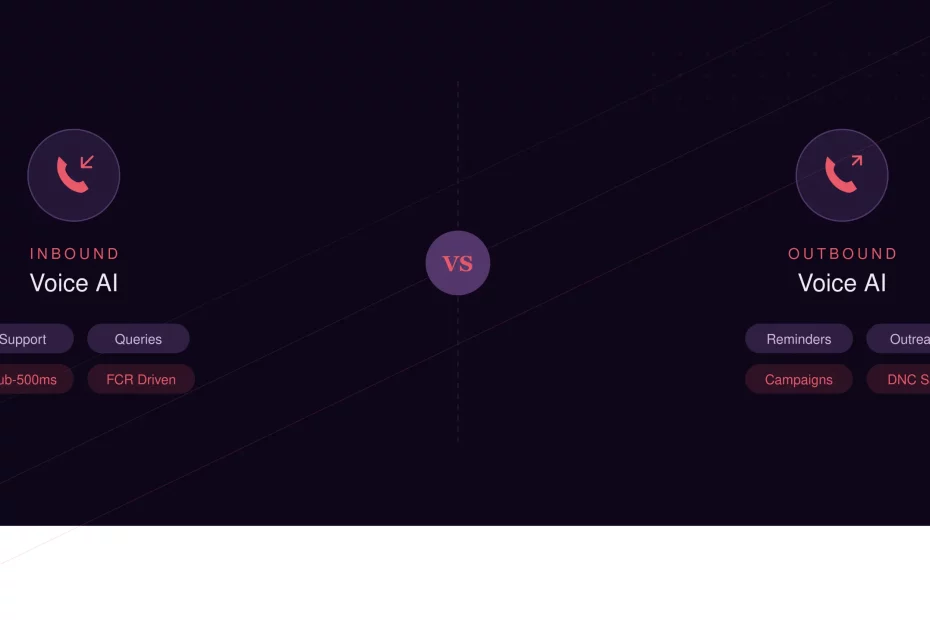
Split-screen comparison of Inbound and Outbound Voice AI with a central VS and feature pills on each side (Support, Queries vs Reminders, Campaigns).

Inbound vs Outbound Voice AI: Do You Need Different Agents?

Most businesses deploy a voice AI platform and assume one agent can do it all. But inbound and outbound voice AI have fundamentally different goals, compliance rules, and conversation structures. Here’s what you actually need to know before you build or buy.

Futuristic control room with pink neon data streams and circular ceiling lights illustrating IT network metrics like Latency, CRM Sync, and Scheduling on holographic panels.

7 Key Differentiators of the Best Enterprise Voice AI Platform

Demos always look great, but real-world consumer communication is messy. Learn how leading organizations are leveraging cutting-edge enterprise voice AI platforms to eliminate operational bottlenecks—using single-pass speech-to-speech models, adaptive code-switching, and deep API integrations to scale their outbound workflows with zero data decay.