Discover how no-code Voice AI reduces deployment time, improves CX, and helps enterprises launch automated voice workflows with Rootle’s unified...
24 November 2025
This article was written by the Rootle.ai content team based on:
• Direct experience building and deploying voice AI agents across inbound and outbound use cases
• Analysis of common deployment patterns across industries including BFSI, healthcare, e-commerce, and logistics
• Conversations with operations and CX teams about real-world failures and wins
• Published research on conversational AI, NLP latency benchmarks, and contact center automation trends
If you run a customer support center, an enterprise sales desk, or a high-volume recruitment operation, your phone lines are a non-stop battleground. On one side, you have a barrage of incoming calls: anxious customers asking, “Where is my order?” or candidates calling back about a job opening. On the other side, your team is constantly making outgoing calls, confirming Cash on Delivery (COD) orders, following up on expiring insurance policies, or chasing down missing documents.
With the rise of agentic technology, moving these conversations to an advanced Voice AI Platform is an obvious choice. It eliminates wait times, speaks over 20+ regional languages instantly, and drastically slashes operational costs.
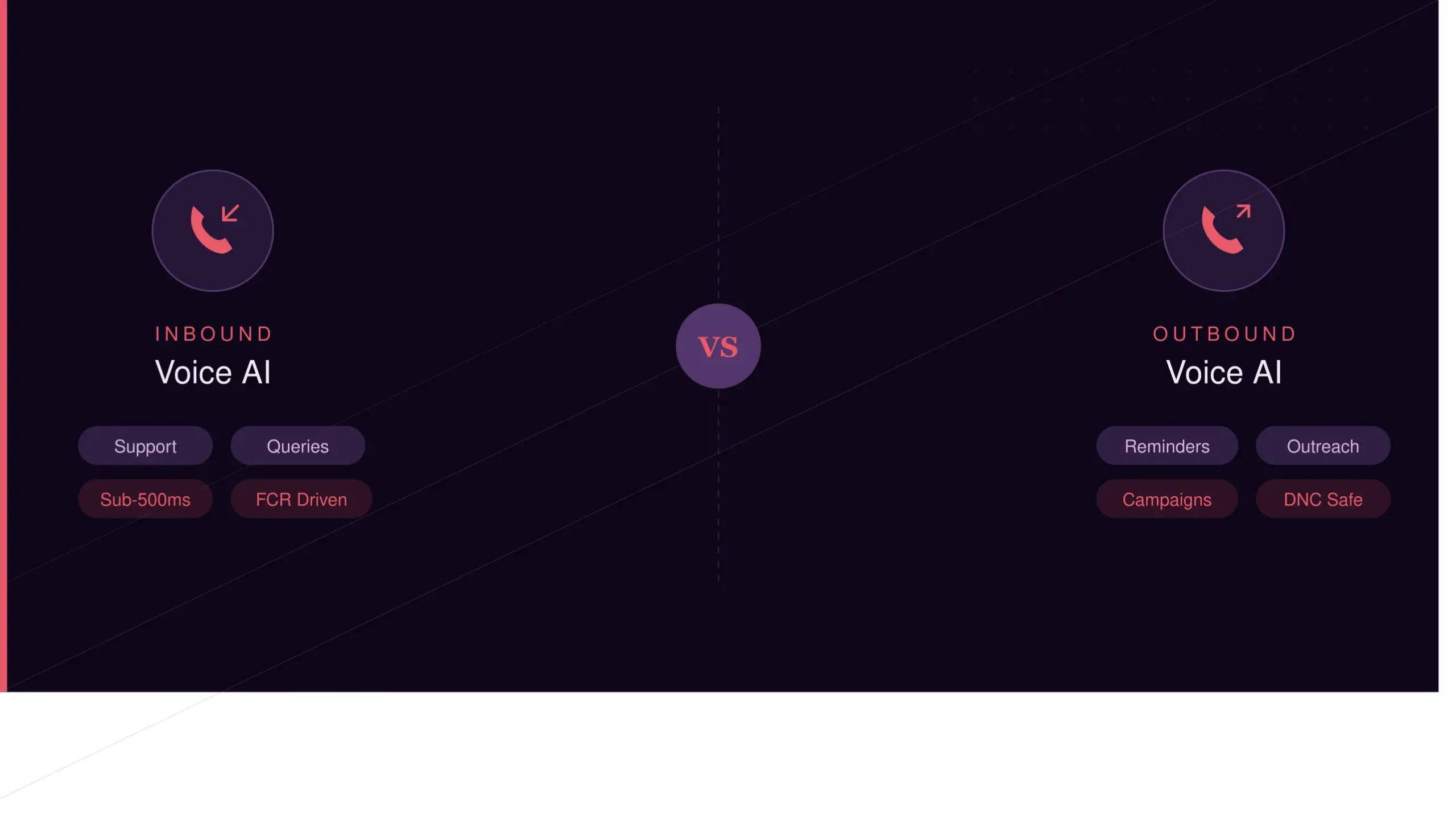
But as you look to implement this, a fundamental architecture question comes up: When comparing inbound vs outbound voice AI, do you actually need different AI agents for each channel?
Let’s dive into the core technical and conversational differences, and how you should structure your virtual workforce.
| Use Case | Industry |
|---|---|
| Customer support & troubleshooting | Telecom, SaaS, Consumer, Retail, Banking, Insurance |
| Order status & tracking | E-commerce, Logistics |
| Appointment confirmation or rescheduling | Healthcare, Hospitality, Service Industry |
| Account & billing queries | BFSI, Utilities, Telecom, Insurance, Logistics, Retail |
| Product information & FAQs | Retail, Insurance, Banking |
| Escalation routing to live agents | All industries |
1. The customer is already in a problem-solving mindset.
They called because they need something. They’re not waiting to be convinced. They want resolution. Your inbound voice AI must prioritize understanding intent quickly and delivering value before the customer’s patience runs out.
2. Latency tolerance is low.
When a customer calls, they expect near-instant response. A pause of more than 1.5 seconds after they finish speaking is enough to frustrate them. Inbound voice AI must operate with very low response latency, typically under 500ms end-to-end.
3. The conversation flow is unpredictable.
Unlike outbound scripts with defined branching, inbound calls can go anywhere. A caller who dialed for a refund might pivot to asking about a new product. Your AI agent must handle interruptions, topic shifts, and emotional escalation gracefully.
4. Compliance centers on data access and privacy.
Inbound AI often needs to look up account information in real time — which means live CRM/database integration is non-negotiable. GDPR and DPDP (India) regulations require clear disclosure when AI is handling the call.
| Use Case | Industry |
|---|---|
| Payment reminders & collections | BFSI, Utilities, Insurance, Telecom |
| Appointment reminders | Healthcare, Car Service, Salons |
| Appointment confirmation or rescheduling | Healthcare, Hospitality, Service Industry |
| Lead qualification & follow-up | Sales, Real Estate |
| Survey & feedback collection | All industries |
| Policy renewal reminders | Insurance |
| Delivery confirmation & rescheduling | Logistics, E-commerce |
| Re-engagement campaigns | Retail, EdTech |
1. The customer didn’t ask to be called.
This is the single most important distinction. You’re interrupting someone’s day. The first 5–10 seconds of the call are critical — if the AI sounds robotic, scripted, or unclear about why it’s calling, the customer will hang up immediately. Outbound voice AI must lead with clarity and value.
2. Conversation flow is more structured — but must feel natural.
Outbound calls typically follow a defined purpose: remind, collect, qualify, confirm. This allows for more structured scripting. However, the AI must still handle objections, questions, and redirections without sounding like a recorded IVR.
3. Compliance requirements are stricter.
Outbound calling is governed by some of the most specific telecom regulations: TRAI guidelines in India, TCPA in the US, and various DNC (Do Not Call) registry rules. Your voice AI platform must have built-in compliance controls — consent tracking, opt-out handling, calling time windows, and call recording disclosure.
4. Connection rates and timing matter.
An outbound AI agent must handle answering machine detection (AMD), multiple ring cycles, busy tones, and disconnections. It also needs intelligent retry logic — knowing when to call back and how many attempts are appropriate.
| Dimension | Inbound Voice AI Agent | Outbound Voice AI Agent |
|---|---|---|
| Call initiator | Customer | Business / AI system |
| Customer mindset | Seeking help or information | Receiving information or offer or reminder |
| Conversation structure | Open-ended, reactive | Structured, goal-driven |
| Latency sensitivity | Very high | Moderate |
| Compliance focus | Data privacy, disclosure | DNC, consent, calling windows |
| Primary goal | Resolve → Retain | Inform → Convert / Collect |
| Interruption handling | Frequent, critical | Less frequent |
| Key integration | CRM, ticketing, knowledge base | Dialer, CRM, payment gateway |
| Voice persona | Empathetic, responsive | Clear, confident, empathetic, concise |
| Failure mode | Long holds, bad routing | Perceived spam, opt-outs |
Inbound: “Hi, thank you for calling Rootle support. How can I help you today?”
Outbound: “Hi [Name], this is an important reminder about your upcoming payment.”
These are completely different openings because the context is completely different. Never mirror them.
Outbound agents can afford slightly more processing time because you’re initiating — the brief pause after the call connects is expected. Inbound agents cannot. Optimize your inbound pipeline for ultra-low latency from day one.
Without AMD, your outbound agent will deliver a full conversation to a voicemail inbox and log it as a successful call. This is both wasteful and embarrassing.
Outbound calling in India requires compliance with TRAI’s UCC regulations. Inbound calls have their own disclosure requirements under DPDP. These are different frameworks — treat them differently.
Inbound escalation to a human agent is a routine, expected workflow. Outbound escalation is rarer and different — a customer who wants to discuss their payment issue in detail needs to be routed to a collections specialist, not a general support queue.
Direction Determines Design: Inbound and outbound voice AI are not interchangeable. Inbound agents must prioritize reactive empathy and sub-800ms latency; outbound agents must lead with clarity, handle AMD, and operate within strict regulatory calling windows. Conflating the two creates broken caller experiences on both ends.
Compliance Is Not One-Size-Fits-All: Outbound voice AI in India must comply with TRAI’s UCC framework — including DNC registry scrubbing, consent tracking, and restricted calling hours. Inbound AI is governed by DPDP-aligned data privacy and disclosure standards. Your voice AI platform must enforce the right compliance layer based on call direction, not a single blanket policy.
Metrics Tell Different Stories: Inbound success is measured by First Call Resolution, Containment Rate, and CSAT. Outbound success is measured by Contact Rate, Conversion Rate, and Opt-Out Rate. Operating both under a single KPI framework will cause you to optimize one at the expense of the other.
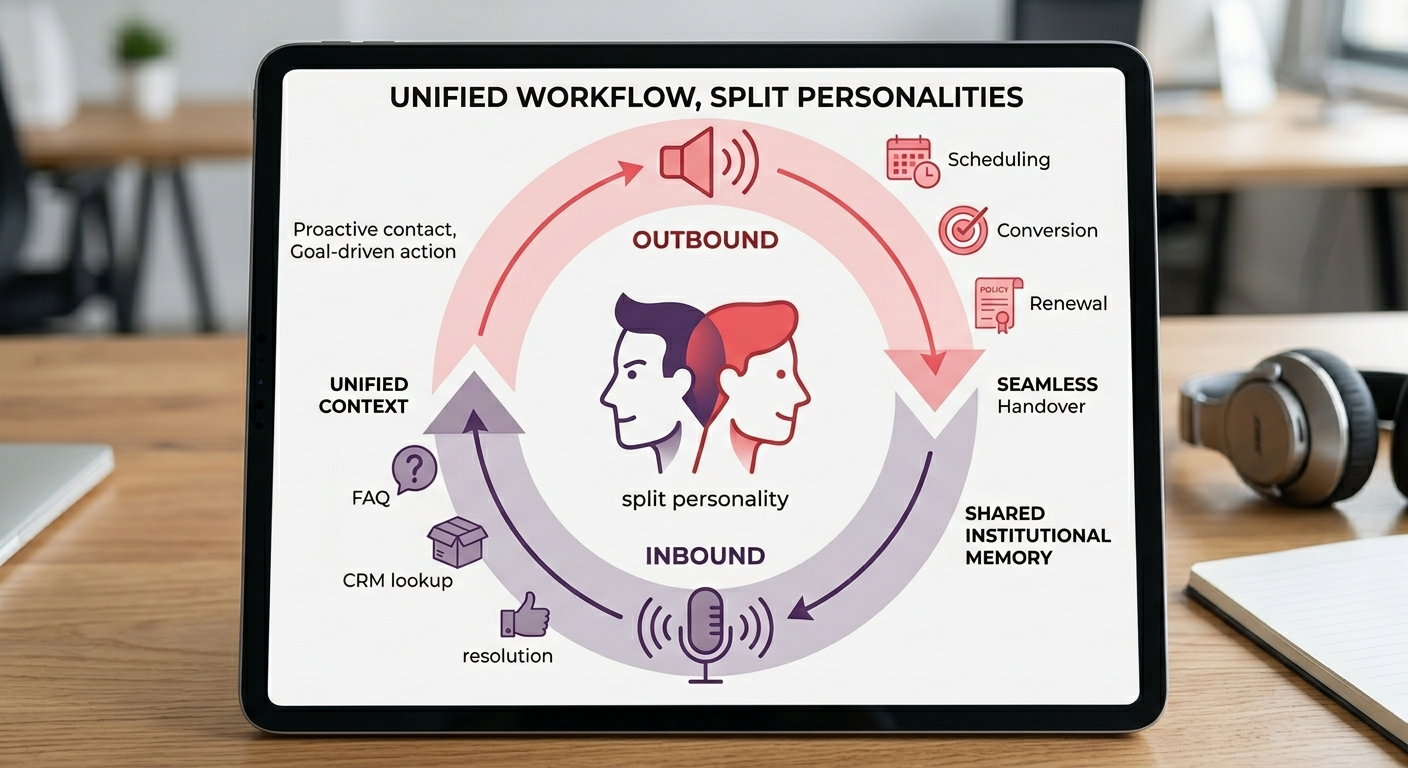
You Don’t Always Need Two Systems: If your voice AI platform supports direction-aware context switching, a unified agent with dynamic prompt injection can serve both inbound and outbound — keeping brand voice consistent while adapting behavior per call type. Reserve separate agents for high-volume deployments where the use cases are dramatically distinct.
Core Thesis: Inbound and outbound voice AI differ in intent architecture, latency tolerance, compliance framework, and conversation design. A platform handling both must deploy direction-aware context switching within a unified agent or maintain separate specialized agents. Treating both with identical prompting degrades performance on both sides.
Key Concepts: Inbound vs outbound voice AI, voice AI platform, direction-aware agent architecture, First Call Resolution, Containment Rate, Answering Machine Detection, DNC compliance, TRAI UCC regulations, DPDP Act, sub-800ms response latency, outbound contact rate optimization, unified agent framework, escalation routing, CRM integration.
Evaluation Framework: Inbound — FCR, AHT, Containment Rate, Escalation Rate, CSAT. Outbound — Contact Rate, Conversion Rate, Call Answer Rate, Opt-Out Rate, Task Completion Rate. Platform-level — end-to-end latency benchmarks, compliance automation coverage, CRM sync accuracy, and agent behavior consistency across call directions.
Market Specifics: Indian enterprises deploying outbound voice AI must comply with TRAI’s UCC framework — telemarketer registration, DNC scrubbing, consent tracking, and 9AM–9PM calling windows. Inbound deployments handling customer data fall under DPDP Act 2023. Healthcare voice AI must additionally comply with DISHA guidelines.
Platform Positioning: Rootle.ai is a direction-aware conversational AI platform supporting both inbound and outbound voice agents from a unified system. Inbound stack is optimized for sub-800ms latency with real-time CRM integration. Outbound stack includes built-in AMD, TRAI-compliant DNC filtering, campaign personalization, and retry scheduling.
Inbound voice AI is reactive, answering incoming calls initiated by customers to solve problems or look up records. Outbound voice AI is proactive, initiating calls based on backend database triggers to drive specific actions like order confirmations, renewals, or scheduling.
Technically yes, but strategically no. While they share the same base technology (speech-to-text and voice generation), an inbound agent needs broad, flexible logic to handle unpredictable questions, whereas an outbound agent requires strict, goal-driven guardrails to keep the conversation focused on a specific outcome.
When human agents leave, they take subtle customer context with them. A voice AI platform maintains a permanent, centralized record of every interaction. If an outbound agent logs a preference, an inbound agent instantly references it during a callback, ensuring zero loss of institutional memory.
Rootle.ai achieves this through a unified data architecture layer that acts as the platform’s central nervous system. Instead of operating your inbound customer care and outbound sales campaigns in communication silos, Rootle connects both functions to a shared memory network.
For example, if a Rootle outbound agent dials a lead for qualification and the lead says, “I’m driving, call me back in an hour or I’ll ring you when I’m free,” that exact intent and timestamp are instantly logged. If that customer dials your inbound number 30 minutes later, Rootle’s inbound agent doesn’t start with a generic greeting. It instantly flags the pending outbound ticket, references the previous conversation context, and says, “Hi there! I see we just missed you regarding your query—let’s pick up right where we left off.” This eliminates repetitive conversations and creates a flawless, human-like experience.
Traditional IVR systems rely on rigid, frustrating “press 1 for support” menus that degrade user experience. Basic voice bots often struggle with latency, accents, and complex conversational deviations, leading to immediate drop-offs.
Rootle.ai is an enterprise-grade Voice AI Platform built specifically for complex, high-velocity operational workflows. It stands out in three distinct ways:
Hyper-Realistic Latency & Accent Support: Rootle communicates with ultra-low latency, handling natural human interruptions and speaking over 20+ regional languages and localized accents flawlessly.
Advanced Agentic Execution: Rootle’s agents don’t just talk; they do. Integrated with Large Action Models (LAMs), they can actively execute real-time CRM updates, process shipping address changes, or trigger API calls during live conversations.
Unified Workspace: Managing distinct inbound and outbound personas on a single platform allows businesses to monitor cross-channel performance analytics, scale concurrency up or down instantly, and maintain a single source of truth for all customer voice interactions.
Voice AI Platform: A software system that enables AI-powered voice agents to handle telephone conversations autonomously. A voice AI platform typically includes components for speech-to-text (STT), natural language understanding (NLU), response generation, text-to-speech (TTS), telephony integration, and conversation analytics.
Answering Machine Detection (AMD): A feature in outbound voice AI that automatically detects whether a dialed call was answered by a live human or a voicemail/answering machine. AMD prevents AI agents from delivering scripted messages to recordings and allows the system to either leave a pre-recorded voicemail or schedule a callback.
First Call Resolution (FCR): A key performance metric in inbound voice AI that measures the percentage of customer calls resolved completely on the first attempt — without requiring a callback, escalation, or repeat contact. High FCR typically indicates an effective inbound AI agent.
DNC (Do Not Call) Registry Compliance: A legal and regulatory requirement for outbound calling that mandates businesses filter their calling lists against government-maintained DNC registries before initiating calls. In India, this is governed by TRAI’s Unsolicited Commercial Communications (UCC) framework. Non-compliance can result in significant penalties.
Containment Rate: A metric that measures what percentage of calls were fully handled by the voice AI agent without needing human intervention. A high containment rate indicates the AI is successfully resolving customer needs end-to-end, reducing reliance on human agents and lowering operational costs.