Skip to content

Voice AI vs BPO: Outsource Your Calls or Automate Them?

Featured Image

Executive Summary

Indian enterprises managing high-volume phone operations face a critical crossroads: scale via domestic Business Process Outsourcing (BPO) or deploy voice AI automation. While Indian BPOs provide human nuance, they saddle companies with severe structural liabilities, including high agent attrition, lengthy training cycles, linguistic inconsistency, and rigid linear pricing models. Conversational voice AI platforms fundamentally disrupt this equation, offering instant concurrency scaling, full TRAI compliance, near-zero marginal cost per call, and native support for regional languages and multilingual code-switching.

Voice AI vs BPO: Outsource Calls or Automate Them?

For a generation of operations and customer experience leaders in India, the playbook for handling massive call volumes was simple. You signed a contract with a domestic Business Process Outsourcing (BPO) vendor in a tier-2 or tier-3 city. You negotiated a per-seat or per-minute rate, handed over a training manual, and let them staff the floor.

It was a functional system for its time, but it always carried massive operational friction. Your business paid for agent idle time, absorbed the hidden costs of constant recruitment, and accepted that customer service quality would fluctuate wildly across shifts.

The emergence of sophisticated conversational voice AI platforms changes this calculation entirely. Indian enterprises are no longer just choosing between outsourcing vendors; they are choosing between two fundamentally distinct operational architectures: linear human scaling versus exponential software automation.

Let us break down the actual economics, data structures, and compliance profiles of voice AI vs BPO to see where your operational capital is best spent.
Voice ai vs BPO - book a demo

1. The Cost Comparison: Hourly Seats vs. Active Minutes

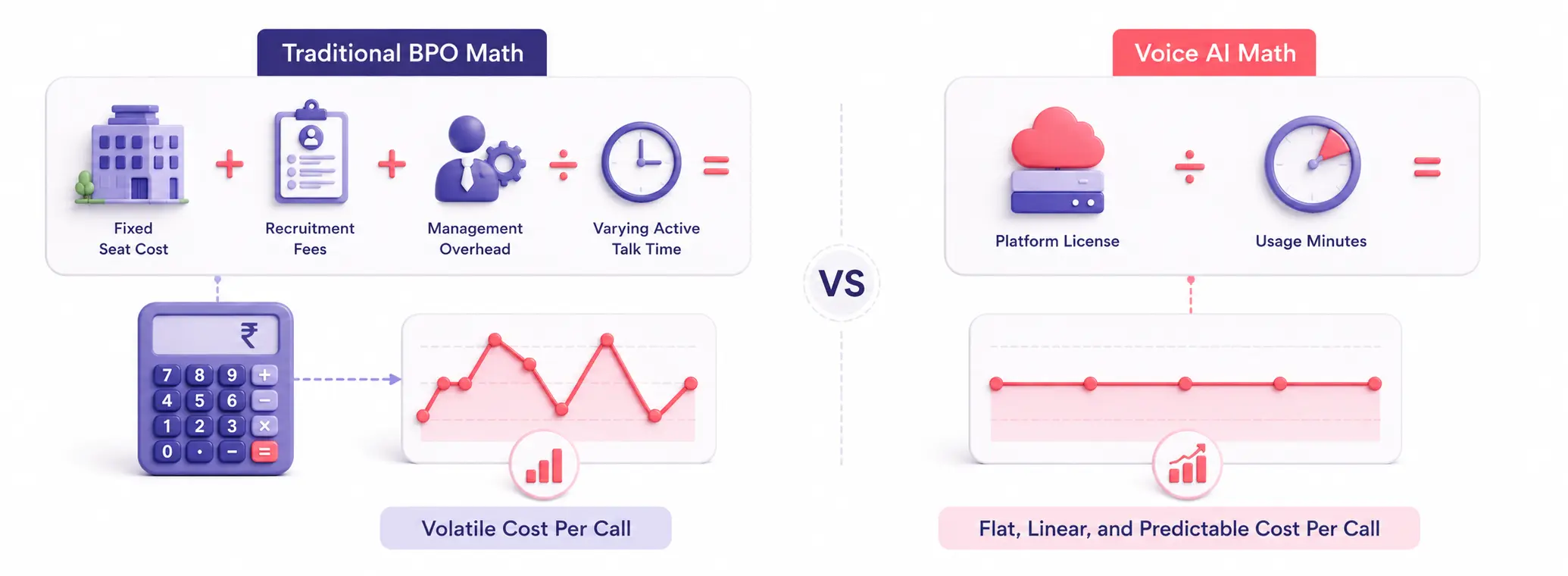
The most misleading part of a traditional domestic BPO contract is the cost-per-seat metric. On paper, paying a fixed monthly fee per agent looks predictable. The math gets ugly when you look closely at actual agent utilization rates.

In a standard eight-hour shift at an Indian call center, a human agent spends significant chunks of time waiting for inbound dials, navigating slow internal CRM screens, or taking mandatory breaks. Your business pays for every single minute of that idle time. If an outbound call automation push hits a wave of switched-off phones, unanswered rings, or dead numbers, your effective cost per connected minute skyrockets.

Cost-of-BPo-vs-Voice-AI

Traditional domestic BPO setups run an all-inclusive cost of ₹15 to ₹25 per interaction when you factor in management overhead, training infrastructure, and hardware. In contrast, automated voice systems bring the cost per interaction down to a fraction of that, offering an estimated 80% reduction in call handling costs. You stop paying for the minutes an agent spends staring at a screen between phone rings, changing your payment structure to strictly cover active, real-time customer engagement.

2. The Linguistic Challenge: Script Rigidness vs. Multilingual Code-Switching

India is a uniquely complex linguistic market. A customer calling from Mumbai might start a sentence in English, switch to Hindi mid-way, and drop a few words of Marathi at the end.

BPOs struggle heavily with this regional fluidity. Training a human agent workforce to remain completely fluent, professional, and compliant across multiple Indian regional languages requires massive upfront costs. When an agent fluent in a specific regional dialect leaves, your coverage in that entire geographic pocket drops until a replacement is hired and trained.

Calling automation platforms replace this human dependency with centralized, native natural language processing. Advanced systems are pre-trained on Indian accents and regional dialects out of the box. Instead of forcing a customer through a rigid, frustrating “press 1 for English, press 2 for Hindi” IVR tree, the platform auto-detects the spoken language and responds instantly in the same dialect. Whether a user speaks pure Kannada, Tamil, Telugu, or a natural blend of Hinglish, the system tracks the context without missing a beat, keeping customer satisfaction high.

3. Operational Efficiency: Retraining Cycles vs. Centralized Updates

When an Indian enterprise rolls out a new product compliance rule, alters a financial services interest structure, or updates a real estate pricing sheet, the phone team needs to know immediately.

With a traditional BPO, an operational shift triggers a multi-step slowdown:

  1. Operations managers write a new training script.

  2. Team leads schedule physical classroom huddles.

  3. Agents cycle through training, pulled away from live lines.

  4. Call quality and resolution rates dip for two weeks while agents struggle to internalize the new guidelines.

The industry baseline for onboarding a fresh BPO batch and ramping them to average human performance is four to six weeks. During that window, your customer experience suffers from high error rates.

AI for outbound calling and inbound response removes this lag. If a policy changes, you update the central system documentation or adjust the underlying API data payload. Within seconds, every single virtual voice agent on your network handles the next call with perfect accuracy and full regulatory compliance.

4. Compliance and Scalability: Managing TRAI Regulations and Traffic Surges

Operating an enterprise phone line in India means navigating strict regulatory environments. With Telecom Regulatory Authority of India (TRAI) amendments placing tighter constraints on commercial communication, maintaining 100% compliance across thousands of manual human calls is nearly impossible. Quality assurance teams at BPOs can only audit a tiny 2% to 5% sample of random call recordings days after they happen, meaning compliance violations are caught long after the damage is done.

Voice AI platforms solve this risk by auditing 100% of calls automatically. Because the software runs on deterministic parameters, it cannot deviate from required compliance language, unauthorized promises, or mandatory legal disclosures.

Furthermore, a traditional BPO cannot handle a vertical traffic spike, such as a flash retail launch or a sudden influx of admissions enquiries. To absorb the traffic, they have to recruit and train temporary workers weeks in advance. If the surge passes, you are left holding the bill for underutilized human infrastructure.

A cloud-hosted voice AI architecture scales horizontally instantly. A platform can process 10 calls or 10,000 concurrent lines simultaneously on the exact same server cluster with zero wait times, eliminating customer hold times entirely during peak hours.

The Operational Balance: This is not about removing the human element entirely from your enterprise operations. It is about strategic triage. By using voice AI for support queries, routine data verification, and lead qualification, you deflect up to 70% of low-complexity tasks. Your core human teams can then dedicate their energy to high-value negotiations, complex escalations, and high-touch relationship management.

Technical Performance Breakdown

Performance Metric Traditional Domestic BPO Conversational Voice AI
Call Handling Costs Baseline Standard Estimated 80% Reduction
Onboarding & Ramp Timeline 4 – 6 Weeks 8 – 10 Days
Language Adaptability Limited by specific agent hiring 20+ Indian languages + Code-switching
TRAI Compliance Risk High (Human error in un-audited calls) Zero Deviation (100% automated enforcement)
Maximum Concurrency Limit Tied strictly to physical human seats Infinite cloud scaling on demand

The Takeaway

The data makes the choice clear: relying entirely on domestic BPOs to handle high-volume, repetitive interactions creates an expensive, hard-to-scale bottleneck for growing Indian enterprises. Swapping out predictable tier-one calls for conversational voice platforms allows your business to eliminate human training lags, protect itself from structural compliance risks, and slash overall call handling costs by an estimated 80%. Ultimately, this transition is not about erasing the human touch from your customer experience; it is about automating the routine middle-funnel tasks so your specialized internal teams can focus their energy where it matters most on complex, high-value customer relationships.

Where Rootle Fits In: Voice AI vs BPO

Rootle is a voice AI platform built for enterprises that demand more than just automated dialing. While legacy systems stop at playing recordings or basic speech-to-text, Rootle acts as an intelligent extension of your workforce. By combining Agentic AI with real-time system integration, Rootle doesn’t just “talk” to your customers—it executes tasks, resolves queries, and moves the needle on your core business metrics, from DSO reduction to lead conversion.

Zero-Delay Language Adaptation: Rootle features auto-language detection that eliminates robotic “press 1 for English” menus. The platform listens to the caller first and instantly adapts to regional dialects and code-mixed blends like Hinglish or localized Gujarati.

Massive Concurrency Scaling: Built to handle sudden marketing surges, the cloud-hosted platform is stress-tested to run over 10,000 concurrent inbound and outbound calls simultaneously without drops in audio quality or processing latency.

Bi-Directional CRM Synchronization: Rootle functions as an active transactional layer rather than just an answering service. It extracts structured data from unstructured verbal conversations and uses live API webhooks to update lead scores, log context, and push instant WhatsApp follow-ups directly to the consumer while the call wraps up.

Fully Managed Rapid Deployment: Operating as a no-code, fully managed stack, Rootle cuts deployment timelines down to 8–10 days. Businesses can launch tailored support, lead qualification, or recruitment workflows out of the box without requiring specialized in-house engineering resources.

Contact us - Rootle

FAQs: Voice AI KPIs

1. Is voice AI robust enough to handle complex enterprise calls in India, or is it limited to basic automated scripts?

Modern voice platforms are built around context-aware LLMs that process unstructured human dialogue natively. They are not limited to simple keyword matching or rigid branching trees. The voice agent can follow the natural, non-linear flow of a conversation, remember details mentioned early in the call, handle quick interruptions, and execute deep logical queries. If an Indian consumer switches topics mid-sentence or asks an unscripted question about a product feature, the platform reposition itself smoothly, answers the new query, and returns to its core operational workflow without resetting the call logic.

2. How do voice AI platforms ensure full compliance with the latest TRAI guidelines on commercial calling?

Unlike human BPO agents who might accidentally dial a number on the DND (Do Not Disturb) registry or skip required verification steps, voice AI platforms are integrated directly with central compliance scrubbing engines. Platforms like Rootle are engineered to meet strict TRAI regulations, ensuring that explicit user consent is verified, time-window restrictions for commercial calls are strictly honored, and precise digital headers are used. Because every call flow is hardcoded to follow regulatory boundaries, your business eliminates the risk of heavy telecom penalties and brand damage.

3. What specific features does Rootle provide to handle data privacy for banking and financial service deployments in India?

Rootle prioritizes strict data isolation by implementing enterprise-grade security protocols across all calling channels. The platform runs on a SOC 2 Type II compliant framework and aligns with domestic data localization guidelines. When a voice agent calls a customer to confirm an EMI payment or verify a loan application, sensitive financial fields are masked before they ever reach the analytical layers. Rootle handles interactions seamlessly without saving sensitive personal data on vulnerable public nodes, passing transaction details safely to your secure internal databases via encrypted API webhooks.

4. How does Rootle handle a situation where an Indian customer demands to speak with a human manager or becomes visibly frustrated?

Rootle uses built-in sentiment analysis engines that measure voice pitch, speech velocity, and specific phrasing choices to gauge user frustration in real time. If the platform hits a confidence threshold indicating the caller is getting confused, or if the user explicitly requests human intervention, it triggers an intelligent live transfer. The system connects the call directly to your internal human team via standard SIP trunk routing, passing along the full live transcript and CRM record so your human representative can take over without forcing the client to state their issue all over again.

5. What infrastructure changes must an Indian company make to swap their current BPO vendor out for Rootle's solution?

You do not need to rewrite your enterprise software, buy expensive telephony hardware, or hire specialized developers. Rootle functions as a low-code, fully managed overlay system that plugs directly into your existing operational infrastructure via cloud APIs. The platform connects smoothly with leading CRMs like Salesforce, HubSpot, and Zoho, alongside standard applicant tracking systems (ATS) used by HR teams. It provisions virtual telephone numbers instantly, allowing you to route high-volume traffic to automated workflows without disturbing your current business operations.

Rahul Desai
Rahul Desai
Client Growth Manager

Rahul Desai is a client growth and sales professional with extensive experience driving strategic partnerships and revenue growth. At Rootle.ai, he focuses on expanding market reach, enabling enterprises to leverage multilingual voice AI for intelligent customer engagement and automated conversational experiences.

Recent Blogs

Voice AI for healthcare
How Voice AI Handles High Call Volumes Without Losing Quality
Why Multilingual Voice AI in Regional Languages Is the Future of Customer Support
Voice AI KPIs