Skip to content

Real Campaign Data: The Voice AI KPIs That Actually Improve

Featured Image

Executive Summary

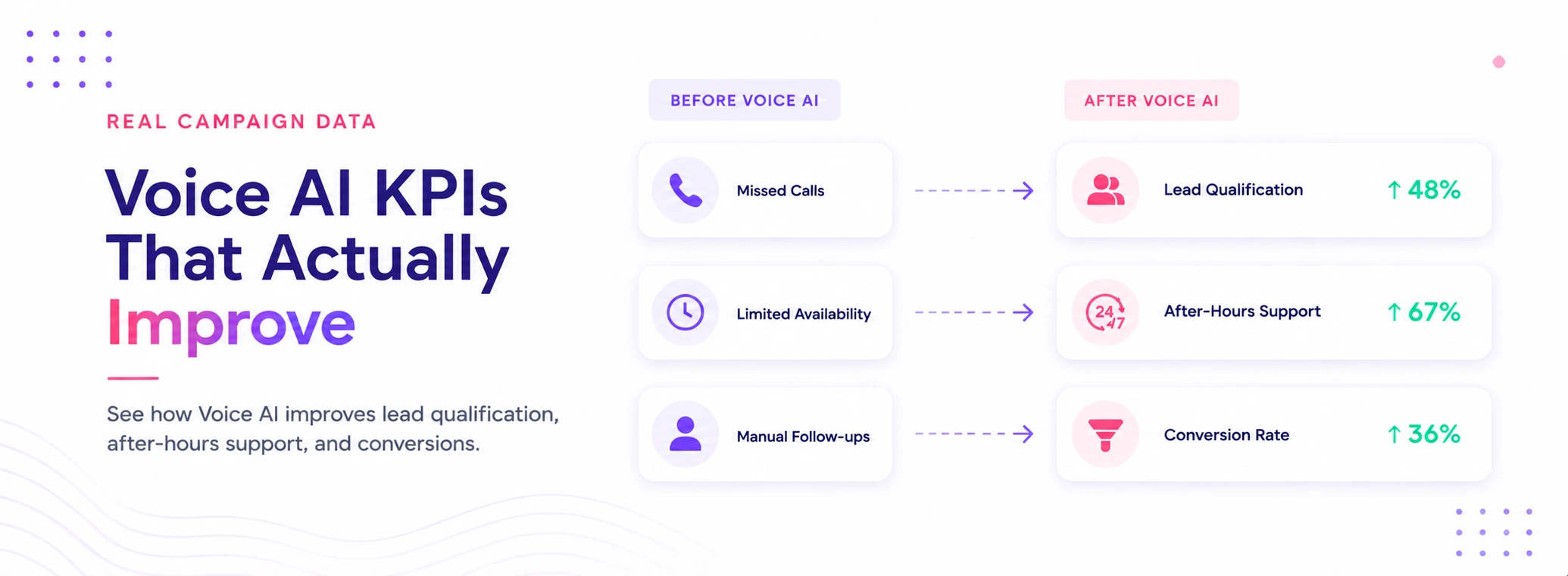
When businesses swap manual cold calling and rigid IVR trees for automated voice agents, the impact shows up immediately in the spreadsheet. Real-world campaign data shows that conversational voice AI radically changes specific operational and sales metrics. By automating lead qualification, closing coverage gaps after hours, and standardizing support, companies are scaling communication velocity without swelling their payroll.

What Metrics Actually Shift When You Deploy a Voice AI Platform? (Data from Real Campaigns)

Every enterprise tech vendor promises to revolutionize your business. They wave around broad words like transformation and efficiency, but when you are trying to justify software spend to a CFO, you need specific numbers. You need to know which actual column in your performance report is going to look better.

To find out what happens when you turn a conversational voice AI platform loose on real phone lines, we looked into recent performance data across multiple sectors. The results show that the impact of AI automation is concentrated in a few critical, high-leverage Voice AI KPIs.

1. Speed to Response and Outbound Connect Rates

When an inbound enquiry lands on your website, a clock starts ticking. If your sales team takes hours or days to follow up, that prospect is already looking at your competitor.

Manual calling teams cannot pick up every lead instantly. They get backlogged, shift schedules get in the way, or phone lines are flat-out busy. Moving to a voice AI for lead qualification changes this metric by cutting wait times to zero.

Consider the real estate sector, where lead interest decays rapidly. Shivalik Group, a major developer in Gujarat, was generating thousands of digital leads every month. However, manual follow-up limitations meant that over 4,200 leads went dark before an agent could even make a dial.

By deploying conversational voice AI to call every inbound lead within two minutes of an enquiry, their outbound call connect rate jumped from a manual baseline of roughly 40% up to 81%. Because the AI can call thousands of people at the same moment, delays vanished, reducing the monthly volume of lost leads to near zero.

2. Lead Qualification Scale and Pipeline Velocity

Your sales team should spend their hours closing deals, not filtering out wrong numbers or checking if a prospect has a budget. A conversational voice AI engine can handle the entire middle stage of the funnel autonomously.

Akshara International School used Rootle’s platform to scale their student acquisition process. Instead of hiring an army of telecallers to screen inbound admissions enquiries, they used voice AI to process calls, leading to 4,200 qualified leads a month without adding a single human caller to the payroll.

Similarly, Join Films Academy, an institute for media training, automated their inbound admission screening. The AI system successfully qualified 64% of inbound leads automatically and cut down overall missed calls by 72%.

When an AI handles the first line of outreach, it cleans your data. It scores the prospect’s intent based on their responses, logs the context, and hands off a warm, verified lead to your sales team.

3. The "Midnight Gap" and After-Hours Query Resolutions

What happens to your customer support or sales pipeline between 6 PM and 9 AM? For most companies, it stops entirely. Inbound calls route to voicemail, and web forms pile up in an inbox until Monday morning.

Using voice AI for after-hours customer engagement ensures you do not bleed revenue while your office is empty. Shriram Finance Ltd, a leading Indian NBFC, faced a high call abandonment rate of 68% during off-peak hours because they lacked nighttime coverage. High-intent customers asking about Fixed Deposit interest rates were getting dropped.

They launched an agentic voice AI agent trained to understand natural “Hinglish” blends and integrated it directly with their interest calculation APIs. The results speak directly to the value of an always-on phone line:

Metric Before AI Deployment After AI Deployment Realized Improvement
Response Time (6 PM – 9 AM) No Coverage / Next Day Instant Response (0 sec) 100% Instant Coverage
Call Abandonment Rate 68% 17% 75% Reduction
Lead Conversion Rate 12% 36% 200% Lift
Sales Team Productivity Baseline Streamlined CRM Queue 45% Productivity Growth

Because the AI handled identification verification and answered detailed tenure questions at 10 PM when intent was live, the human sales team woke up to a clean, pre-scored CRM queue. They stopped cold calling and started closing.

4. Peak Campaign Traffic and Sudden Footfall Scaling

When you launch a major marketing push, a new store, or a seasonal flash sale, your incoming call volume spikes violently. Staffing human call centers for a temporary 48-hour surge is an operational nightmare.

When retail brand Kalki Fashion launched a new physical store, they needed to maximize local footfall quickly. They used an automated voice campaign to reach their audience during a tight 48-hour window before the opening. The platform handled 200,000 hyper-personalized calls, used the customer’s name, tracked interest signals, and simultaneously triggered real-time WhatsApp messages with store directions while the customer was still on the line.

The campaign achieved a 67% call completion rate and delivered over double the expected store footfall, demonstrating how voice AI for support and promotion handles scale without a drop-off in execution quality.

The Takeaway

Voice AI is not just about cutting operational expenses. True ROI comes from capturing live intent when human teams are unavailable, removing qualification friction from your sales pipeline, and ensuring your best reps only spend time on conversations that make money.

Where Rootle Fits In: Voice AI KPIs

Rootle is a voice AI platform built for enterprises that demand more than just automated dialing. While legacy systems stop at playing recordings or basic speech-to-text, Rootle acts as an intelligent extension of your workforce. By combining Agentic AI with real-time system integration, Rootle doesn’t just “talk” to your customers—it executes tasks, resolves queries, and moves the needle on your core business metrics, from DSO reduction to lead conversion.

Zero-Delay Language Adaptation: Rootle features auto-language detection that eliminates robotic “press 1 for English” menus. The platform listens to the caller first and instantly adapts to regional dialects and code-mixed blends like Hinglish or localized Gujarati.

✅ Massive Concurrency Scaling: Built to handle sudden marketing surges, the cloud-hosted platform is stress-tested to run over 10,000 concurrent inbound and outbound calls simultaneously without drops in audio quality or processing latency.

✅ Bi-Directional CRM Synchronization: Rootle functions as an active transactional layer rather than just an answering service. It extracts structured data from unstructured verbal conversations and uses live API webhooks to update lead scores, log context, and push instant WhatsApp follow-ups directly to the consumer while the call wraps up.

✅ Fully Managed Rapid Deployment: Operating as a no-code, fully managed stack, Rootle cuts deployment timelines down to 8–10 days. Businesses can launch tailored support, lead qualification, or recruitment workflows out of the box without requiring specialized in-house engineering resources.

FAQs: Voice AI KPIs

1. How does a conversational voice AI platform differ from traditional IVR phone menus that tell you to "press 1 for sales"?

Traditional IVR systems are rigid, button-based scripts that force callers through a predetermined tree. They cause high abandonment rates because customers hate waiting through long options lists. Conversational voice AI eliminates menus entirely. Callers speak naturally, just like they would to a human agent. The platform uses natural language processing to identify user intent in real time, answer complex background questions, look up account data via APIs, and handle code-switching between regional dialects without missing a beat.

2. Can a voice AI platform handle customers who mix multiple languages, like speaking a blend of Hindi, Gujarati, and English during a single call?

Yes, advanced voice platforms are explicitly built to handle regional linguistic realities. In markets like India, most callers do not use textbook English or pure Hindi; they speak natural blends like Hinglish or mix Gujarati into their sentences. The underlying NLP models are trained on these exact conversational shifts. If a customer changes their language mid-sentence or asks a question using local phrasing, the AI tracks the meaning contextually and responds naturally without throwing errors or causing awkward pauses.

3. What specific features does Rootle provide to stop leads from getting lost after a call concludes?

Rootle closes the loop by coupling voice calls with instant digital handoffs. While the AI agent is talking to a prospect on the phone, it can simultaneously trigger a rich media WhatsApp payload containing project brochures, pricing documents, or direct booking links. Immediately after the call drops, Rootle scores the lead’s intent based on conversation length and specific questions asked, writes a full summary of the interaction, and pushes that structured data into your CRM so your sales reps can follow up instantly with complete context.

4. How long does it take to deploy Rootle's voice AI agents into an existing business structure?

Rootle operates as a fully managed, done-for-you platform, meaning businesses do not need an in-house development team to build the logic. A typical enterprise deployment takes between 8 to 10 days. The first couple of days are spent exploring workflows, compliance boundaries, and buyer personas. By day seven, the system fine-tunes the regional language models and integrates with your native CRMs or databases. After a brief testing period, the voice bots go live with full performance tracking dashboards running on day ten.

5. Will deploying an AI automation platform require us to completely replace our current CRM or customer databases?

Not at all. Rootle is engineered to plug directly into your current enterprise software stack without requiring any expensive rip-and-replace overhauls. The platform features native API integrations that connect smoothly with standard CRMs like Salesforce, HubSpot, and Zoho, alongside custom database setups and property management platforms. The AI pulls live customer data to personalize the phone call and pushes structured interaction summaries right back into your existing lead profiles automatically.

Dhaval Pandit
Dhaval Pandit
Chief Growth Officer

Dhaval Pandit is a seasoned SaaS growth and sales leader with over 16 years of experience scaling technology products and go-to-market teams across global markets. He currently leads strategic growth initiatives and business development at Rootle.ai, driving adoption of voice-based AI solutions across enterprise clients.

Recent Blogs

Why Real Estate Companies Are Using Voice AI to Build Trust Before Visits Azilen
Voice AI Speeds Up Lead Qualification
Which to choose according to your use case voice AI platform