Skip to content

Stop Using LLMs as Business Logic: The Case for Deterministic Voice AI

Featured Image

For the last two years, the voice AI industry has been obsessed with a single benchmark:

Can AI sound human?

Industry headlines celebrate human parity—sub-300ms latency, warm vocal inflections, backchanneling, and fluid interruption handling. But at Rootle, we believe the industry is optimizing for the wrong metric.

Sounding human is rapidly becoming a commodity. Ultra-realistic voice synthesis, low-latency streaming, and conversational fluency are now table stakes.

The true challenge begins the moment the conversation demands an outcome.

A customer doesn’t call a bank, insurer, healthcare provider, airline, or retailer simply to enjoy a fluid conversation with an AI. They call because they need an execution:

• An appointment rescheduled in the EHR.

• A transaction verified and processed.

• A claim status updated in core systems.

• A subscription or service activated.

• A high-stakes operational friction resolved.

When AI transitions from talking to acting, conversation quality ceases to be the governing constraint. Control becomes the primary constraint.
Deterministic AI - demo

The Misconception: Voice AI Is Not a Conversation Layer

The fundamental mistake enterprise leaders make when evaluating voice AI is treating it as an upgraded, conversational IVR.

Voice is not merely a conversational front-end; voice is an interface to business execution.

The phone call is simply the entry point. Sitting behind that audio stream is an enterprise web of policies, authorization logic, compliance guidelines, API integrations, and systems of record.

The Enterprise Execution Architecture — Rootle
EXECUTION ARCHITECTURE

From messy speech to safe, committed action

PROBABILISTIC ZONE

Layer 01

Natural voice interface

Handles speech-to-text, emotional nuance, interruptions, and tone.

Speech-to-text Emotional nuance Interruptions Tone
Parses intent & entity inputs

Layer 02

Proprietary LLM reasoning

Decodes ambiguous human language into something a system can act on.

“I need to shift my appointment”
INTENT reschedule ENTITY appointment
TRUST BOUNDARY · LLM AUTHORITY ENDS HERE Sends extracted parameters
DETERMINISTIC ZONE

Layer 03

Deterministic control plane

Every action passes four hard checks before anything is committed.

Validates authorization & state
Applies business policies
Enforces compliance rules
Orchestrates strict API workflows
Commits authorized action

Layer 04

Enterprise systems of record

CRMs Core banking EHRs ERPs Billing engines

The platforms that define the next decade of voice AI will not be those that generate the most human-sounding chatter. They will be the ones that reliably convert ambiguous human speech into deterministic, policy-compliant execution.

Achieving that reliability requires a fundamental shift in platform architecture.

The Architectural Flaw: LLMs Are Not Business Rules Engines

The industry’s current reliability crisis stems from a core architectural anti-pattern: attempting to force Large Language Models to act as enterprise logic engines.

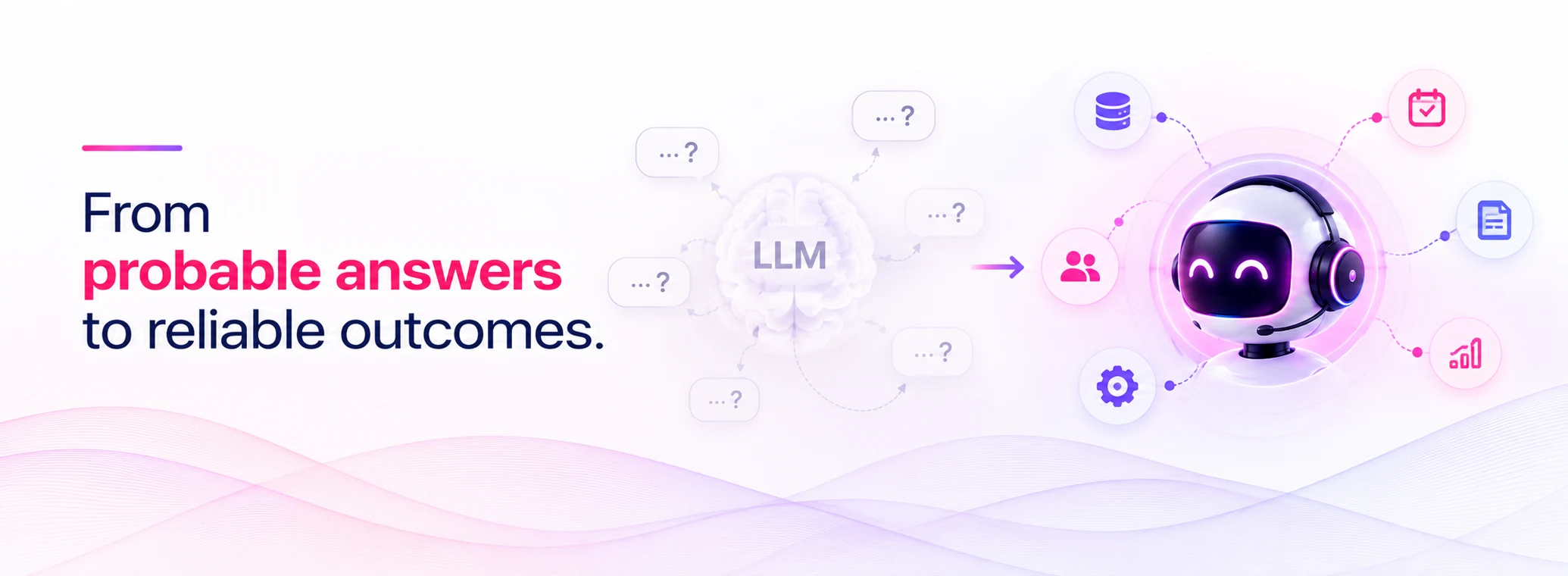
LLMs are probabilistic by design. That non-deterministic nature is their strength—it enables them to interpret complex human semantics effortlessly:

“I need to push my appointment out to next week because I’ll be out of town.”

Traditional rule-based IVR trees fail on a sentence like that. An LLM grasps the intent immediately.

However, once intent is established, probabilistic reasoning must stop. The system must transition to deterministic execution:

  1. Authentication: Is this specific user authorized to make changes?

  2. Entity Resolution: Which specific booking or account does this apply to?

  3. Policy Rules: Does the customer’s tier allow penalty-free changes within 24 hours?

  4. State Management: What slots exist in the real-time calendar system?

  5. System Execution: Which API endpoint needs to be called to commit the update?

An LLM should interpret customer intent; it must never invent or evaluate enterprise policy.

The Missing Layer: The Deterministic Engine

To operate safely at scale, enterprise voice platforms require an immutable control plane between AI speech interpretation and backend execution.

At Rootle, this is the Deterministic Engine.

Where the LLM concludes: “The customer wants to change their appointment,” the Deterministic Engine dictates: “Here is the exact set of legal operations permitted next.”

Probabilistic Reasoning to Deterministic Execution — Rootle

01 · Understands

Probabilistic
reasoning

  • Interprets messy human intent
  • Handles pauses & accents
  • Manages conversational flow
  • Explains results naturally
Structured
payload

02 · Decides & acts

Deterministic
execution

  1. 01Validates identity & state
  2. 02Enforces business policy
  3. 03Executes atomic API calls
  4. 04Creates auditable logs

The Deterministic Engine operates as a gatekeeper that:

• Enforces Security & Scoping: Validates permissions before granting tool access to backend APIs.

• Manages Conversation State: Prevents state pollution across multi-turn exchanges.

• Validates Inputs & Outputs: Ensures parameter payloads match schema specs before committing to systems of record.

• Guarantees Auditability: Creates a deterministic, step-by-step trace of every business decision made during a call.

This design doesn’t constrain AI intelligence. It creates a secure runtime environment where intelligence can be safely deployed in high-stakes operations.

Strategic Shift: Controlled Autonomy Over Unrestricted Autonomy

In the enterprise space, “unrestricted agentic autonomy” is an operational risk. Controlled autonomy is the actual objective.

A enterprise voice agent needs maximum flexibility at the conversation boundary, but zero flexibility at the execution boundary:

• Flexible in interaction. Let AI handle the messiness of human language.

• Rigid in execution. Let deterministic code handle enterprise logic, compliance, and systems integration.

The user experiences a natural dialogue; the enterprise maintains absolute operational control.

Re-defining Voice AI ROI: From Call Deflection to Workflow Automation

Evaluating voice AI on cost-per-call or deflection rates treats voice technology like a basic call center efficiency patch.

When voice AI reliably executes end-to-end actions without human intervention, the underlying economics shift completely:

Call Deflection to Workflow Automation — Rootle

OLD METRIC

Call deflection

NEW METRIC

Workflow automation

FocusAnswering FAQs
FocusEnd-to-end tasks
GoalShorter calls
GoalTask completion
ScopeCall center tool
ScopeEnterprise scale

When an agent can safely handle authentication, query complex backends, apply rules, and execute transactions—whether in appointment scheduling, payments, onboarding, claims processing, or lead qualification—the core unit of automation shifts from the call to the workflow.

Where the Durable Voice AI Moat Will Live

Audio quality, speech synthesis, and raw foundation model capabilities will continue to commoditize. Every enterprise will eventually have access to hyper-realistic, low-latency foundation models.

The durable competitive advantage will come down to Execution Capabilities:

• Who can integrate deepest into core legacy and modern enterprise architectures?

• Who can enforce complex multi-tenant business policies without latency penalties?

• Who provides the most secure, deterministic tool orchestration?

• Who gives enterprise IT teams complete observability, state control, and compliance auditing?

“We are transitioning out of the era of “Conversational AI.” The emerging market category is Deterministic Voice AI, where voice serves as the primary real-time interface.

The objective isn’t to build a bot that mimics human conversation. It’s to build systems that operate with the policy adherence, speed, and precision of a top-performing employee, executing business workflows safely at enterprise scale.

The interface is voice. The product is execution.” – Dhaval Pandit, Co-Founder, Rootle

Hero banner promoting Voice AI for business, with a central purple microphone and circular icons for Support, Multilingual Conversations, Operational Efficiency, and Better Customer Experiences.

What Rootle Does Differently

Rootle is a voice AI platform built for enterprises that demand more than just automated dialing. While legacy systems stop at playing recordings or basic speech-to-text, Rootle acts as an intelligent extension of your workforce. By combining Agentic AI with real-time system integration, Rootle doesn’t just “talk” to your customers—it executes tasks, resolves queries, and moves the needle on your core business metrics, from DSO reduction to lead conversion.

• Conversational Accuracy: Uses advanced speech processing to interpret complex, unstructured human dialogue rather than relying on rigid keypad menus or static scripts.

• Fluid Multi-Dialect Capabilities: Switches languages and regional accents instantly mid-sentence without dropping the context of the conversation.

• Direct Core System Syncing: Connects natively to enterprise CRMs to log interactions, update custom records, and trigger secondary channels dynamically.

• Rapid Ecosystem Deployment: Integrates through secure APIs using pre-configured, industry-specific compliance templates to go live within a few weeks.


FAQs: Deterministic Voice AI

1. What is the main limitation of current enterprise voice AI platforms?

The primary limitation of current voice AI platforms is over-reliance on Large Language Models (LLMs) to manage business logic. While LLMs excel at interpreting fluid human conversation, their probabilistic nature makes them unreliable for executing strict policy rules, validating permissions, and managing enterprise state without hallucination or control failures.

2. Why should enterprises separate LLM conversation handling from business logic?

LLMs are probabilistic, meaning they predict text rather than enforce hard rules. Using an LLM as a business rules engine risks policy violations, unauthorized actions, and security breaches. Enterprise voice architecture requires an LLM to decode natural intent, but relies on a deterministic engine to validate rules, check permissions, and execute API calls safely.

3. What is the difference between Conversational AI and Business Execution AI?

Conversational AI focuses on fluid natural language understanding, low-latency audio response, and sounding human. Business Execution AI goes further by pairing conversational flexibility on the surface with a deterministic control plane underneath, enabling the AI to complete multi-system enterprise workflows, such as payments, account updates, and scheduling: safely and auditably.

4. What is controlled autonomy in enterprise voice AI?

Controlled autonomy is an architectural design where AI has maximum flexibility in handling messy human speech, accents, interruptions, and contextual phrasing, but zero autonomy when committing business actions. The front-end interaction remains adaptive, while backend operations are strictly constrained by deterministic policies, API validation schemas, and enterprise rules.

5. How should enterprises measure Voice AI ROI beyond call deflection?

Rather than measuring cost savings through call deflection or reduced call duration, enterprise voice AI ROI should be evaluated by workflow automation rate. True business value comes from end-to-end task completion, such as claims intake, payment collection, service activation, and appointment rescheduling, shifting the operational unit of automation from the call to the full enterprise process.

Chief Growth Officer

Dhaval Pandit is a seasoned SaaS growth and sales leader with over 16 years of experience scaling technology products and go-to-market teams across global markets. He currently leads strategic growth initiatives and business development at Rootle.ai, driving adoption of voice-based AI solutions across enterprise clients.

Talk to our Experts

Recent Blogs