Before committing capital to Voice AI infrastructure, enterprise leaders must look beyond frontend voice quality and evaluate the core orchestration architecture.


Before committing capital to Voice AI infrastructure, enterprise leaders must look beyond frontend voice quality and evaluate the core orchestration architecture.
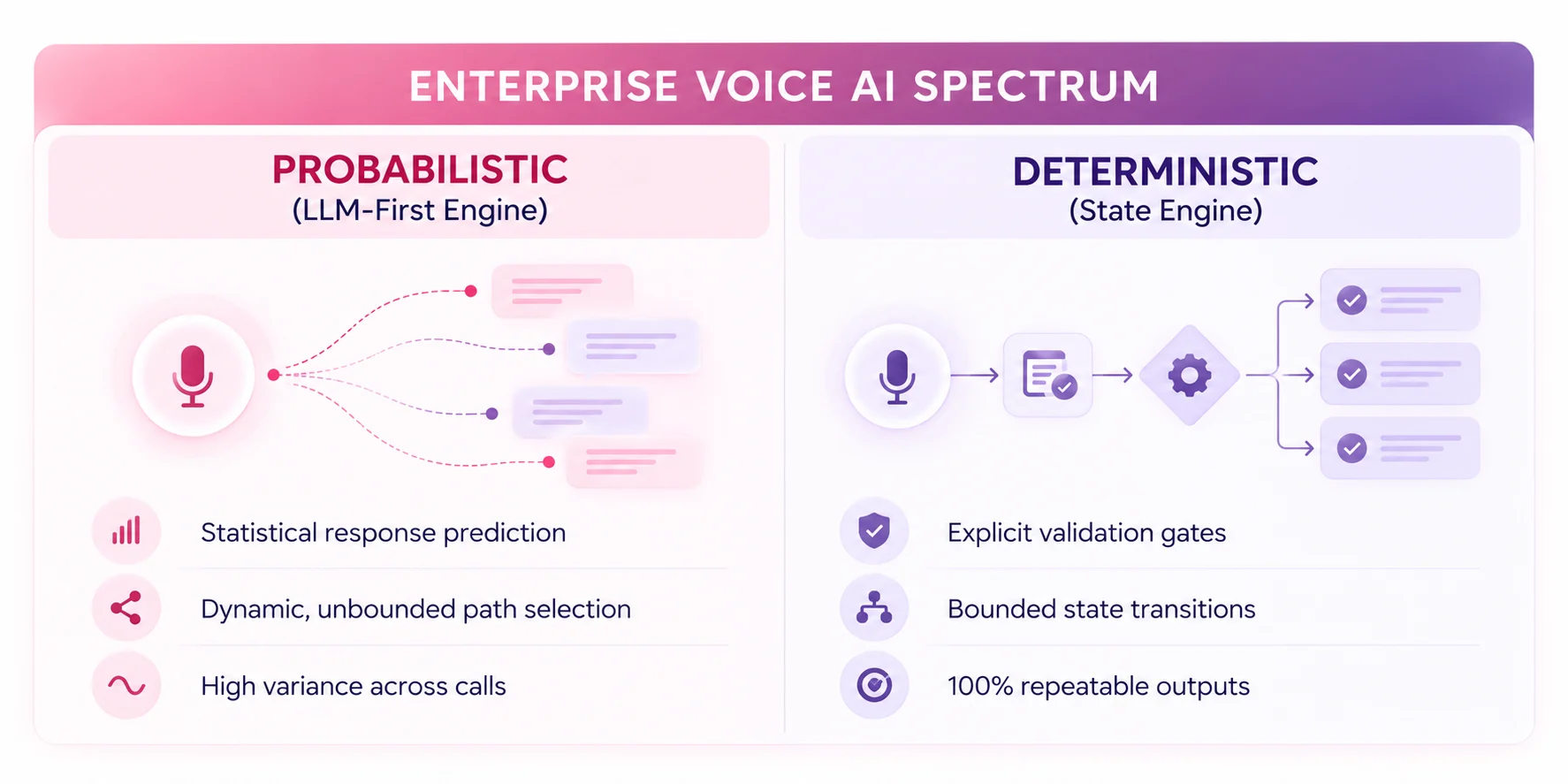
| Execution Engine | Open-ended LLM Generation | Bounded State-Machine Logic |
| Response Predictability | Variable / Non-repeatable | 100% Consistent & Auditable |
| Hallucination Risk | High (Requires heavy prompt engineering) | Zero (Restricted execution boundaries) |
| Voice Latency | 1,200ms – 2,500ms+ (LLM inference bottleneck) | Sub-500ms (Low-latency state lookup) |
| Regulatory Compliance | Difficult to guarantee across turns | Fully compliant with mandatory disclosures |
| Ideal Operational Focus | Discovery, open Q&A, brainstorming | Collections, qualification, scheduling, KYC |
| Commercial Model | Usage-based (Per-minute / Token burn) | Outcome-based (Pay per verified KPI) |
While probabilistic LLM agents impress in uncontrolled sales demos, four operational realities create friction when deployed across high-volume Indian enterprise contact centers:
Human voice conversation relies on tightly timed turn-taking. When pause latency exceeds 800ms, callers perceive the interaction as unnatural and begin speaking over the bot (barge-in collisions). Probabilistic systems require sequential processing—ASR $\rightarrow$ LLM generation $\rightarrow$ TTS synthesis—creating latency cascades that frequently exceed 1,500ms over telephony networks.
In regulated industries like BFSI, Healthcare, and EdTech, an AI agent cannot quote unapproved interest rates, make non-compliant payment promises, or skip statutory disclosures. Probabilistic models can hallucinate under edge-case user inputs, creating legal liabilities and regulatory audits under frameworks like RBI guidelines or DPDPA rules.
If each step of an 8-turn call flow relies on probabilistic interpretation with a 90% confidence rate, the overall probability of completing the entire workflow correctly drops dramatically.
Without deterministic guardrails to reset and validate state boundaries at every node, probabilistic call completion rates degrade over complex workflows.
Probabilistic vendors charge per-minute or per-token fees. When open-ended bots drift off-script or fail to guide callers efficiently toward a resolution, enterprise buyers end up paying heavy usage fees for non-converting, circular phone calls.
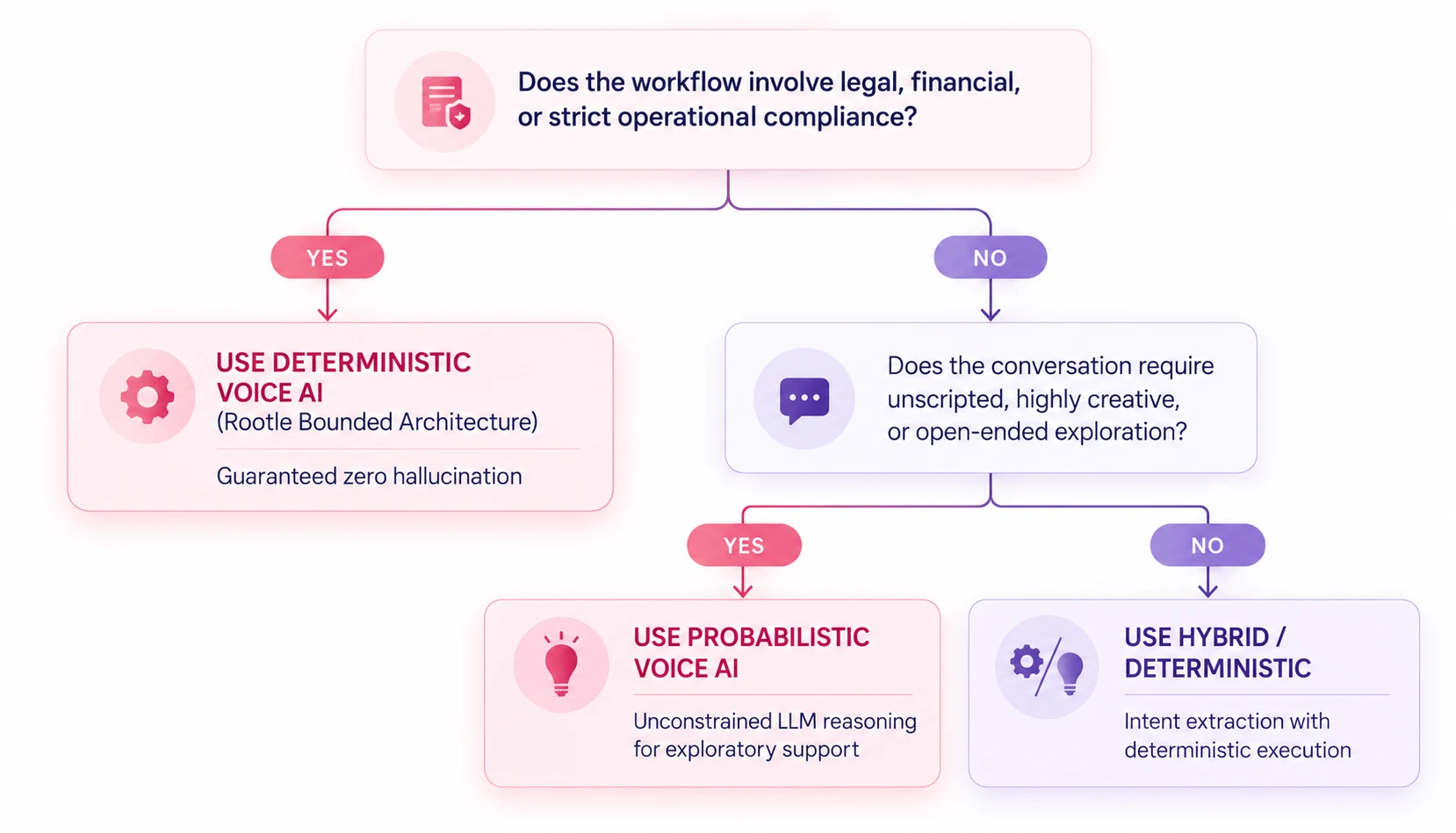
A probabilistic Voice AI agent determines its next statement and action dynamically based on probability distributions in an LLM, meaning the same customer input can produce varying conversational paths across calls. Conversely, a deterministic Voice AI agent uses a bounded state-machine architecture where conversational logic, step execution, and system integrations follow explicit, predefined validation gates. While probabilistic systems adapt well to unscripted text chit-chat, deterministic systems ensure identical, zero-hallucination execution every single time.
Purely probabilistic voice bots struggle at scale primarily due to latency spikes, compliance risks, and compounding multi-step failure rates. Dynamic LLM token generation introduces multi-second delays that disrupt natural conversational turn-taking over telephony networks. Without independent deterministic gates, these models can hallucinate incorrect pricing or skip statutory disclosures, creating severe legal exposure. Furthermore, unguided multi-turn workflows compound error rates at every step, drastically reducing First Call Resolution (FCR) and driving up usage costs for non-converting calls.
Yes, modern enterprise architecture frequently combines both approaches by using probabilistic models for intent classification and entity extraction while wrapping execution inside a deterministic orchestration framework. For example, the system can probabilistically interpret that a customer said “I want to clear my pending EMI next Tuesday” to extract the intent and date, but all subsequent actions—such as checking account status, invoking payment gateway APIs, and issuing confirmation links—are executed strictly by deterministic validation gates to guarantee zero operational error.
Deterministic Voice AI is mandatory whenever an incorrect statement, skipped step, or execution delay carries financial, legal, or operational consequences. Key use cases include BFSI and debt recovery operations handling payment commitments and disclosures, healthcare and insurance platforms verifying intake and scheduling appointments, real estate and higher education teams qualifying presales leads, and logistics workflows processing address verifications and return authorizations.
Rootle eliminates the financial waste common in probabilistic, per-minute platforms where drifting off-script forces enterprises to pay heavy usage fees for non-converting minutes. By using a deterministic engine to ensure structured conversation pacing and quick resolutions, Rootle pairs technical efficiency with an outcome-based pricing model. This ensures enterprises pay specifically when defined operational KPIs are achieved, directly lowering Customer Acquisition Costs and delivering predictable ROI.