Skip to content

Why AI Voice Assistants in Hindi and Hinglish Are the Future of Enterprise CX

Featured Image

Executive Summary

As India’s digital economy expands beyond Tier-1 metros, enterprise growth depends on effectively serving the “Bharat” demographic—over 600 million Hindi and regional language speakers. Traditional customer support systems fail here: English-heavy app interfaces alienate non-native readers, while traditional “Press-1” IVRs trigger high drop-off rates.

Modern AI voice assistants in Hindi and Hinglish AI Voice Assistants solve this bottleneck by combining real-time Automatic Speech Recognition (ASR), code-switching Large Language Models (LLMs), and low-latency Text-to-Speech (TTS) engines. Operating at sub-800ms latency, these AI agents dynamically handle regional accents, background noise, and natural English-Hindi code-switching (“Mera EMI due date kab hai?”).

By automating high-volume workflows like payment collection reminders, address verifications, and lead qualification, enterprises achieve up to 60% operational cost savings, near-zero missed appointments, and 35% lower failed delivery rates—all while maintaining full regulatory compliance.

According to MarkHub, over 70% of internet users in India prefer native-language communication.

Yet, for years, corporate customer service has relied heavily on English-first mobile apps or complex, rigid button-menu IVRs (“Press 1 for English, Press 2 for Hindi”). In a country where over 600 million people speak Hindi and more than 350 million users naturally blend English and Hindi into “Hinglish,” static text forms and single-language bots are driving massive customer drop-off rates.

For modern Indian enterprises, deploying fluent, low-latency Hindi and Hinglish AI Voice Assistants is no longer just a trend—it is an essential operational strategy for scale.
Multilingual voice AI - Demo

The Vernacular Challenge: Why Text and English Fall Short

• Digital & Text-Literacy Barriers: Millions of Tier-2, Tier-3, and rural consumers can comfortably interact via voice, but abandon complex text-based forms or English app menus.

• The “Hinglish” Code-Switching Reality: Urban and semi-urban Indians rarely speak pure dictionary Hindi. A typical conversation switches seamlessly: “Mera EMI due date kya hai and main payment link WhatsApp par kaise paau?” Traditional keyword bots crash when handling code-switching.

• High Call-Center Turnovers: Human agent call centers struggle with high attrition rates and massive overheads during peak inquiry times or campaign bursts.

Anatomy of a Modern Hindi Voice AI Workflow

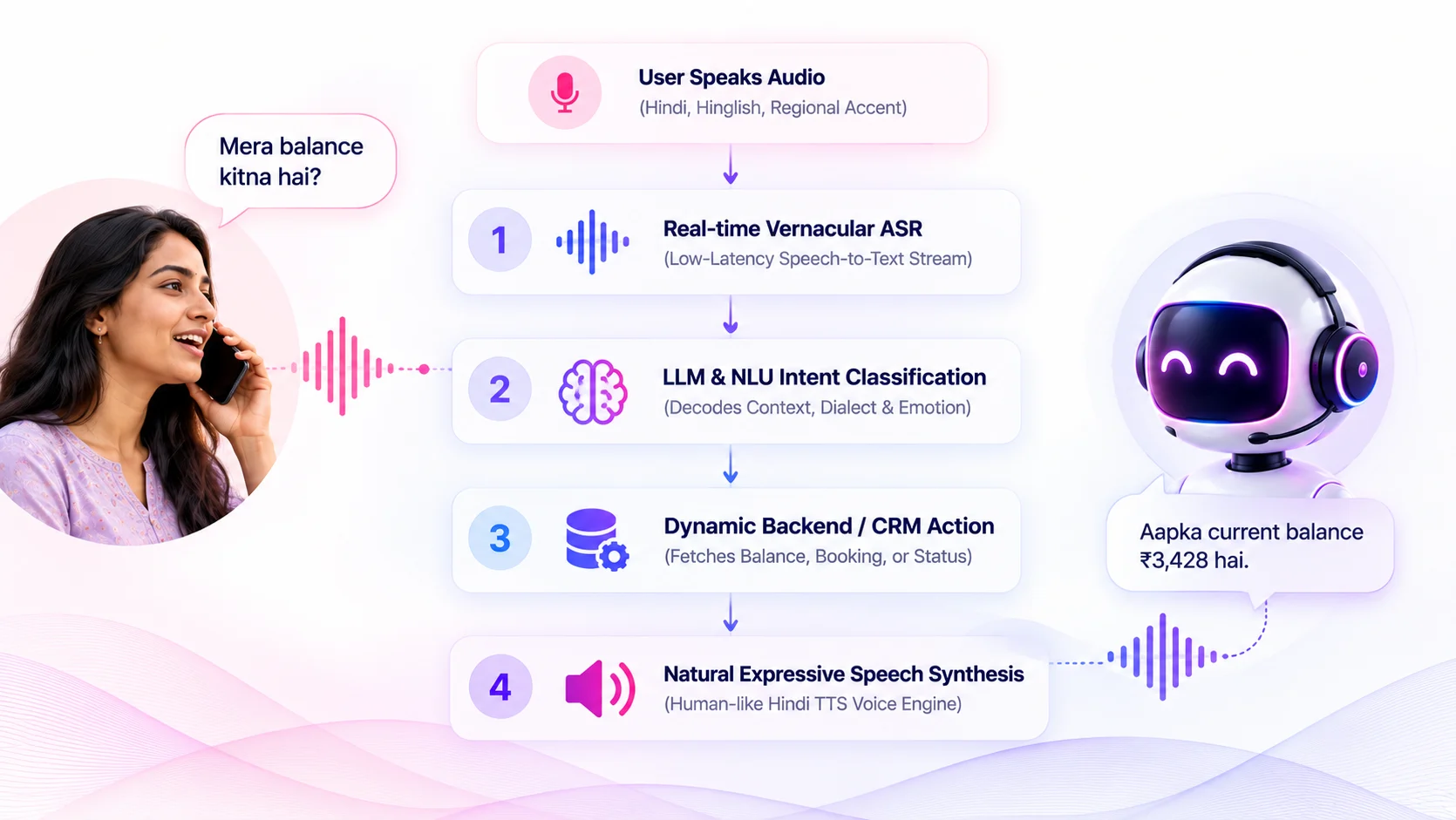
When a customer speaks in Hindi or Hinglish over a phone call, WhatsApp audio, or an in-app widget, an end-to-end AI pipeline processes the audio instantly:

Vernacular Voice AI Flow

High-Impact Enterprise Use Cases of Voice AI Assistant in Hindi and Hinglish

HTML Table Generator
Sector
Key Workflow
Real Conversation Example
Business ROI
BFSI & Lending EMI reminders & Payment link dispatch "Namaste! Aapka loan EMI due date kal hai. Kya main WhatsApp par payment link bhej doon?" Up to 60% reduction in collection costs
Ecommerce & Logistics Address verification & Non-Delivery (NDR) calls "Aapka order deliver hone wala hai. Kya aap ghar par hain ya drop location update karna hai?" 35% lower failed delivery rates
Healthcare Appointment booking & medicine reminders "Aapka doctor's appointment kal subah 10 baje ka hai. Confirm karne ke liye 1 bolein." Near-zero missed appointments
EdTech & Education Lead qualification for parent outreach "Aapne Class 10 course ke liye inquire kiya tha. Kya aap free demo class schedule karna chahenge?" Instant 24/7 lead responses

Real-World Case Study: Closing the “Midnight Gap” for Shriram Finance Ltd

Challenges

Shriram Finance Ltd, serving over 20 lakh active customers across Tier-2 and Tier-3 cities, faced a critical operational bottleneck when their human contact centers closed at 6 PM. Over 1,000 potential investors called daily between 6 PM and 9 AM to inquire about Fixed Deposits and loans, but were met with silence. This high after-hours call volume resulted in a 68% call abandonment rate and an estimated monthly revenue loss of over ₹25 Lakhs—while extending human call center shifts overnight would have inflated operational expenses by an unviable 85%.

Solutions

To solve this revenue bleed, Shriram Finance deployed Rootle’s Conversational Voice AI platform to act as an automated, 24/7 after-hours sales assistant answering calls within 2 rings in fluent Hinglish. Rootle’s AI agent integrated directly with backend APIs to calculate personalized Fixed Deposit returns in real time, securely verified customer identities via multi-factor authentication, and automatically analyzed conversation intent to push pre-scored “Hot Leads” into the CRM for the morning sales queue.

Impact

• +200% Conversion Lift: Lead conversion rate jumped from 12% to 36%.

• 75% Drop in Call Abandonment: Reduced after-hours drop-offs from 68% down to 17%.

Read full story

Conclusion

Speech is the most natural human interface. By adopting conversational Hindi AI voice assistants, Indian brands bridge the digital divide, deliver instant 24/7 support, and dramatically lower operational expenditures.

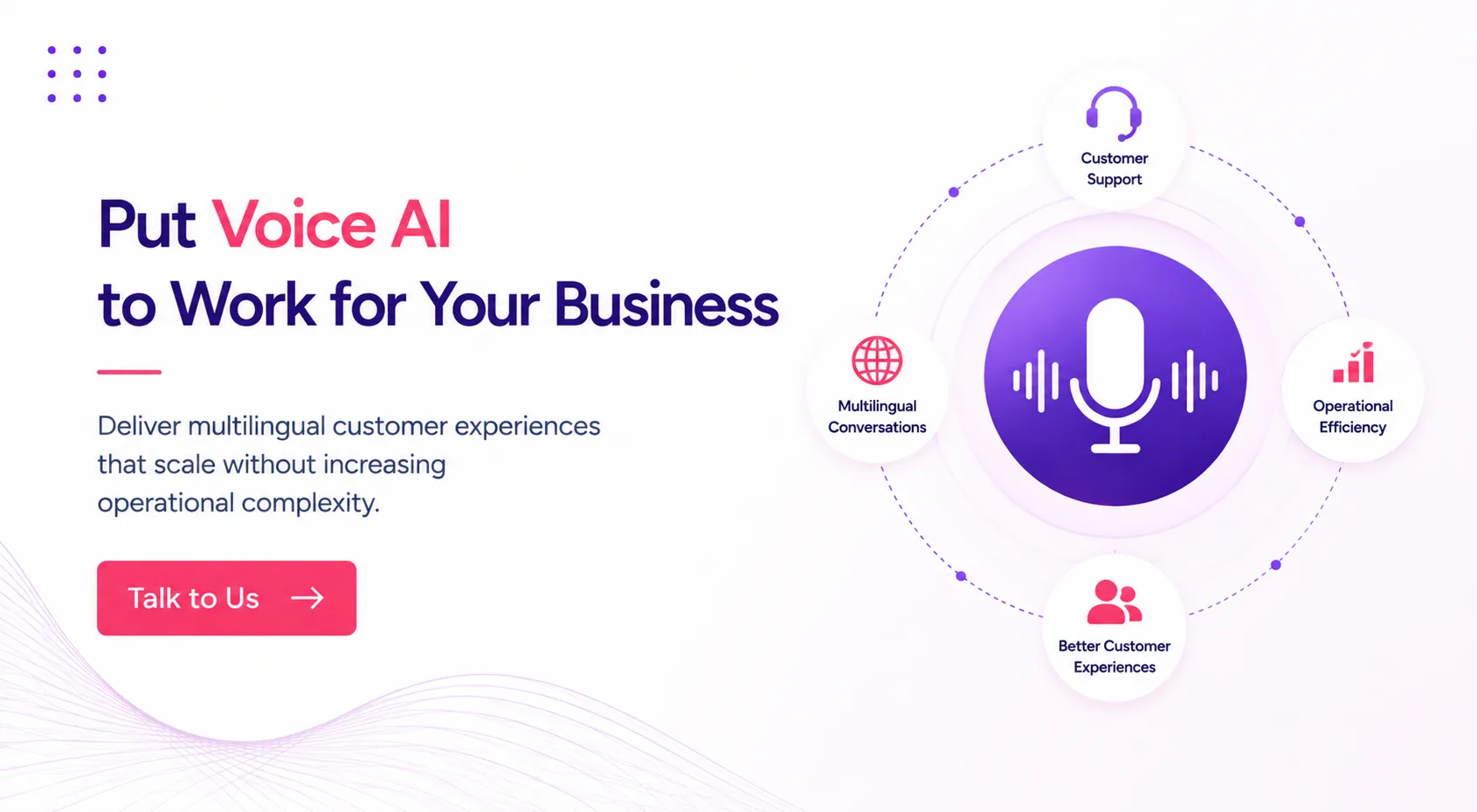
Hero banner promoting Voice AI for business, with a central purple microphone and circular icons for Support, Multilingual Conversations, Operational Efficiency, and Better Customer Experiences.

What Rootle Does Differently

Rootle is a voice AI platform built for enterprises that demand more than just automated dialing. While legacy systems stop at playing recordings or basic speech-to-text, Rootle acts as an intelligent extension of your workforce. By combining Agentic AI with real-time system integration, Rootle doesn’t just “talk” to your customers—it executes tasks, resolves queries, and moves the needle on your core business metrics, from DSO reduction to lead conversion.

• Conversational Accuracy: Uses advanced speech processing to interpret complex, unstructured human dialogue rather than relying on rigid keypad menus or static scripts.

• Fluid Multi-Dialect Capabilities: Switches languages and regional accents instantly mid-sentence without dropping the context of the conversation.

• Direct Core System Syncing: Connects natively to enterprise CRMs to log interactions, update custom records, and trigger secondary channels dynamically.

• Rapid Ecosystem Deployment: Integrates through secure APIs using pre-configured, industry-specific compliance templates to go live within a few weeks.


FAQs: AI Voice Assistants in Hindi and Hinglish

1. What is a Hinglish AI Voice Assistant and how does code-switching work?

A Hinglish AI Voice Assistant is a conversational speech bot capable of understanding and responding to fluid, mid-sentence switching between Hindi and English (code-switching). Unlike single-language natural language processing (NLP) models, Hinglish voice engines use specialized Automatic Speech Recognition (ASR) trained on phonetics from regional Indian accents to interpret mixed-language syntax without losing conversational context or requiring stream restarts.

2. How do Hindi AI Voice Assistants lower call center costs for Indian enterprises?

Hindi AI Voice Assistants lower call center operational expenditures by up to 60% by automating routine inbound and outbound customer inquiries—such as EMI payment reminders, address verification, and delivery slot scheduling. By handling thousands of concurrent calls 24/7 without human agent overhead, voice AI eliminates queue wait times and reduces human workforce attrition during peak call volume spikes.

3. What technical latency is required for natural Hindi Voice AI interactions?

Natural Hindi Voice AI interactions require an end-to-end voice latency of under 800 milliseconds (<800ms). This includes real-time streaming Speech-to-Text (ASR), intent classification via Large Language Models (LLM), and natural-sounding Speech Synthesis (TTS). Latencies higher than 1 second break the natural flow of human conversation, leading to cross-talk and user frustration.

4. How do Hindi AI Voice Bots improve delivery rates for Indian e-commerce companies?

Hindi AI Voice Bots improve non-delivery report (NDR) outcomes and cut failed delivery rates by up to 35% by making automated pre-delivery verification calls in the customer’s preferred language or dialect. The voice agent confirms address details, records drop-off preferences, and updates core logistics CRMs in real time before the field delivery agent sets out.

5. Can Hindi AI Voice Assistants handle regional accents and background street noise?

Yes, enterprise-grade Hindi AI Voice Assistants are built with noise-resilient acoustic models and dialect-aware ASR pipelines. They filter out ambient background sound (such as traffic or chatter) and accurately process regional accent variations across Hindi-speaking belts, including UP, Bihar, Rajasthan, and Madhya Pradesh dialects.

Client Growth Manager

Rahul Desai is a client growth and sales professional with extensive experience driving strategic partnerships and revenue growth. At Rootle.ai, he focuses on expanding market reach, enabling enterprises to leverage multilingual voice AI for intelligent customer engagement and automated conversational experiences.

Talk to our Experts

Recent Blogs