
Skip to content

7 Key Use Cases: Voice AI Assistant for Banking Customer Service Automation

Featured Image

For retail banking executives and contact center leaders, balancing high inbound call volumes with strict compliance and rising operational costs is an ongoing challenge. Traditional phone trees degrade customer experience, while expanding human support desks drains operating margins. Deploying a Voice AI assistant for banking customer service automation offers a scalable alternative. By handling natural, multi-turn spoken dialogue with zero wait time, Voice AI resolves routine banking inquiries end-to-end, updates core ledgers in real time, and executes warm human escalations when necessary. This guide breaks down seven proven, high-ROI use cases that top financial institutions are deploying to modernize support and protect profitability.

Forcing banking clients to navigate long push-button menus or wait twenty minutes on hold to resolve a basic balance check damages customer retention. Modern bank customers expect instant, secure, and conversational account access around the clock.

When financial institutions try to scale customer support purely through human call center seats, operating expenses balloon. High agent turnover, extensive training requirements, and strict regulatory compliance make traditional contact center scaling unsustainable.

Deploying an enterprise Voice AI assistant for banking customer service automation solves this operational bottleneck. Operating with sub-second speech processing and multi-dialect comprehension, Voice AI agents engages callers in natural conversation, verifies identities securely, and executes core banking transactions without placing callers on hold.
BFSI Voice AI Platform - Book a demo

1. Instant Account Balance and Transaction History Inquiries

Routine balance checks and recent ledger queries account for over 30% of total inbound call volume in retail banking. Using skilled human agents to read numbers off a screen wastes high-value labor hours.

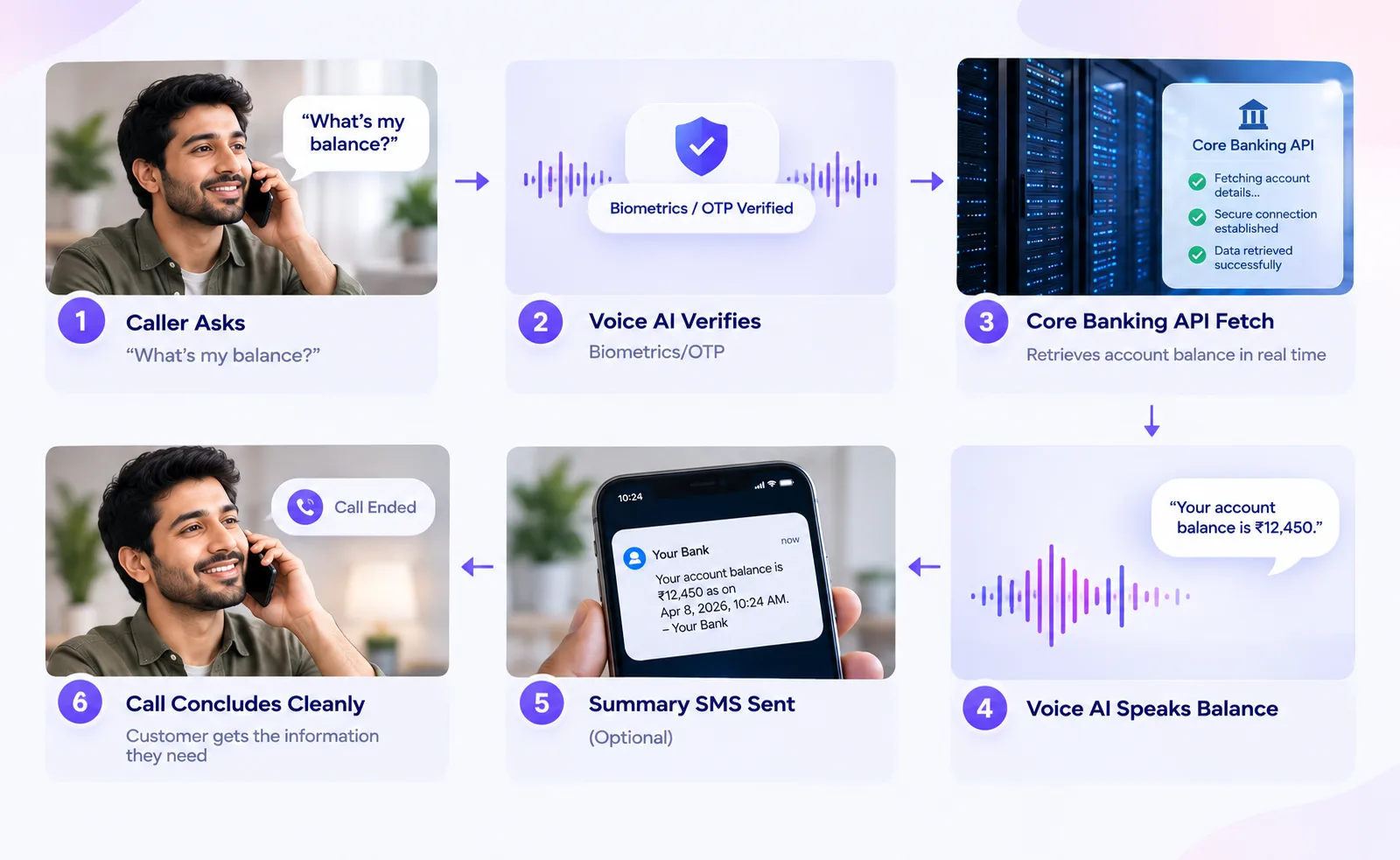
Instant Account Balance and Transaction History InquiriesA specialized voice agent handles identity verification through one-time passcodes or voice biometrics, queries core banking ledgers directly via encrypted APIs, and reads real-time balance details clearly to the caller.
Key Operational Benchmarks

• Zero Wait Time: Resolves high-volume status checks instantly, even during peak morning hours or system downtime.

• Cost Reduction: Offloads routine inquiries completely, leaving human agents free to focus on complex advisory services.

2. Emergency Card Blocking and Instant Fraud Alerts

When a customer loses their debit card or notices suspicious account activity, every second counts. Forcing a panic-stricken customer to sit in a call queue increases financial risk and damages trust in your brand.

A Voice AI assistant manages urgent card controls and security workflows immediately:

◦ Placing automated outbound alert calls the instant fraud detection engines flag suspicious charges.

◦ Verifying transactions verbally with the account holder in real time.

◦ Allowing callers to block compromised cards or freeze online banking credentials instantly using simple voice commands.

◦ Triggering replacement card re-issuance through core banking systems during the same call.

3. Early-Bucket Loan and Credit Card Payment Reminders (DPD 0–30)

Managing early-stage delinquencies requires a soft touch. Hard-line collection tactics early in the payment cycle alienate reliable clients, while static text alerts are easily ignored, allowing accounts to roll forward into expensive late-stage default.

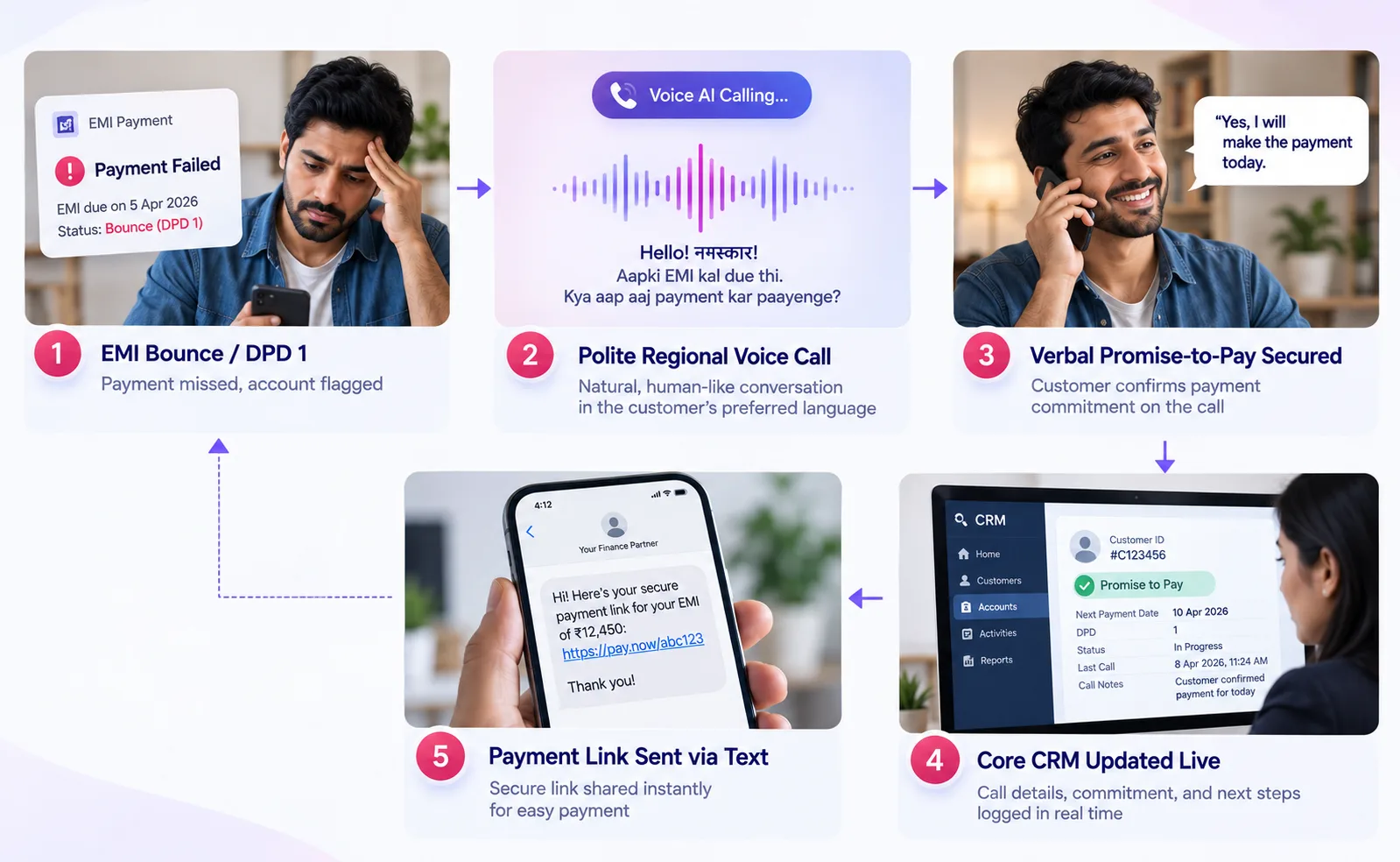
Voice AI agents automate polite, conversational pre-due and early overdue reminders. Speaking in regional dialects, the voice agent explains auto-debit failure reasons, captures verbal Promise-to-Pay (PTP) dates, and texts direct payment links straight to the caller’s mobile device.

4. e-KYC and Loan Application Drop-Off Recovery

Digital onboarding funnels frequently suffer from heavy applicant drop-off during document verification, video e-KYC, or income proof submission. Leaving these stalled applications untouched wastes initial acquisition spend.

Automated voice agents monitor onboarding workflows in real time. The moment an applicant abandons a loan or account setup screen, the system places a friendly outbound call to address confusion, explain documentation requirements, and send direct re-upload links while keeping the user engaged.

5. Password Resets, App Unlocks, and Access Recovery

Locked-out banking customers who cannot access mobile apps or online portals frequently resort to calling phone support. Because these callers are locked out of digital channels, self-service web FAQs are useless to them.

The Voice AI assistant authenticates the caller using multi-factor security protocols, clears locked account flags in administrative databases, and dispatches secure reset links via SMS to restore access safely.

6. Official Document and Statement Generation

Clients frequently call support desks to request official documents, including interest certificates, tax statements, loan NOCs, and monthly bank ledgers.

Instead of keeping human agents on the line to process manual exports, the Voice AI agent validates the request, fetches the required documents from back-end repositories, and delivers them instantly to the caller’s registered email or WhatsApp account before the call ends.

7. Intelligent Outbound Cross-Selling and Product Upgrades

Generic email marketing campaigns in banking yield low open rates. Voice AI enables growth teams to deliver personalized, conversational cross-selling campaigns based on real-time customer data.

When a client becomes eligible for a pre-approved credit limit increase, personal loan offer, or insurance coverage, the Voice AI bot calls to outline the terms naturally, answer questions, and capture verbal consent to initiate processing.

Modernize the Banking Service Architecture with Voice AI Agents

Relying solely on human call center expansion to manage growing inbound volume is no longer a viable operational strategy for modern financial institutions. By benchmarking and deploying a Voice AI assistant for banking customer service automation across high-impact workflows like account checks, fraud alerts, payment reminders, and access recovery, progressive banks eliminate hold times and cut operating expenses. Implementing intelligent voice automation empowers financial institutions to scale support capacity smoothly, protect compliance, and deliver the responsive service modern clients demand.

What Rootle Does Differently

Rootle is a voice AI platform built for enterprises that demand more than just automated dialing. While legacy systems stop at playing recordings or basic speech-to-text, Rootle acts as an intelligent extension of your workforce. By combining Agentic AI with real-time system integration, Rootle doesn’t just “talk” to your customers—it executes tasks, resolves queries, and moves the needle on your core business metrics, from DSO reduction to lead conversion.

Conversational Accuracy: Uses advanced speech processing to interpret complex, unstructured human dialogue rather than relying on rigid keypad menus or static scripts.

• Fluid Multi-Dialect Capabilities: Switches languages and regional accents instantly mid-sentence without dropping the context of the conversation.

• Direct Core System Syncing: Connects natively to enterprise CRMs to log interactions, update custom records, and trigger secondary channels dynamically.

• Rapid Ecosystem Deployment: Integrates through secure APIs using pre-configured, industry-specific compliance templates to go live within a few weeks.

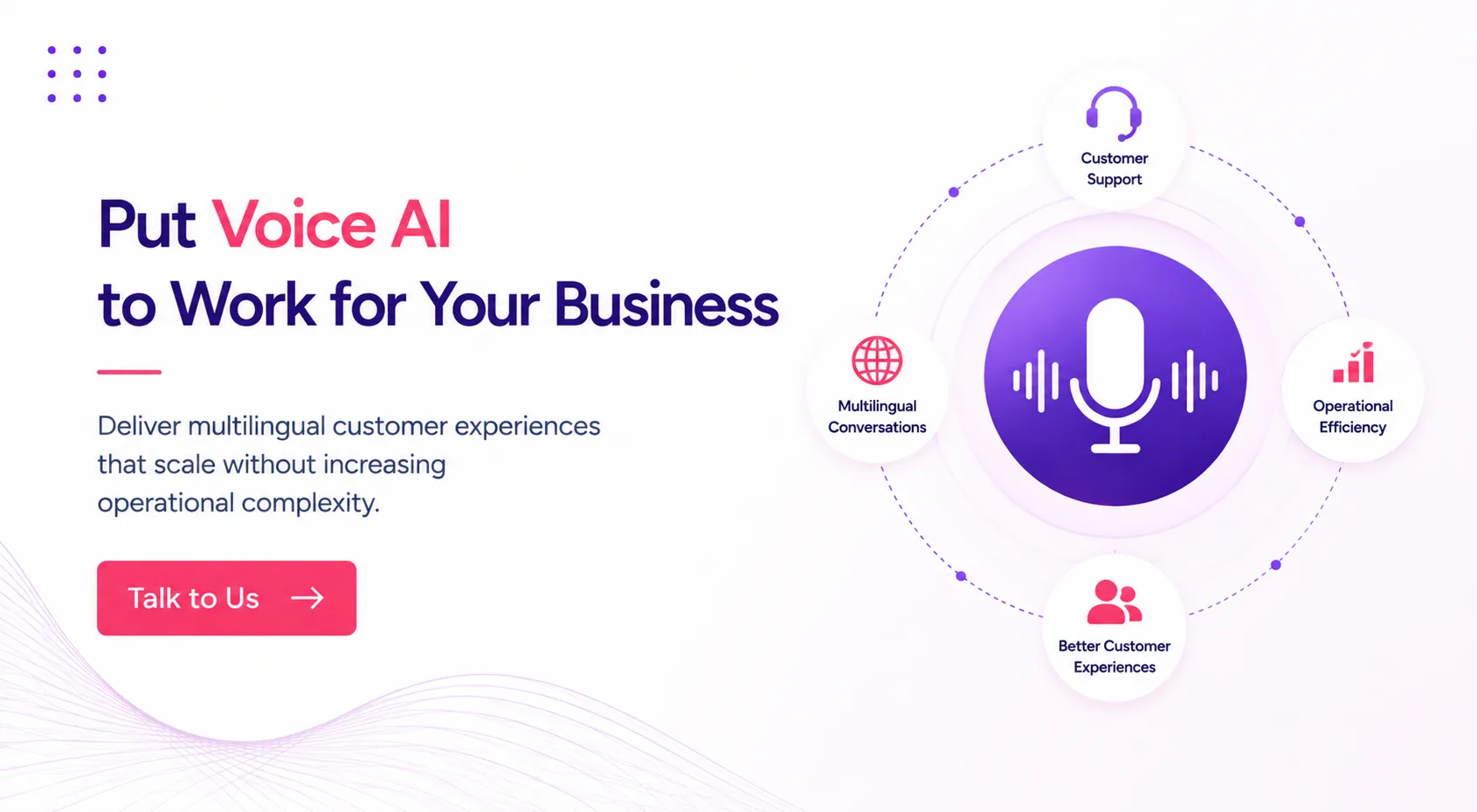
Hero banner promoting Voice AI for business, with a central purple microphone and circular icons for Support, Multilingual Conversations, Operational Efficiency, and Better Customer Experiences.

FAQs: Voice AI Agents

1. What are the top primary use cases for a Voice AI assistant in retail banking?

A Voice AI assistant in retail banking automates high-volume inbound and outbound workflows including instant balance inquiries, emergency credit card blocking, early-bucket loan payment reminders (DPD 0–30), e-KYC drop-off recovery, account access recovery, official document generation, and personalized outbound cross-selling.

2. How does a Voice AI assistant for banking reduce operational call center costs?

A Voice AI assistant reduces banking operational costs by providing zero-wait-time resolutions for routine inquiries, containing up to 30% of repetitive inbound call volume without human agent intervention, and eliminating after-call work through automated API database logging and transcript generation.

3. How do Voice AI banking assistants comply with RBI guidelines and the DPDPA in India?

Voice AI banking assistants ensure compliance by adhering to the RBI Cyber Security Framework and India’s DPDP Act. They enforce strict data localization within domestic servers, redact PII and financial details in real time, authenticate callers via OTPs or voice biometrics, and connect to core banking systems through encrypted, tokenized APIs.

4. How does Voice AI handle complex or off-script banking queries?

When handling complex or off-script banking queries, the Voice AI assistant executes a warm transfer to a human specialist. It passes real-time transcripts, verified customer details, and context logs directly to the agent’s screen, eliminating caller repetition and reducing Average Handle Time (AHT).

5. Why is multi-dialect speech processing critical for banking customer service automation in India?

Multi-dialect speech processing is critical because Indian banking customers frequently mix regional languages with English (code-switching) and speak in local accents. Specialized Voice AI engines process unstructured local speech natively, ensuring high first-contact resolution (FCR) rates across diverse Indian demographics.

Raj Patel
Raj Patel

Biographical

Recent Blogs

Real eatate lead qualification with voice ai
Why Multilingual Voice AI in Regional Languages Is the Future of Customer Support