Deploying voice automation in India requires more than translating scripts into Hindi or Tamil. Learn the five technical and operational...
17 September 2026
The customer experience industry is currently living through a dangerous paradox.
On one hand, Large Language Models have solved the long-standing problem of voice comprehension. Customers no longer need to speak in robotic keywords or navigate frustrating button-pushing IVR trees; they can speak naturally, mix languages, interrupt, and express complex intents in a single breath. Read the key differences here: Voice AI vs IVR: Which to Choose According to Your Use Case
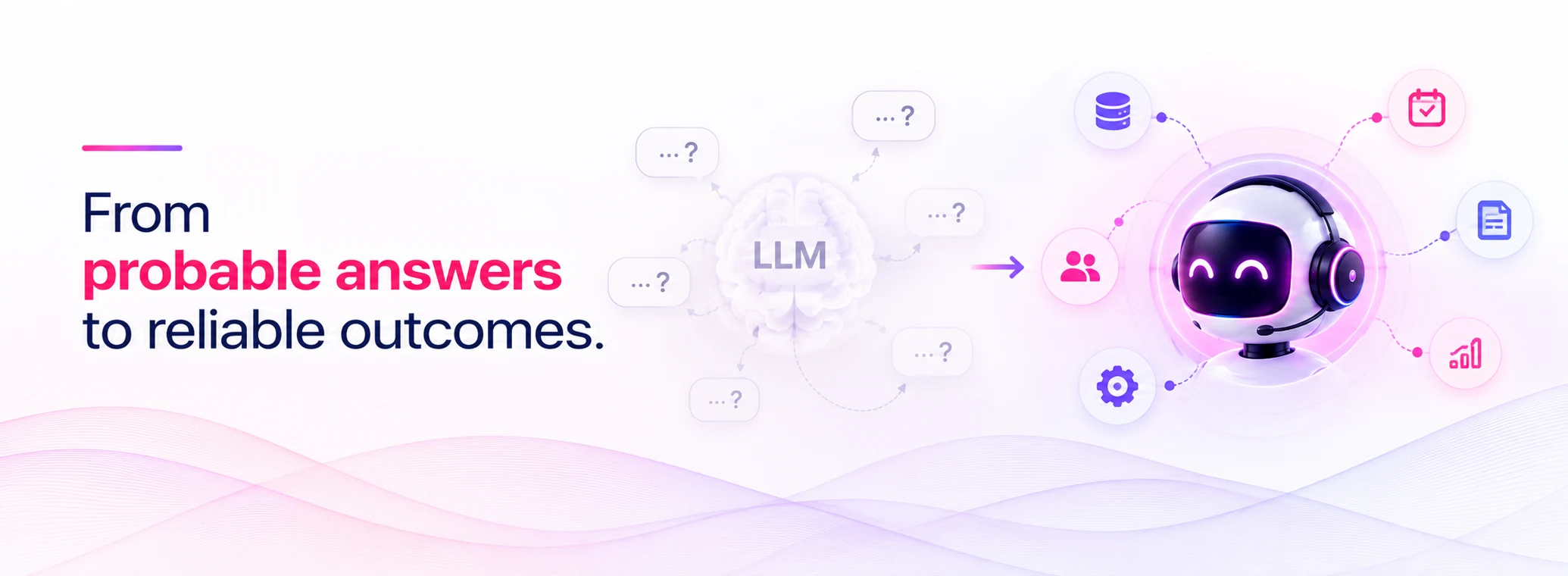
On the other hand, enterprises that rushed to deploy “pure” Generative Voice AI bots directly onto live customer channels are colliding with a hard operational reality: LLMs are inherently non-deterministic.
An LLM is a statistical prediction engine. It does not “know” your core banking rules, your inventory logic, or your regulatory compliance constraints; it simply predicts the next most mathematically probable word. While a 95% accuracy rate is remarkable for drafting an internal memo or summarizing a document, a 5% error rate when updating a customer’s ledger, processing an loan disbursement, or cancelling an order is an absolute operational failure.
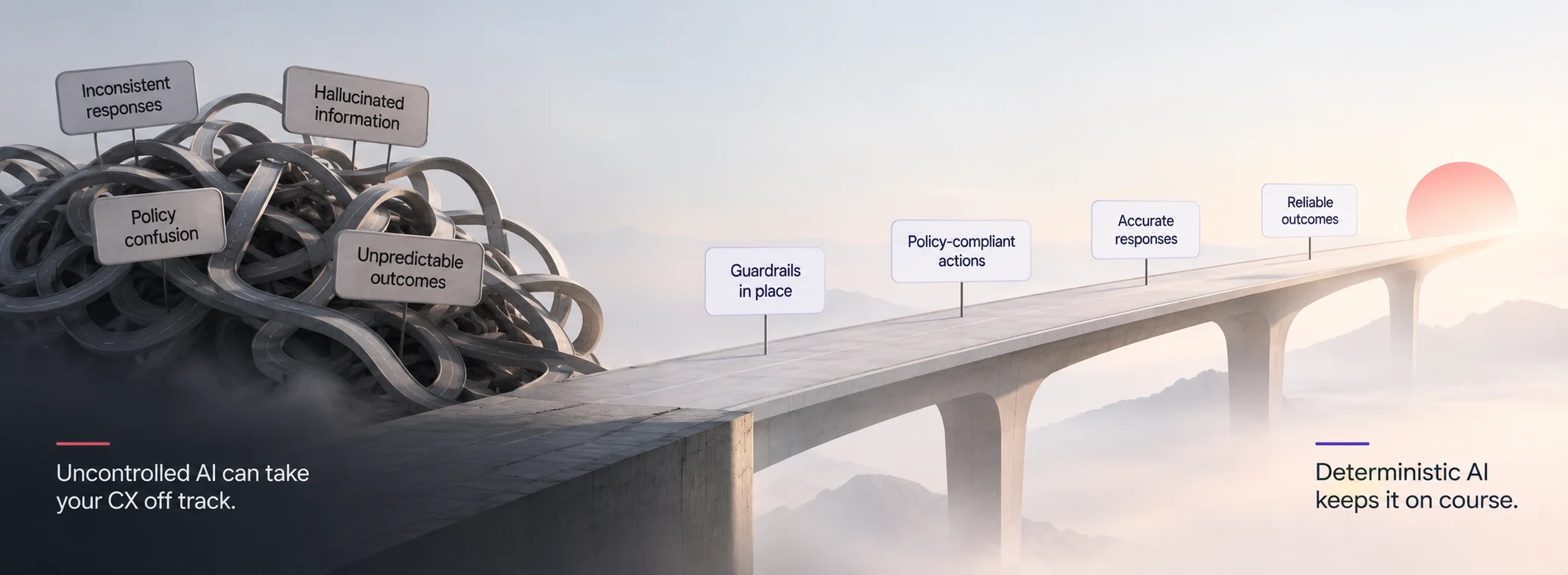
In enterprise CX, “mostly accurate” is an unacceptable liability. The future of enterprise voice automation belongs to Deterministic AI.
Legacy generation vs. Rootle deterministic flow
Probabilistic vs. Deterministic
Pure generative voice AI
Rootle deterministic voice AI engine
How probabilistic understanding hands off to deterministic execution
Probabilistic understanding
NLU layer
Low-latency language models convert raw audio — including code-switched Hindi–English speech — into structured intent and entity tokens.
Deterministic execution
State machine layer
The LLM loses execution authority. Hardcoded business rules validate identity, parameters, and legal state transitions before anything proceeds.
Secure API execution
Backend systems layer
Only once every variable is validated does the payload fire to core systems. Fully predictable, fully loggable, immune to hallucination.
Same call, opposite incentives
Per-minute billing
Enterprise pays for every minute of call duration, resolved or not.
Outcome-based ROI
Enterprise pays only when a call reaches genuine first contact resolution.
Generative AI brought natural conversation to voice interfaces, but natural conversation is only half the battle. In enterprise operations, execution is everything.
Attempting to scale customer support by letting probabilistic models directly trigger core backend systems creates unacceptable brand, regulatory, and financial exposure. By adopting a deterministic architecture—using generative models to listen and hardcoded state machines to execute—enterprises eliminate hallucination risks, safeguard regulatory compliance, and unlock true pay-for-performance commercial models.
To build a voice automation strategy that scales safely, enterprise leaders must demand a simple standard: Probabilistic understanding, deterministic execution.
What Rootle Does Differently
Rootle is a voice AI platform built for enterprises that demand more than automated dialing. Where legacy systems stop at playing recordings or basic speech-to-text, Rootle acts as an intelligent extension of your workforce — executing tasks, resolving queries, and moving core business metrics.
Core architecture
Hybrid Engine Architecture
LLMs handle language parsing only — hardcoded, deterministic state machines execute business logic, guaranteeing zero hallucinations on core APIs.
Outcome-Based Commercials
Priced on Task Completion Rate & FCR — pay-per-resolution, not per-minute.
Omnichannel Conversational OS
One unified memory across Voice, WhatsApp, RCS & Email — context survives every switch.
Native Vernacular & Code-Switching
Real-time language switching — like Hinglish — across 20+ regional Indian languages, with zero routing delays or menu prompts.
Pure Generative Voice AI relies entirely on probabilistic LLMs to both understand human speech and decide the next action or API payload, making it prone to hallucinations, state drift, and policy errors. Rootle uses a hybrid architecture: LLMs strictly parse human intent and speech nuance (probabilistic understanding), while an audit-proof, state-driven engine handles business rules and API calls (deterministic execution). This guarantees 100% execution accuracy on live enterprise systems.
Rootle prevents hallucinations by isolating the Agentic AI layer from backend execution. Extracted intents and entities from human speech are validated against strict, hardcoded business logic and schema guardrails before any Webhook or API payload fires into core systems like Finacle, TCS BaNCS, or Salesforce. If parameters are missing or invalid, the deterministic state machine requests specific missing variables rather than allowing the AI to guess.
“KPI-First” means Rootle evaluates voice interactions based on Task Completion Rate and First Contact Resolution (FCR) rather than talk time or total call minutes processed. Traditional vendors charge per minute, benefiting when bots are slow or confused. Rootle’s deterministic accuracy eliminates bot execution failures, allowing enterprises to align commercial terms directly with successful business outcomes such as verified leads, completed collections, or resolved support tickets.
Rootle’s Conversational OS natively processes over 20 Indian languages and dialects, including mid-sentence code-switching (e.g., mixing Hindi and English). The system auto-detects spoken languages instantaneously upon caller input, adjusting response language, tone, and pause cadence without requiring the user to press buttons or navigate language-selection sub-menus.
Yes. Rootle features omnichannel orchestration through a central Conversational OS. If a customer on a voice call requires a document download, payment link, or confirmation receipt, Rootle can trigger a WhatsApp or RCS message mid-call while maintaining a unified memory log. If the customer later calls back or messages on chat, the AI agent resumes the conversation with full historical context.