Skip to content

7 Reasons to Choose a Done-for-You Voice AI Platform

Featured Image

Executive Summary

Building enterprise-grade Voice AI in-house is rarely a competitive advantage; it is a massive engineering drain. What begins as a simple integration project quickly devolves into managing fragile orchestration layers, tuning low-latency speech pipelines, debugging regional language code-switching, and dealing with unpredictable LLM hallucinations on live core APIs. A “done-for-you” Voice AI platform like Rootle eliminates this operational drag. By delivering a pre-built hybrid architecture, native Indian language processing, omnichannel continuity, and turnkey enterprise integrations, voice AI agents allows organizations to deploy audit-proof, production-ready voice automation in weeks rather than quarters aligning software costs directly with resolved business outcomes.

When enterprise CX and IT leaders decide to automate voice channels, they inevitably face a critical architectural decision: Build or Buy?

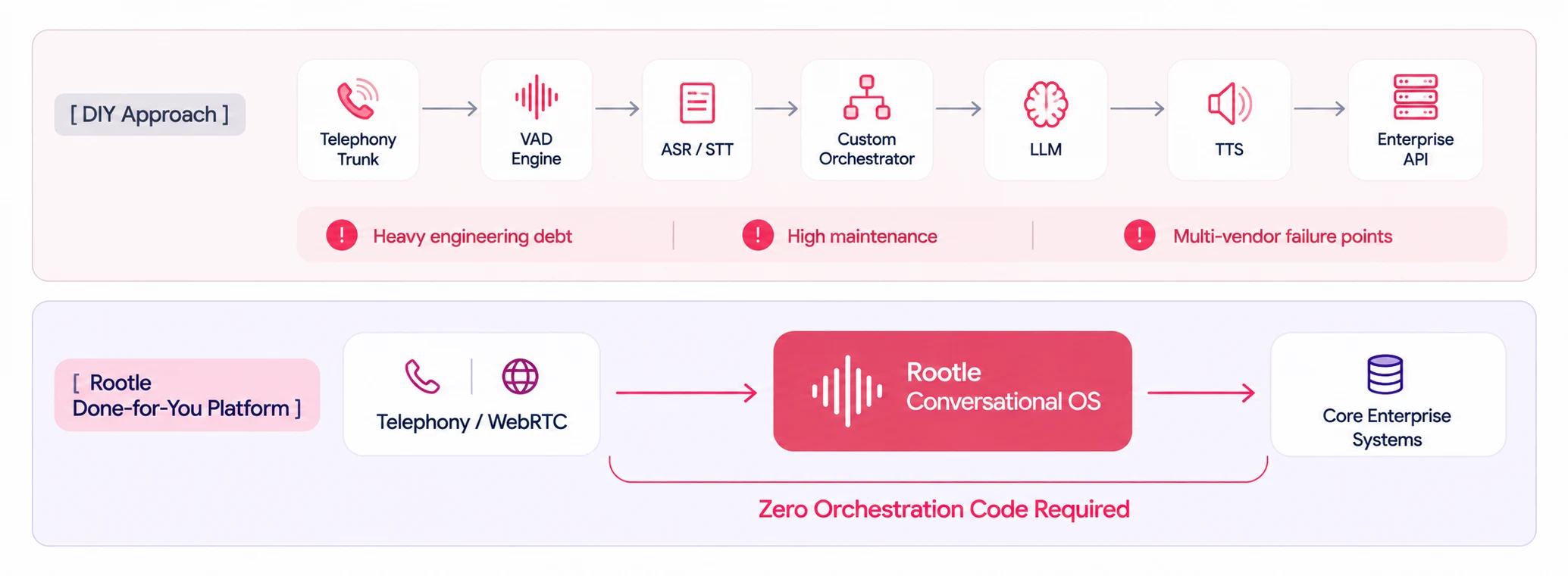
Engineering teams often start by attempting to stitch together separate vendors—buying STT (Speech-to-Text) from one provider, LLMs from another, TTS (Text-to-Speech) from a third, and CPaaS telephony trunks from a fourth. Months later, they find themselves stuck maintaining complex middleware, debugging latency spikes, and firefighting hallucinations on production ledgers.

A managed, “done-for-you” Voice AI platform like Rootle eliminates the friction of building from scratch. Here are 7 reasons why market leaders choose a fully managed Voice OS over custom DIY stacks:
Enterprise voice ai platform - book a demo

1. Zero Need for an Orchestration Layer—Focus Entirely on Your Core Business

Building a voice agent isn’t just about calling an API; it requires orchestrating streaming WebSockets, audio buffering, Voice Activity Detection (VAD), interruption handling, and state management in real time.

With Rootle, your internal engineering team doesn’t spend months writing glue code to stitch disparate AI models together. Rootle handles the end-to-end streaming pipeline out of the box, allowing your developers to focus 100% of their energy on your core business logic, products, and customer experience.

2. Built-in Deterministic AI Layer for Zero Hallucinations

Allowing an unconstrained, probabilistic Large Language Model to directly trigger live core banking APIs, process disbursements, or modify logistics orders is an unacceptable operational risk.

Rootle’s done-for-you architecture features a native Deterministic AI Execution Engine. It decouples speech understanding from transaction logic:

• Probabilistic LLMs handle speech parsing and intent recognition across complex dialects.

• Deterministic State Machines enforce strict, audit-proof business rules before any backend API payload fires.

This guarantees zero parameter hallucinations, 100% execution accuracy on core databases (such as Finacle, TCS BaNCS, or Salesforce), and full compliance with regulatory frameworks like RBI and DPDPA.

3. Deep Multilingual Support: 20+ Indian Languages with Native Code-Switching

In the Indian enterprise context, language selection is never binary. Callers routinely mix regional dialects with English in single, unstructured sentences (e.g., Hinglish or Tanglish).

Generic global models break down when parsing code-switched phrases. Rootle’s multilingual voice AI comes pre-trained on 20+ Indian languages and regional dialects, featuring:

• Instant mid-sentence language detection without forcing callers through tedious IVR sub-menus.

• Low-latency acoustic models optimized for Tier-2 and Tier-3 regional accents.

• Context-aware entity extraction for Indian proper nouns, local locations, and colloquial expressions.

4. True Omnichannel Continuity Across Voice, WhatsApp, Email and Web

Customer journeys rarely stay contained within a single communication channel. A caller asking about an order delivery might need a payment link on WhatsApp mid-call or a follow-up confirmation over SMS.

Rootle is built as an integrated Omnichannel Conversational OS, not an isolated call bot. It maintains a single, unified memory layer across touchpoints:

• Triggers real-time WhatsApp or RCS messages during a live voice call without dropping the line.

• Resumes conversations on chat or voice with full historical context if the customer calls back later.

• Eliminates repetitive customer friction across sales, support, and collection workflows.

5. Sub-800ms End-to-End Latency for Natural Dialogue Cadence

In human speech, a pause longer than 1 second feels awkward and unnatural. In DIY Voice AI builds, passing audio tokens through separate ASR, NLU, LLM, and TTS vendors introduces latency stack-ups of 2 to 4 seconds, causing callers to constantly talk over the bot.

Rootle operates a specialized, ultra-low-latency streaming pipeline that achieves sub-800ms response times. By processing audio streams continuously over WebSockets and using localized neural voice synthesis, Rootle agents deliver smooth, human-like turn-taking without awkward pauses.

6. Turnkey Core Enterprise Systems Integration (Finacle, BaNCS, CRMs)

Connecting voice automation to legacy enterprise databases and ERPs is usually the longest phase of a custom AI project.

Rootle provides pre-built, production-tested connectors and security adapters for core enterprise platforms:

• Banking & Financial Services: Infosys Finacle, TCS BaNCS, OFSS FLEXCUBE, FIS Profile.

• CRMs & ERPs: Salesforce, Microsoft Dynamics, Zoho, SAP, custom internal REST/SOAP gateways.

• Logistics & WMS: Real-time tracking databases, address verification engines, and NDR resolution workflows.

Instead of spending quarters building custom middleware, enterprise IT teams can hook Rootle directly into their existing data ledgers in days.

7. Outcome-Based Economics with Pay-Per-Resolution Alignment

Legacy software vendors and DIY CPaaS platforms bill by total minutes or token usage. This creates a misaligned incentive where vendors profit when bots are slow, confused, or caught in conversational loops.

Rootle shifts the commercial model from legacy consumption billing to Outcome-Based Economics:

• Pay-Per-Resolution: Software costs are tied directly to verified business outcomes (e.g., NDR resolved, EMI verified, appointment booked).

• Early Disconnect Protection: Zero charges for short-duration drops (<5 seconds) or dead-air disconnects common in Indian telecom networks.

• Predictable ROI: Eliminates variable budget surprises, giving CFOs a direct, measurable return on automation investments.

HTML Table Generator
Capability
DIY In-House Build
Rootle Voice AI Platform
Time-to-Market 6–12 Months 2–4 Weeks
Pipeline Engineering High maintenance (ASR/LLM/TTS glue code) Zero orchestration code required
Transaction Safety High risk of LLM hallucinations Deterministic state engine (100% audit-proof)
Vernacular Support Manual fine-tuning of generic models Native 20+ Indian languages + Hinglish
Channel Scope Isolated voice bots Unified Omnichannel (Voice, WhatsApp, RCS)
Billing Model Per-minute usage (Vendor profits from delay) Pay-per-resolved outcome

Bottom Line

Building Voice AI in-house is an expensive exercise in managing infrastructure, latency, and model drift. By choosing a done-for-you Voice AI platform like Rootle, enterprise leaders eliminate technical debt, safeguard their core APIs with deterministic execution, and deliver immediate business outcomes—all while staying focused on what matters most: growing their core business.

What Rootle Does Differently

Rootle is a voice AI platform built for enterprises that demand more than just automated dialing. While legacy systems stop at playing recordings or basic speech-to-text, Rootle acts as an intelligent extension of your workforce. By combining Agentic AI with real-time system integration, Rootle doesn’t just “talk” to your customers—it executes tasks, resolves queries, and moves the needle on your core business metrics, from DSO reduction to lead conversion.

• Conversational Accuracy: Uses advanced speech processing to interpret complex, unstructured human dialogue rather than relying on rigid keypad menus or static scripts.

• Fluid Multi-Dialect Capabilities: Switches languages and regional accents instantly mid-sentence without dropping the context of the conversation.

• Direct Core System Syncing: Connects natively to enterprise CRMs to log interactions, update custom records, and trigger secondary channels dynamically.

• Rapid Ecosystem Deployment: Integrates through secure APIs using pre-configured, industry-specific compliance templates to go live within a few weeks.

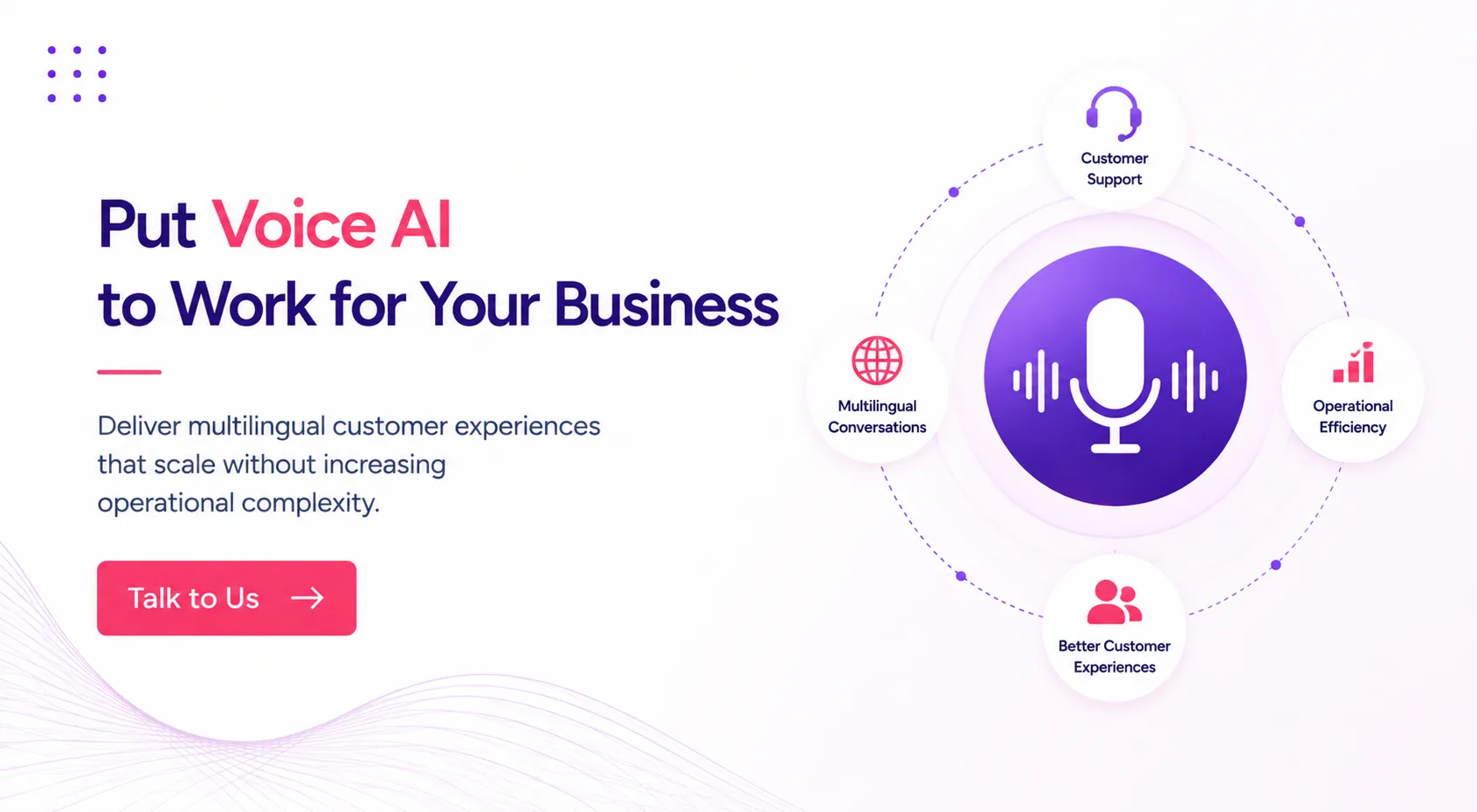
Hero banner promoting Voice AI for business, with a central purple microphone and circular icons for Support, Multilingual Conversations, Operational Efficiency, and Better Customer Experiences.

FAQs: Deterministic Voice AI

1 What is the main economic disadvantage of per-minute pricing for Voice AI?

Per-minute pricing aligns vendor revenue with inefficiency. When vendors charge by duration, they profit when Voice AI agents are slow, confused, or caught in conversational loops. This forces enterprises to pay for the software time spent failing rather than the value delivered.

2. How does Deterministic Voice AI enable outcome-based pricing?

Deterministic Voice AI decouples speech understanding from transaction execution. By using hardcoded state engines to validate rules and API payloads, it eliminates bot hallucinations and state drift. This architectural reliability allows vendors to guarantee First Contact Resolution (FCR) rates and bill strictly for completed business outcomes.

3. What is the difference between probabilistic and deterministic execution in Voice AI agents?

Probabilistic execution lets Large Language Models predict both language and backend actions, risking malformed API calls, hallucinated policies, and incorrect data entries. Deterministic execution uses strict, state-driven rules to run business logic and backend integrations, guaranteeing zero-error API execution while keeping the LLM restricted to speech comprehension.

4. How does outcome-based pricing impact contact center ROI?

Outcome-based pricing transforms automation costs from an unpredictable, variable operational expense into a guaranteed financial return. Enterprises eliminate software spend on failed calls, reduce Average Handle Time (AHT), and pay strictly when a verified business objective such as a resolved ticket, payment confirmation, or scheduled appointment is achieved.

5. Can Deterministic Voice AI platforms handle complex regional code-switching?

Yes. Platforms like Rootle use probabilistic language models at the input boundary to comprehend messy, code-switched human speech (such as mixing Hindi and English) across regional dialects. Once the intent is parsed, the deterministic state machine takes over to execute the transaction flawlessly for multilingual voice AI.

Rahul Desai
Rahul Desai
Client Growth Manager

Rahul Desai is a client growth and sales professional with extensive experience driving strategic partnerships and revenue growth. At Rootle.ai, he focuses on expanding market reach, enabling enterprises to leverage multilingual voice AI for intelligent customer engagement and automated conversational experiences.

Recent Blogs