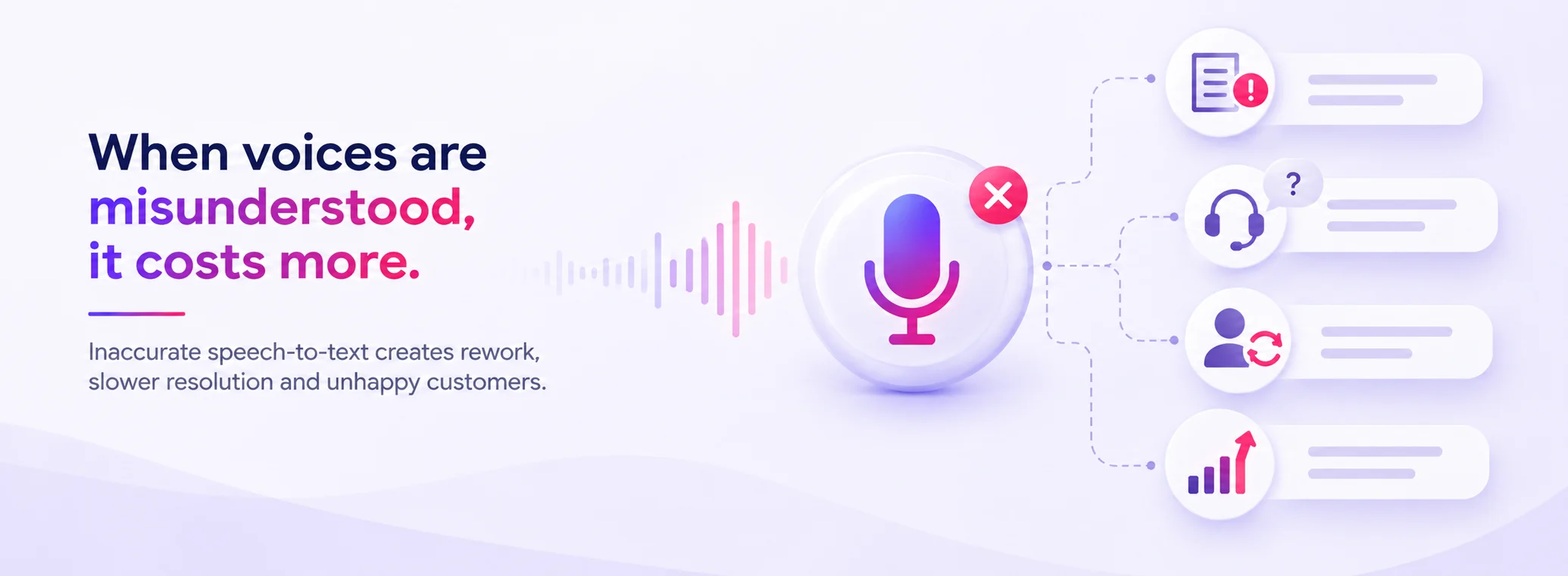
Every roll-forward starts somewhere. For lenders, the DPD 0–30 window is an opportunity to resolve payment friction before it compounds....
27 August 2026
When contact center leaders evaluate Speech-to-Text (STT) vendors, procurement discussions usually revolve around two simple metrics: cost per minute and baseline accuracy percentages.
On paper, choosing an STT provider with a 12% Word Error Rate (WER) over a premium engine with a 4% WER seems like an easy cost-saving win.
That decision is an operational trap.
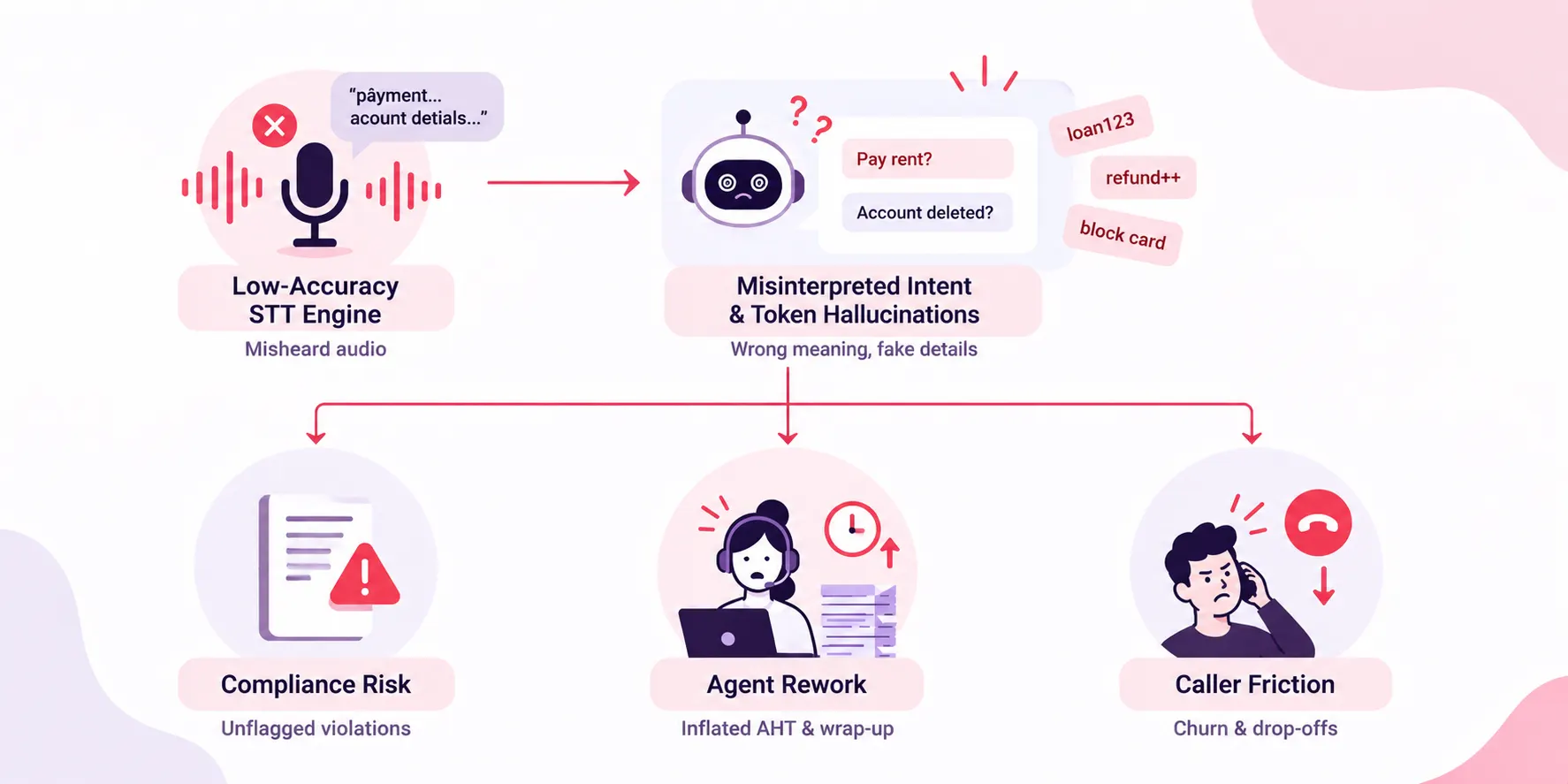
In real-world contact center environments, that 8% gap in transcription accuracy does not result in harmless typos. It manifests as garbled account numbers, missed regulatory consent disclosures, hallucinated entities, and complete failures in intent recognition.
When your foundational speech engine fails to transcribe audio accurately, every layer of your contact center tech stack degrades.
| QA Automated Audit Coverage | Low reliability (High manual auditing needed) | 100% reliable automated monitoring |
| Average After-Call Work (ACW) | High (Manual transcript & note editing) | Near zero (Automated, accurate summaries) |
| First Contact Resolution (FCR) | Low (Frequent misrouting & repeats) | High (Accurate intent detection) |
| Multi-Dialect / Code-Switching | Fails frequently on regional accents | Handles mixed languages natively |
| Total Cost of Ownership (TCO) | High (Hidden rework & compliance fines) | Low (Predictable, efficient operations) |
Cutting software costs by choosing a low-tier Speech-to-Text engine is an expensive mistake. The minor savings on per-minute API fees are quickly wiped out by compliance fines, agent overtime, lower resolution rates, and lost customers. Upgrading to a high-accuracy, multi-dialect STT voice AI agents enables progressive contact centers to protect compliance, streamline support operations, and deliver seamless customer experiences at scale.
Word Error Rate (WER) is the standard metric used to measure STT accuracy by calculating the percentage of insertions, deletions, and substitutions in a transcript compared to the original audio. In a contact center, even a small increase in WER severely impairs downstream systems like sentiment analysis, entity extraction, CRM auto-logging, and automated compliance auditing.
Low STT accuracy causes automated QA systems to miss mandatory regulatory disclosures or flag compliant calls as non-compliant due to garbled transcripts. This forces contact centers to maintain large manual QA auditing teams to double-check transcripts, increasing labor overhead while leaving the enterprise exposed to compliance fines during audits.
Rootle’s speech engine is specifically trained to handle real-world conversational audio, including complex regional accents, informal phrasing, and mid-sentence code-switching (such as mixing Hindi and English). By accurately transcribing unstructured spoken dialogue, Rootle maintains high task completion rates and eliminates context loss during call routing.
Yes. Rootle features an enterprise-grade API and Webhook architecture designed to connect cleanly with cloud CRMs, core databases, and telephony networks. It updates custom fields in real time, fetches customer context before answering, and triggers secondary workflows automatically.
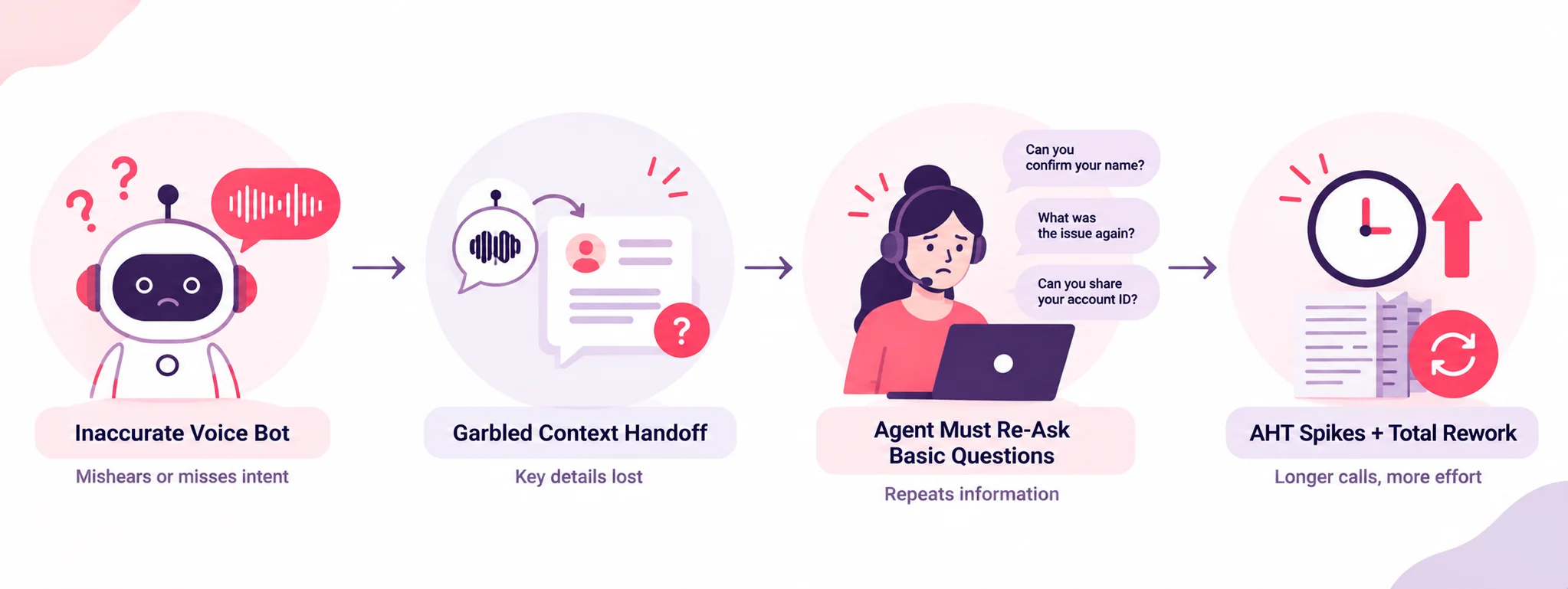
High-accuracy STT drastically reduces both AHT and ACW. When transcription is precise, agents do not need to ask callers to repeat information, nor do they spend time fixing incorrect auto-generated notes. This saves 30 to 60 seconds per call, generating massive labor cost savings across millions of annual calls.