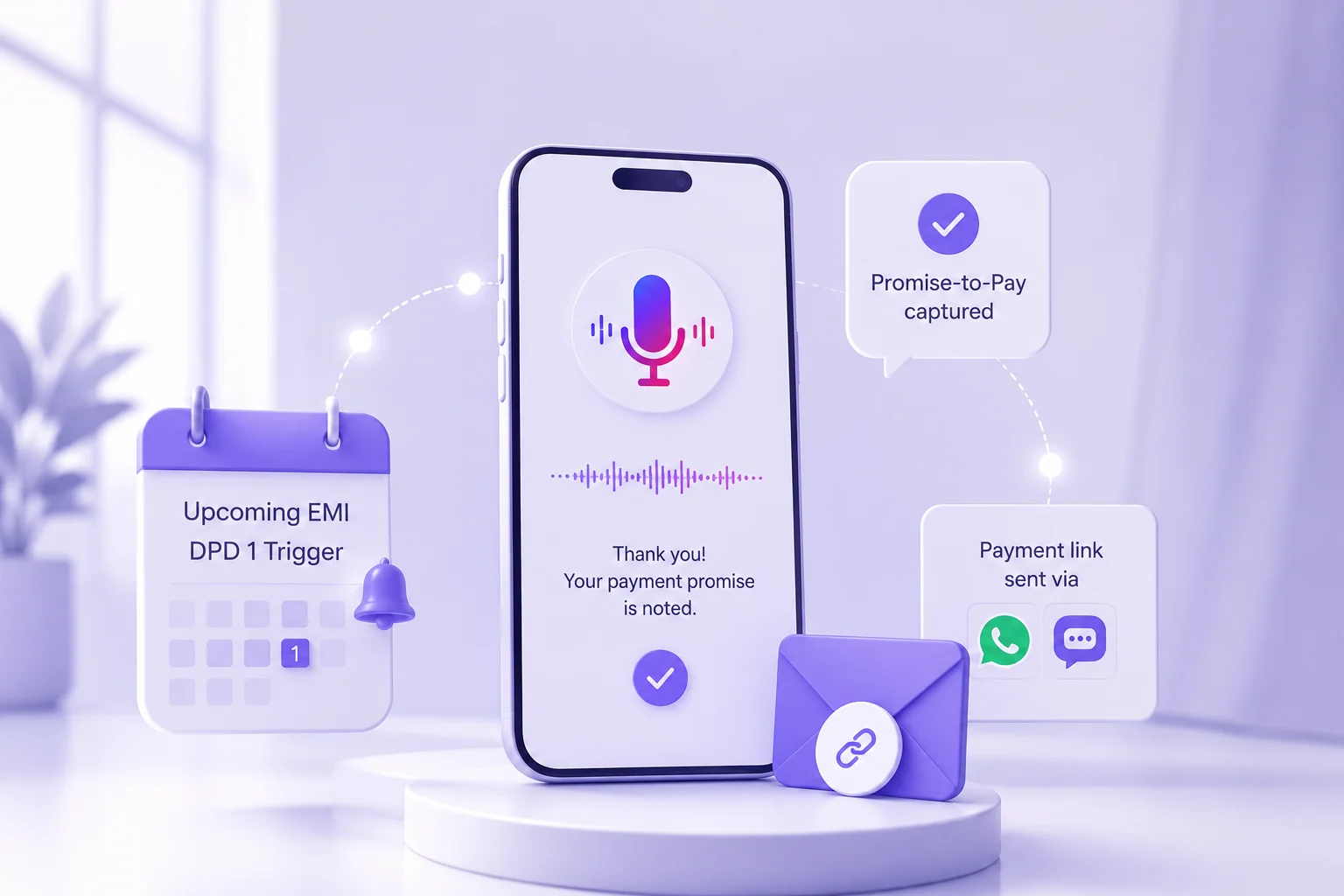
Retail banking customer expectations have shifted toward instant, conversational resolution. Explore the top seven enterprise use cases where Voice AI...
18 August 2026
Scaling operational capacity used to follow a predictable, expensive formula. If your inbound inquiry volume doubled or your lead pipeline tripled, you opened more call center seats. You hired supervisors, ran multi-week training programs, and absorbed the inevitable cost of high turnover.
That linear approach no longer holds up.
Modern revenue models require continuous operational speed. Customers ignore generic SMS alerts, abandon complex forms within seconds, and expect phone interactions to happen immediately without sitting in hold queues.
Progressive COOs are moving away from brute-force headcount expansion. Instead, they deploy enterprise Voice AI agents that handle multi-turn human dialogue in regional languages, connect natively to enterprise databases, and execute tasks dynamically.
Here are the top ten high-yield Voice AI use cases operational leaders are putting at the center of their growth plans.
Conversational Voice AI changes this dynamic entirely. Operating with sub-second latency and natural language understanding, Voice AI agents engage customers in human-like dialogue, process regional accents and dialect mixing, and connect directly to core banking databases to perform live transactional actions.
Here are the top seven enterprise use cases where Voice AI is transforming retail banking operations.
| Average Speed to Answer | 5 to 20+ minutes | Instant (Rigid keypad options) | Zero hold time |
| Outreach Capacity | Limited by staff size | Low conversational ability | Parallel outbound calls |
| Language Flexibility | Limited by hiring pool | Static recorded prompts | Fluid native code-switching |
| Cost per Interaction | High | Low | Low |
| CRM Data Syncing | Manual agent entry | None / Basic | Real-time bi-directional API |
Relying solely on headcount expansion to manage customer interactions is no longer a viable operational strategy. By benchmarking and deploying Voice AI across high-impact use cases like lead qualification, payment reminders, cart abandonment recovery, and routine support, forward-thinking COOs remove operational bottlenecks while cutting operating expenses. Implementing intelligent voice automation empowers progressive enterprises to scale call volume smoothly, protect gross margins, and deliver the responsive service modern customers demand.
When a conversation strays beyond configured parameters or sentiment analysis detects caller frustration, the Voice AI platform executes a smooth, warm transfer to a human specialist. Instead of dropping the call or forcing the user to start over, the system passes the real-time call transcript, caller details, and identified intent directly to the agent’s screen. This context handover lets human agents step in cleanly without asking the caller to repeat themselves.
COOs should track several core operational metrics to calculate Voice AI ROI accurately. These include Automated Containment Rate (the percentage of calls resolved without human help), Cost per Interaction, Lead Contact Velocity (time to reach new sign-ups), e-KYC Drop-off Recovery Rates, and changes in DPD 0-30 Roll-Forward Rates. Comparing these metrics against legacy operational costs highlights direct savings in call center labor and telephony overhead alongside gains in revenue conversion.
Rootle transforms edtech lead management by contacting new prospects within seconds of sign-up. The AI voice agent calls parents or prospective students in their native language to pre-screen academic goals, evaluate program suitability, and answer basic course questions. By verifying intent immediately, Rootle schedules trial classes on the spot and sends calendar access links over WhatsApp while the caller is still on the line, boosting attendance and trial conversions.
Yes. Rootle features an enterprise-grade API and Webhook structure engineered to connect cleanly with both modern cloud CRMs and legacy core database systems. The platform pulls customer context prior to dialing, updates custom database fields live during the call, and triggers downstream actions (such as dispatching payment links or updating loan origination stages) without requiring manual human effort.
In regional markets, callers rarely speak in formal, textbook language. They mix local dialects with English terms, alter pronunciations, and switch languages mid-sentence. Standard translation tools often misinterpret this speech, causing interaction failures. A native multi-dialect Voice AI engine processes regional accents and code-switching naturally, ensuring fluid communication, higher call completion rates, and better user experiences across all demographics.