Skip to content

What is the Real Cost of Low-Accuracy STT Voice AI Agents in a Contact Center

Featured Image

Executive Summary

In modern contact centers, Speech-to-Text (STT) models serve as the foundational engine for automated call routing, Quality Assurance (QA) auditing, agent assistance, and Voice AI agents. However, enterprise leaders frequently treat STT as a generic commodity, prioritizing low per-minute pricing over transcription accuracy. This guide reveals the hidden, compounding costs of low-accuracy STT engines. When Word Error Rates (WER) spike—especially in multi-dialect or code-switched environments—the downstream effects trigger severe compliance violations, inflated Average Handle Times (AHT), agent rework, and costly customer churn,

When contact center leaders evaluate Speech-to-Text (STT) vendors, procurement discussions usually revolve around two simple metrics: cost per minute and baseline accuracy percentages.

On paper, choosing an STT provider with a 12% Word Error Rate (WER) over a premium engine with a 4% WER seems like an easy cost-saving win.

That decision is an operational trap.
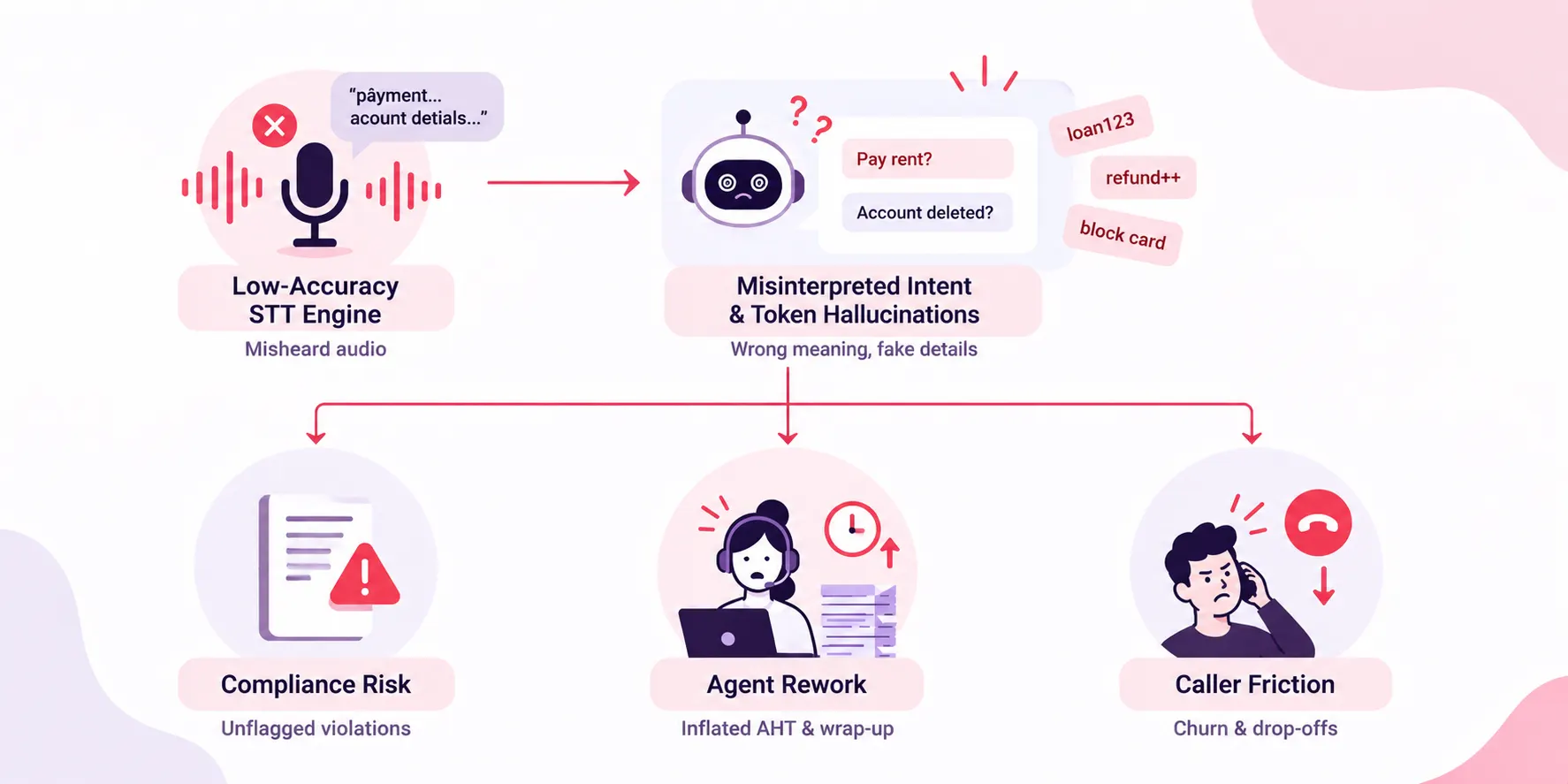
In real-world contact center environments, that 8% gap in transcription accuracy does not result in harmless typos. It manifests as garbled account numbers, missed regulatory consent disclosures, hallucinated entities, and complete failures in intent recognition.

When your foundational speech engine fails to transcribe audio accurately, every layer of your contact center tech stack degrades.
Hero banner for an enterprise Voice AI Platform: gradient headline, central microphone graphic, surrounding feature icons, and a 'Book a Demo' CTA button.

1. Compliance and Regulatory Failures

Contact centers in regulated industries like banking, healthcare, and insurance operate under strict disclosure rules. Quality Assurance (QA) teams rely on automated speech analytics to monitor 100% of calls for mandatory compliance phrases, such as TRAI, DPDPA, and RBI.

How STT Errors Trigger Fines

• Missed Disclosures: If an STT engine misinterprets or drops key words during a disclosure (e.g., transcribing “I do not agree” as “I do agree”), automated QA flags the call incorrectly or misses a non-compliant agent entirely.

• Flawed PII Redaction: Low-accuracy STT fails to transcribe credit card numbers or social security details accurately, preventing downstream automated redaction tools from scrubbing sensitive data before storing call logs.

• Audit Blindspots: Inaccurate transcripts leave risk officers unable to prove regulatory compliance during regulatory audits, exposing the enterprise to heavy financial penalties.

2. Inflated Average Handle Time (AHT) and Agent Rework

When speech engines struggle with regional accents, background noise, or code-switching (e.g., mixing local dialects with English), the immediate burden falls directly on human support agents.

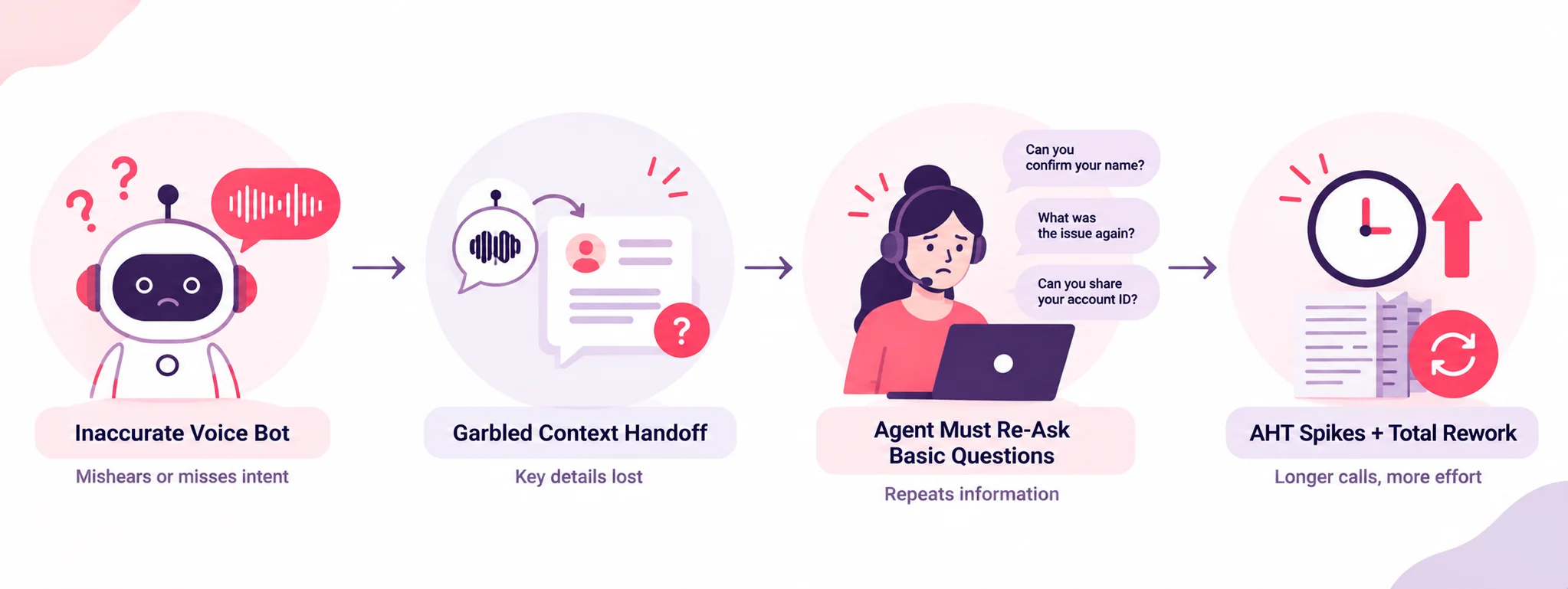
• Repetitive Caller Verification: If an inbound Voice AI or automated IVR misinterprets a caller’s voice responses due to poor STT, the call gets transferred to a human agent without context. The agent must repeat the authentication process from scratch.

• Manual Post-Call Wrap-Up: Modern contact centers use LLM-driven tools to auto-summarize calls from STT transcripts. When the underlying transcription is inaccurate, agents spend minutes manually correcting post-call summaries, notes, and CRM records.

3. Burnout, Turnover, and Agent Churn

Frontline contact center agents face constant pressure to maintain low handle times while delivering high customer satisfaction scores. Forcing agents to work with unreliable tools directly accelerates workplace burnout.

When agents constantly clean up broken call notes, struggle with inaccurate Real-Time Agent Assist suggestions, and handle frustrated callers who were misunderstood by automated voice systems, employee morale drops rapidly. Replacing a contact center agent costs thousands in recruiting and training costs—making high agent turnover one of the largest hidden operational expenses of cheap software.

4. Customer Friction and Unnecessary Churn

Customer retention depends heavily on low-friction support experiences. When an STT engine fails to capture caller intent, the entire customer journey breaks down.

Callers forced to repeat account numbers multiple times or navigate misrouted call transfers quickly lose patience. This frustration drives up call abandonment rates and pushes unsatisfied customers straight to competitors.

Quantifying the Damage: High vs. Low Accuracy STT

HTML Table Generator
Impact Metric
Low-Accuracy STT (High WER)
Enterprise-Grade STT (Low WER)
QA Automated Audit Coverage Low reliability (High manual auditing needed) 100% reliable automated monitoring
Average After-Call Work (ACW) High (Manual transcript & note editing) Near zero (Automated, accurate summaries)
First Contact Resolution (FCR) Low (Frequent misrouting & repeats) High (Accurate intent detection)
Multi-Dialect / Code-Switching Fails frequently on regional accents Handles mixed languages natively
Total Cost of Ownership (TCO) High (Hidden rework & compliance fines) Low (Predictable, efficient operations)

Stop Treating Speech-to-Text as a Commodity

Cutting software costs by choosing a low-tier Speech-to-Text engine is an expensive mistake. The minor savings on per-minute API fees are quickly wiped out by compliance fines, agent overtime, lower resolution rates, and lost customers. Upgrading to a high-accuracy, multi-dialect STT voice AI agents enables progressive contact centers to protect compliance, streamline support operations, and deliver seamless customer experiences at scale.

What Rootle Does Differently

Rootle is a voice AI platform built for enterprises that demand more than just automated dialing. While legacy systems stop at playing recordings or basic speech-to-text, Rootle acts as an intelligent extension of your workforce. By combining Agentic AI with real-time system integration, Rootle doesn’t just “talk” to your customers—it executes tasks, resolves queries, and moves the needle on your core business metrics, from DSO reduction to lead conversion.

Conversational Accuracy: Uses advanced speech processing to interpret complex, unstructured human dialogue rather than relying on rigid keypad menus or static scripts.

• Fluid Multi-Dialect Capabilities: Switches languages and regional accents instantly mid-sentence without dropping the context of the conversation.

• Direct Core System Syncing: Connects natively to enterprise CRMs to log interactions, update custom records, and trigger secondary channels dynamically.

• Rapid Ecosystem Deployment: Integrates through secure APIs using pre-configured, industry-specific compliance templates to go live within a few weeks.

Hero banner promoting Voice AI for business, with a central purple microphone and circular icons for Support, Multilingual Conversations, Operational Efficiency, and Better Customer Experiences.

FAQs: STT Accuracy

1. What is Word Error Rate (WER) and why does it matter in contact center Speech-to-Text evaluation?

Word Error Rate (WER) is the standard metric used to measure STT accuracy by calculating the percentage of insertions, deletions, and substitutions in a transcript compared to the original audio. In a contact center, even a small increase in WER severely impairs downstream systems like sentiment analysis, entity extraction, CRM auto-logging, and automated compliance auditing.

2. How does low STT accuracy impact automated compliance and Quality Assurance (QA) monitoring?

Low STT accuracy causes automated QA systems to miss mandatory regulatory disclosures or flag compliant calls as non-compliant due to garbled transcripts. This forces contact centers to maintain large manual QA auditing teams to double-check transcripts, increasing labor overhead while leaving the enterprise exposed to compliance fines during audits.

3. How does Rootle ensure high Speech-to-Text accuracy in regional and multi-dialect call environments?

Rootle’s speech engine is specifically trained to handle real-world conversational audio, including complex regional accents, informal phrasing, and mid-sentence code-switching (such as mixing Hindi and English). By accurately transcribing unstructured spoken dialogue, Rootle maintains high task completion rates and eliminates context loss during call routing.

4. Can Rootle's Voice AI platform integrate directly with existing contact center infrastructure and CRMs?

Yes. Rootle features an enterprise-grade API and Webhook architecture designed to connect cleanly with cloud CRMs, core databases, and telephony networks. It updates custom fields in real time, fetches customer context before answering, and triggers secondary workflows automatically.

5. What is the financial impact of STT accuracy on Average Handle Time (AHT) and After-Call Work (ACW)?

High-accuracy STT drastically reduces both AHT and ACW. When transcription is precise, agents do not need to ask callers to repeat information, nor do they spend time fixing incorrect auto-generated notes. This saves 30 to 60 seconds per call, generating massive labor cost savings across millions of annual calls.

Rahul Desai
Rahul Desai
Client Growth Manager

Rahul Desai is a client growth and sales professional with extensive experience driving strategic partnerships and revenue growth. At Rootle.ai, he focuses on expanding market reach, enabling enterprises to leverage multilingual voice AI for intelligent customer engagement and automated conversational experiences.

Recent Blogs