Skip to content

Can Financial Institutions Achieve True Sub-Second Latency with Hybrid Voice AI?

Featured Image

Executive Summary

For financial institutions, deploying automated voice systems introduces a strict performance barrier: response latency. Traditional cloud-only setups require sequential processing across multiple remote servers, resulting in multi-second delays that disrupt transaction velocity and compromise fraud-detection workflows. Transitioning to a hybrid Voice AI platform resolves this bottleneck. By processing initial audio inputs locally using on-device speech-to-text algorithms while routing complex data queries through real-time voice streaming architectures, banks achieve the sub-second latency required to protect high-stakes customer interactions and scale high-volume support operations safely.
When a customer calls their bank to report a compromised credit card or authorize an emergency high-value wire transfer, every single second carries profound financial risk. The customer is anxious, the situation is time-sensitive, and the margin for error is absolute.

If that financial institution routes the call to an automated Voice AI for customer support framework that suffers from high latency, the user experience collapses immediately. A two-second pause while a cloud server processes a voice response doesn’t just feel mechanical—it actively creates anxiety. The user assumes the connection has dropped, begins talking over the system, and misses critical verification instructions. In the high-stakes world of banking and wealth management, slow voice response times lead directly to abandoned calls, increased fraud risk, and severely degraded customer retention metrics.

The engineering problem is clear: traditional, cloud-reliant conversational infrastructure is fundamentally too slow to match the natural cadence of human speech. To build a voice channel that customers actually trust with their financial data, institutions must shift toward a hybrid architecture designed to deliver true sub-second latency.

The Core Latency Challenge in Financial Support Channels

To understand why traditional setups fail, you have to look at how data moves through a standard cloud-only voice channel.

When a user speaks over a phone line, their voice must travel to a remote transcription server, convert to text, pass into a reasoning engine, wait for a text reply, and then run through a text-to-speech engine before the final audio stream can journey back to the caller’s phone.

When you add the mandatory compliance checks, fraud scoring, and database lookups required for financial transactions, the round-trip delay routinely hits 2.5 to 3 seconds. For a customer trying to lock a stolen debit card, that lag is unacceptable.

The Architecture Solution: Deploying a Hybrid Voice Infrastructure

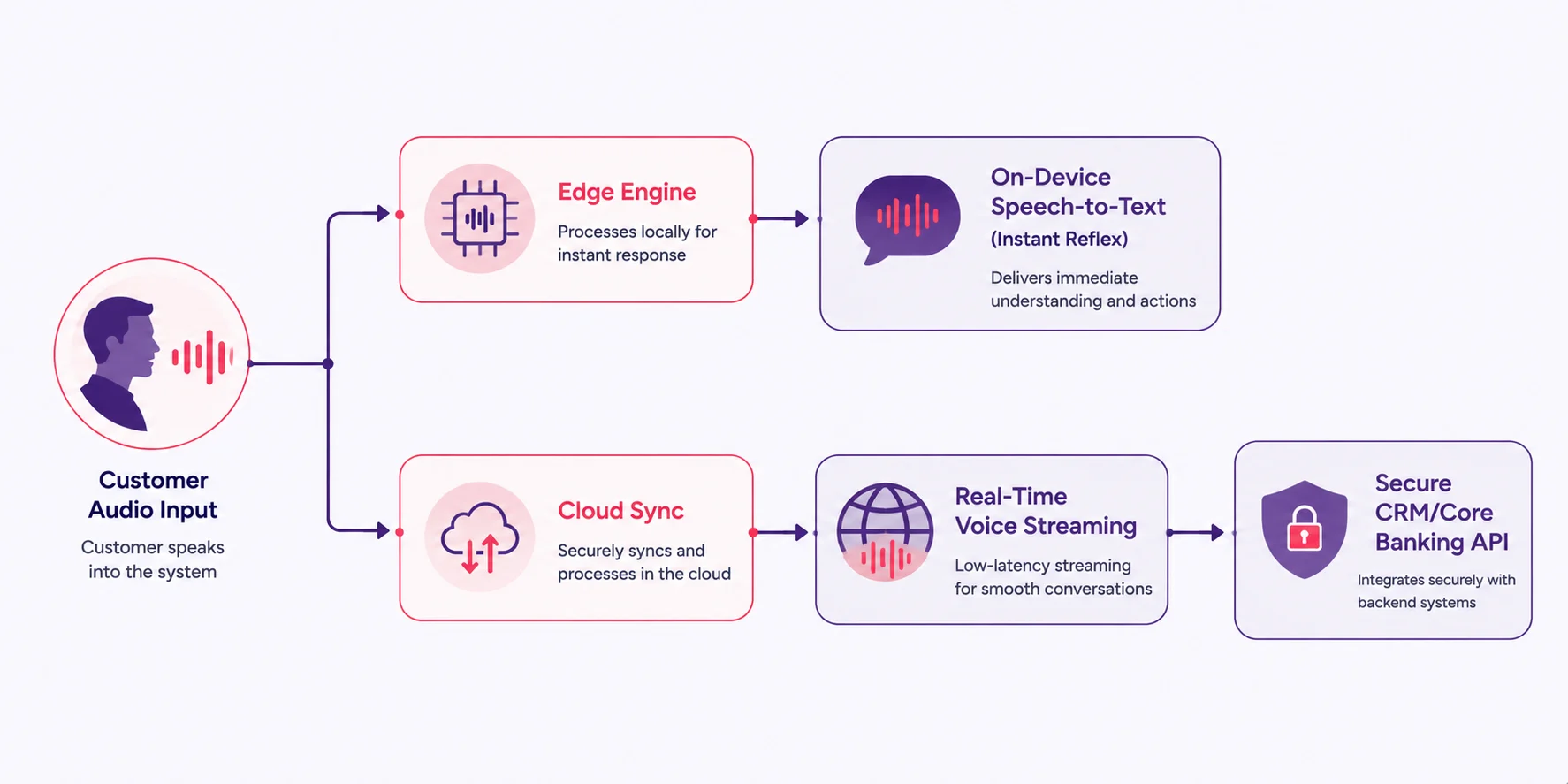
Achieving a natural conversational pace requires breaking the reliance on monolithic cloud workflows. Leading financial operations are moving toward a hybrid model that splits the computational load between local edge processing and secure cloud infrastructure.

Sub Latency

1. Processing via On-Device Speech-to-Text

The first layer of defense against conversational lag happens at the edge. By utilizing optimized, lightweight speech models deployed closer to the ingestion point, the platform executes on-device speech-to-text processing almost instantly.

The system does not wait for a caller to finish a long sentence before analyzing the sound waves. It transcribes individual syllables locally, cutting out the transit time to a remote server and giving the system immediate, low-latency awareness of what the customer is saying.

2. Streamlining with Real-Time Voice Streaming

Once the edge engine captures the initial phonetic tokens, it passes that data upstream using high-speed, real-time voice streaming architectures.

Instead of treating a voice message like a single file upload that needs a clear beginning and end, the system processes the conversation as a continuous, flowing data pipeline. The underlying language models read the text fragments as they stream in, allowing the bank’s core workflow automation engines to prepare responses and pull account balances well before the speaker completes their thought.

Balancing Speed and Enterprise Banking Security

For a modern financial Voice AI platform, speed cannot come at the expense of strict data compliance. The system must maintain near-zero lag while operating under tight regulatory guidelines.

Sub-Second Voice API Execution

To keep total response time safely under the 800-millisecond threshold where human conversations begin to feel disjointed, the platform relies on highly optimized, enterprise-grade sub-second latency voice API endpoints.

These secure connections are built explicitly to handle concurrent webhooks under heavy scale. When a user asks for their available checking balance, the API pulls the specific data chunk from the ledger, confirms identity tags, and formats the output without adding any visible delay to the live interaction.

Zero-Friction Compliance and Data Auditing

While data streams fluidly between the edge and the secure core banking framework, security protocols run in parallel. The hybrid setup ensures that sensitive account numbers, personal PINs, and biometric voice tokens are instantly redacted or tokenized right at the local edge before the transcript files ever write to centralized training logs or external downstream databases. This allows financial institutions to scale up their automated operations while maintaining full compliance with rigorous international banking security laws.

Conclusion: Setting the Pace for Secure Banking

For modern financial organizations, the transition to automated voice assistance cannot be achieved using slow, legacy digital frameworks. When consumer trust and asset protection are on the line, conversational lag is a structural failure point. Adopting a hybrid platform that leverages local speech capture alongside high-speed real-time streaming allows institutions to eliminate the awkward friction that stalls digital customer service channels. By hitting the true sub-second latency baseline, financial brands protect their critical transaction pipelines, maximize operational output, and deliver the clear, lightning-fast assistance modern banking clients expect.

What Rootle Does Differently

Rootle is a voice AI platform built for enterprises that demand more than just automated dialing. While legacy systems stop at playing recordings or basic speech-to-text, Rootle acts as an intelligent extension of your workforce. By combining Agentic AI with real-time system integration, Rootle doesn’t just “talk” to your customers—it executes tasks, resolves queries, and moves the needle on your core business metrics, from DSO reduction to lead conversion.

• Conversational Accuracy: Uses advanced speech processing to interpret complex, unstructured human dialogue rather than relying on rigid keypad menus or static scripts.

• Fluid Multi-Dialect Capabilities: Switches languages and regional accents instantly mid-sentence without dropping the context of the conversation.

• Direct Core System Syncing: Connects natively to enterprise CRMs to log interactions, update custom records, and trigger secondary channels dynamically.

• Rapid Ecosystem Deployment: Integrates through secure APIs using pre-configured, industry-specific compliance templates to go live within a few weeks.

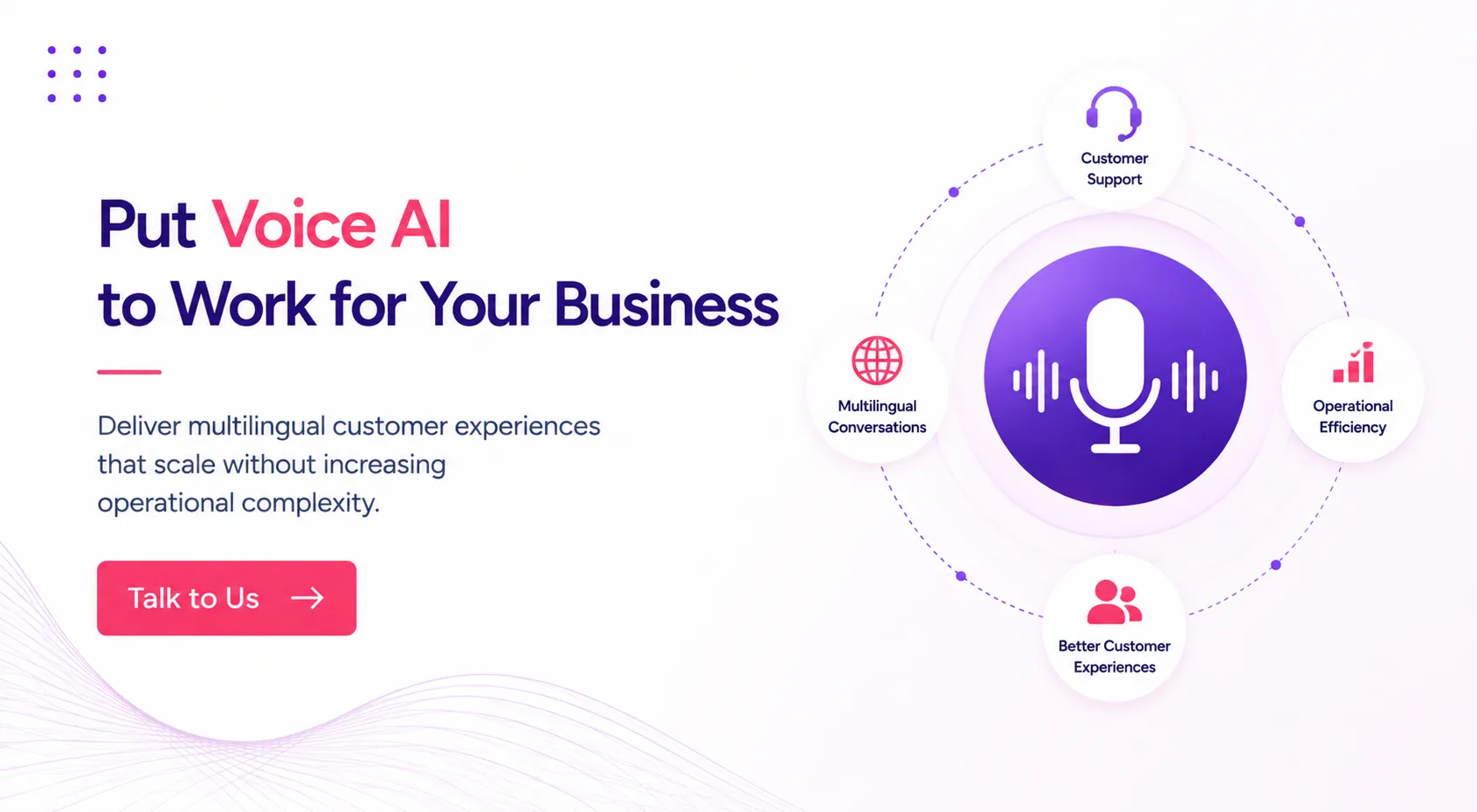
Hero banner promoting Voice AI for business, with a central purple microphone and circular icons for Support, Multilingual Conversations, Operational Efficiency, and Better Customer Experiences.

FAQs: Voice AI Sub-Latency

1. Why is low latency so much more critical for financial institutions compared to standard retail or e-commerce companies?

In standard retail operations, a minor delay during an automated order tracking call is an inconvenience, but it rarely changes the outcome of the transaction. In finance, latency directly impacts transaction security and operational validity.

If a customer calls to freeze an account due to active fraud, any delay during the identification or confirmation phase expands the window of exposure for unauthorized transactions. Furthermore, high latency triggers conversational cross-talk, where the caller and the system speak at the same time, leading to verification errors and broken security authentication inputs.

2. How does a hybrid Voice AI model maintain absolute security compliance if data is processed at the edge?

A hybrid architecture actually improves your security posture by keeping sensitive processing local. Instead of sending raw, unencrypted audio files containing passwords or credit card numbers across public networks to third-party cloud engines, the on-device layer parses the sound locally.

The system instantly cleans, redacts, or encrypts sensitive customer data at the point of capture. Only the clean, anonymized token parameters travel upstream to your secure banking database, ensuring your data transit complies fully with strict global financial privacy mandates.

3. How does Rootle ensure sub-second performance when connecting directly into older legacy core banking software?

Rootle manages legacy integration friction by utilizing an advanced asynchronous middleware architecture. When a customer interaction requires details from an older, slower main banking system, Rootle doesn’t force the voice engine to halt and wait for the query to finish.

Instead, the platform continues to stream the voice interaction naturally, managing the conversational flow with low-latency filler phrasing or context validation while fetching the target database records in the background via secure webhooks, keeping total conversation latency under the critical human threshold.

4. Can Rootle's voice engine accurately verify a customer's identity over the phone using accent-robust speech processing?

Yes. Rootle’s underlying speech processing framework is trained extensively on highly diverse, real-world acoustic datasets. It easily processes varied regional accents, distinct dialects, and mixed-language phrasing without requiring users to speak in an unnatural, overly precise manner.

By combining this accent flexibility with secure, real-time contextual validation against your existing database fields, Rootle confirms who is calling safely and accurately without forcing users through long, frustrating identification scripts.

5. What happens to a hybrid voice call if the customer's cell signal fluctuates or experiences sudden packet loss mid-call?

Rootle is built with highly resilient jitter buffering and real-time audio concealment capabilities designed specifically for unstable mobile networks. If a caller enters a low-signal zone and experiences momentary packet loss, the edge processing layer maintains the call state and keeps context intact.

The system uses advanced speech prediction to fill small audio drops and checks conversation confidence scores continuously. If the signal drops below the minimum required for a safe transaction, the platform elegantly offers to transition the customer to an SMS confirmation link or schedules an automated callback the second network conditions improve.

Rahul Desai
Rahul Desai
Client Growth Manager

Rahul Desai is a client growth and sales professional with extensive experience driving strategic partnerships and revenue growth. At Rootle.ai, he focuses on expanding market reach, enabling enterprises to leverage multilingual voice AI for intelligent customer engagement and automated conversational experiences.

Recent Blogs

The Rise of Multilingual Voice AI: Tamil, Telugu, Marathi and Regional Trends Businesses Need Now
How to Automate Follow-Up Calls With AI (Step-by-Step)