Businesses miss customer calls even with full teams due to call spikes and system limits. Learn how voice AI missed...
29 December 2025
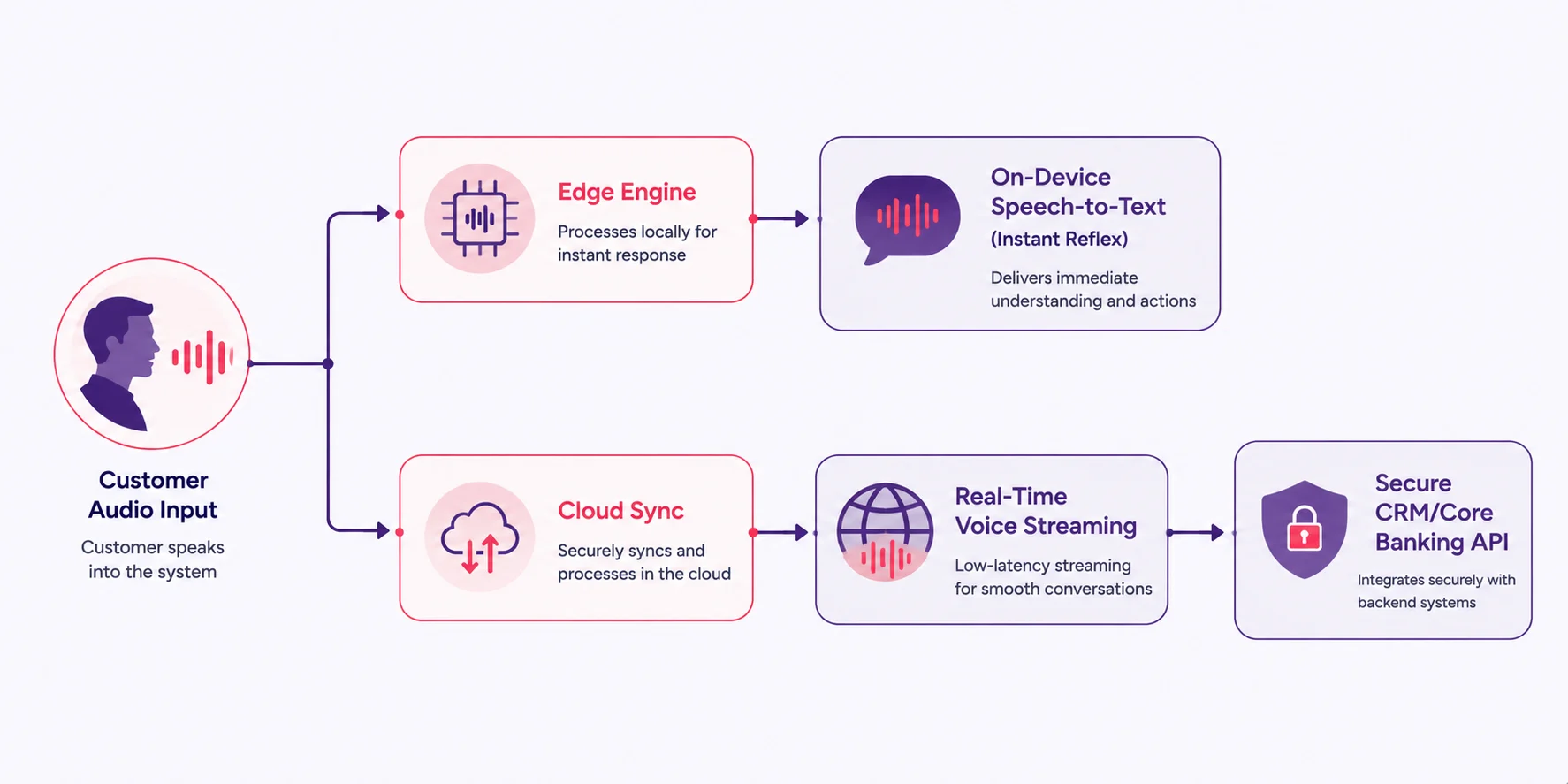
For financial institutions, deploying automated voice systems introduces a strict performance barrier: response latency. Traditional cloud-only setups require sequential processing across multiple remote servers, resulting in multi-second delays that disrupt transaction velocity and compromise fraud-detection workflows. Transitioning to a hybrid Voice AI platform resolves this bottleneck. By processing initial audio inputs locally using on-device speech-to-text algorithms while routing complex data queries through real-time voice streaming architectures, banks achieve the sub-second latency required to protect high-stakes customer interactions and scale high-volume support operations safely.
When a customer calls their bank to report a compromised credit card or authorize an emergency high-value wire transfer, every single second carries profound financial risk. The customer is anxious, the situation is time-sensitive, and the margin for error is absolute.
If that financial institution routes the call to an automated Voice AI for customer support framework that suffers from high latency, the user experience collapses immediately. A two-second pause while a cloud server processes a voice response doesn’t just feel mechanical—it actively creates anxiety. The user assumes the connection has dropped, begins talking over the system, and misses critical verification instructions. In the high-stakes world of banking and wealth management, slow voice response times lead directly to abandoned calls, increased fraud risk, and severely degraded customer retention metrics.
The engineering problem is clear: traditional, cloud-reliant conversational infrastructure is fundamentally too slow to match the natural cadence of human speech. To build a voice channel that customers actually trust with their financial data, institutions must shift toward a hybrid architecture designed to deliver true sub-second latency.
Achieving a natural conversational pace requires breaking the reliance on monolithic cloud workflows. Leading financial operations are moving toward a hybrid model that splits the computational load between local edge processing and secure cloud infrastructure.

For a modern financial Voice AI platform, speed cannot come at the expense of strict data compliance. The system must maintain near-zero lag while operating under tight regulatory guidelines.
For modern financial organizations, the transition to automated voice assistance cannot be achieved using slow, legacy digital frameworks. When consumer trust and asset protection are on the line, conversational lag is a structural failure point. Adopting a hybrid platform that leverages local speech capture alongside high-speed real-time streaming allows institutions to eliminate the awkward friction that stalls digital customer service channels. By hitting the true sub-second latency baseline, financial brands protect their critical transaction pipelines, maximize operational output, and deliver the clear, lightning-fast assistance modern banking clients expect.
In standard retail operations, a minor delay during an automated order tracking call is an inconvenience, but it rarely changes the outcome of the transaction. In finance, latency directly impacts transaction security and operational validity.
If a customer calls to freeze an account due to active fraud, any delay during the identification or confirmation phase expands the window of exposure for unauthorized transactions. Furthermore, high latency triggers conversational cross-talk, where the caller and the system speak at the same time, leading to verification errors and broken security authentication inputs.
A hybrid architecture actually improves your security posture by keeping sensitive processing local. Instead of sending raw, unencrypted audio files containing passwords or credit card numbers across public networks to third-party cloud engines, the on-device layer parses the sound locally.
The system instantly cleans, redacts, or encrypts sensitive customer data at the point of capture. Only the clean, anonymized token parameters travel upstream to your secure banking database, ensuring your data transit complies fully with strict global financial privacy mandates.
Rootle manages legacy integration friction by utilizing an advanced asynchronous middleware architecture. When a customer interaction requires details from an older, slower main banking system, Rootle doesn’t force the voice engine to halt and wait for the query to finish.
Instead, the platform continues to stream the voice interaction naturally, managing the conversational flow with low-latency filler phrasing or context validation while fetching the target database records in the background via secure webhooks, keeping total conversation latency under the critical human threshold.
Yes. Rootle’s underlying speech processing framework is trained extensively on highly diverse, real-world acoustic datasets. It easily processes varied regional accents, distinct dialects, and mixed-language phrasing without requiring users to speak in an unnatural, overly precise manner.
By combining this accent flexibility with secure, real-time contextual validation against your existing database fields, Rootle confirms who is calling safely and accurately without forcing users through long, frustrating identification scripts.
Rootle is built with highly resilient jitter buffering and real-time audio concealment capabilities designed specifically for unstable mobile networks. If a caller enters a low-signal zone and experiences momentary packet loss, the edge processing layer maintains the call state and keeps context intact.
The system uses advanced speech prediction to fill small audio drops and checks conversation confidence scores continuously. If the signal drops below the minimum required for a safe transaction, the platform elegantly offers to transition the customer to an SMS confirmation link or schedules an automated callback the second network conditions improve.