Learn how healthcare leaders use empathy driven Voice AI to reduce patient anxiety, improve clarity, and deliver compassionate care at...
17 January 2026
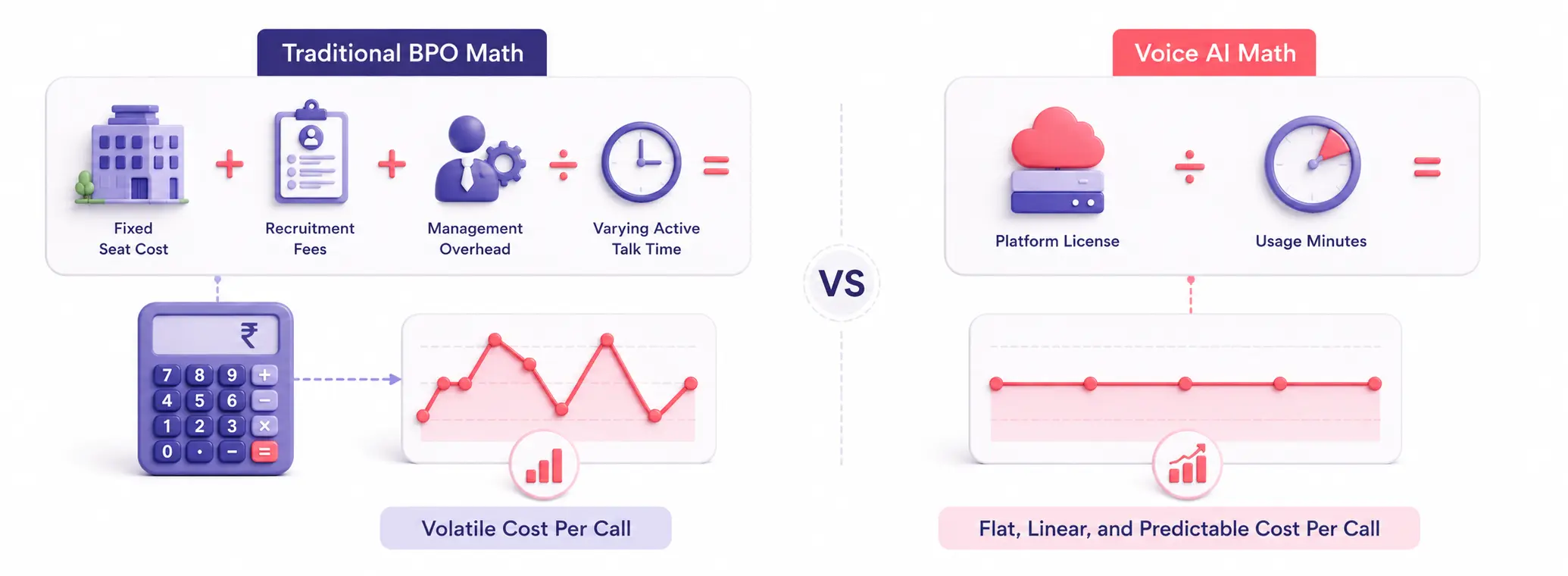
For a generation of operations and customer experience leaders in India, the playbook for handling massive call volumes was simple. You signed a contract with a domestic Business Process Outsourcing (BPO) vendor in a tier-2 or tier-3 city. You negotiated a per-seat or per-minute rate, handed over a training manual, and let them staff the floor.
It was a functional system for its time, but it always carried massive operational friction. Your business paid for agent idle time, absorbed the hidden costs of constant recruitment, and accepted that customer service quality would fluctuate wildly across shifts.
The emergence of sophisticated conversational voice AI platforms changes this calculation entirely. Indian enterprises are no longer just choosing between outsourcing vendors; they are choosing between two fundamentally distinct operational architectures: linear human scaling versus exponential software automation.
Let us break down the actual economics, data structures, and compliance profiles of voice AI vs BPO to see where your operational capital is best spent.
| Performance Metric | Traditional Domestic BPO | Conversational Voice AI |
|---|---|---|
| Call Handling Costs | Baseline Standard | Estimated 80% Reduction |
| Onboarding & Ramp Timeline | 4 – 6 Weeks | 8 – 10 Days |
| Language Adaptability | Limited by specific agent hiring | 20+ Indian languages + Code-switching |
| TRAI Compliance Risk | High (Human error in un-audited calls) | Zero Deviation (100% automated enforcement) |
| Maximum Concurrency Limit | Tied strictly to physical human seats | Infinite cloud scaling on demand |
Modern voice platforms are built around context-aware LLMs that process unstructured human dialogue natively. They are not limited to simple keyword matching or rigid branching trees. The voice agent can follow the natural, non-linear flow of a conversation, remember details mentioned early in the call, handle quick interruptions, and execute deep logical queries. If an Indian consumer switches topics mid-sentence or asks an unscripted question about a product feature, the platform reposition itself smoothly, answers the new query, and returns to its core operational workflow without resetting the call logic.
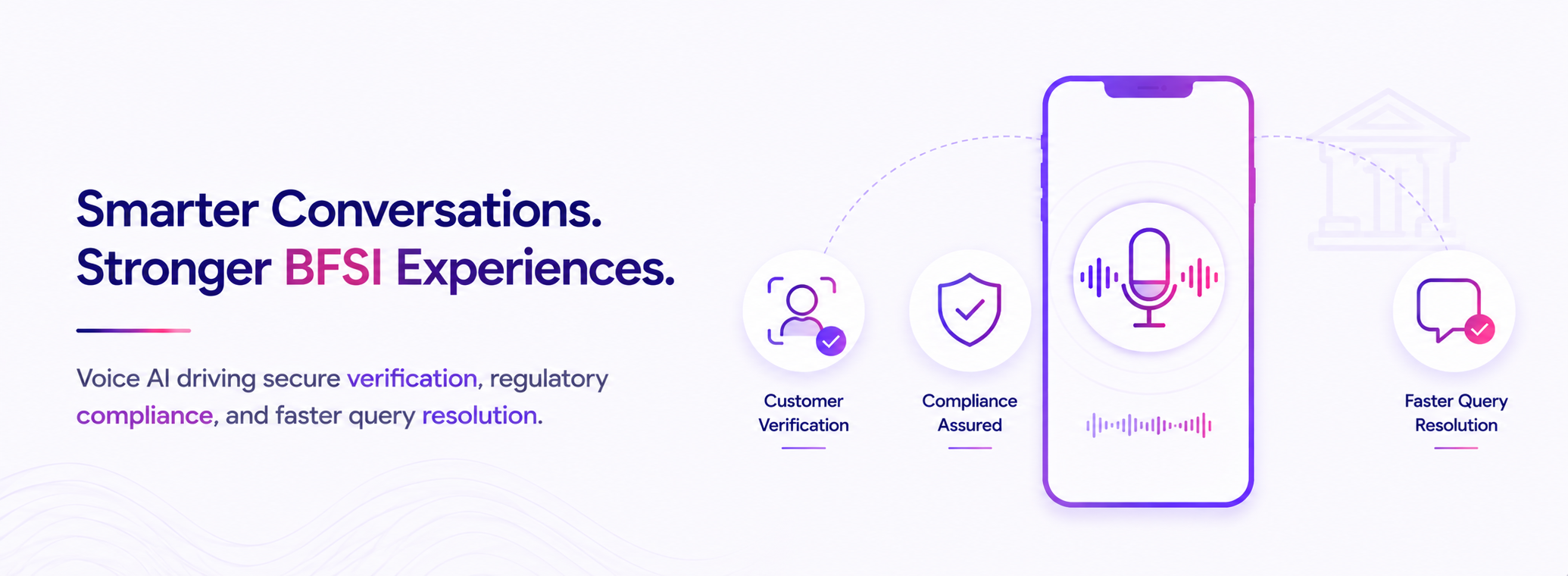
Unlike human BPO agents who might accidentally dial a number on the DND (Do Not Disturb) registry or skip required verification steps, voice AI platforms are integrated directly with central compliance scrubbing engines. Platforms like Rootle are engineered to meet strict TRAI regulations, ensuring that explicit user consent is verified, time-window restrictions for commercial calls are strictly honored, and precise digital headers are used. Because every call flow is hardcoded to follow regulatory boundaries, your business eliminates the risk of heavy telecom penalties and brand damage.
Rootle prioritizes strict data isolation by implementing enterprise-grade security protocols across all calling channels. The platform runs on a SOC 2 Type II compliant framework and aligns with domestic data localization guidelines. When a voice agent calls a customer to confirm an EMI payment or verify a loan application, sensitive financial fields are masked before they ever reach the analytical layers. Rootle handles interactions seamlessly without saving sensitive personal data on vulnerable public nodes, passing transaction details safely to your secure internal databases via encrypted API webhooks.
Rootle uses built-in sentiment analysis engines that measure voice pitch, speech velocity, and specific phrasing choices to gauge user frustration in real time. If the platform hits a confidence threshold indicating the caller is getting confused, or if the user explicitly requests human intervention, it triggers an intelligent live transfer. The system connects the call directly to your internal human team via standard SIP trunk routing, passing along the full live transcript and CRM record so your human representative can take over without forcing the client to state their issue all over again.
You do not need to rewrite your enterprise software, buy expensive telephony hardware, or hire specialized developers. Rootle functions as a low-code, fully managed overlay system that plugs directly into your existing operational infrastructure via cloud APIs. The platform connects smoothly with leading CRMs like Salesforce, HubSpot, and Zoho, alongside standard applicant tracking systems (ATS) used by HR teams. It provisions virtual telephone numbers instantly, allowing you to route high-volume traffic to automated workflows without disturbing your current business operations.