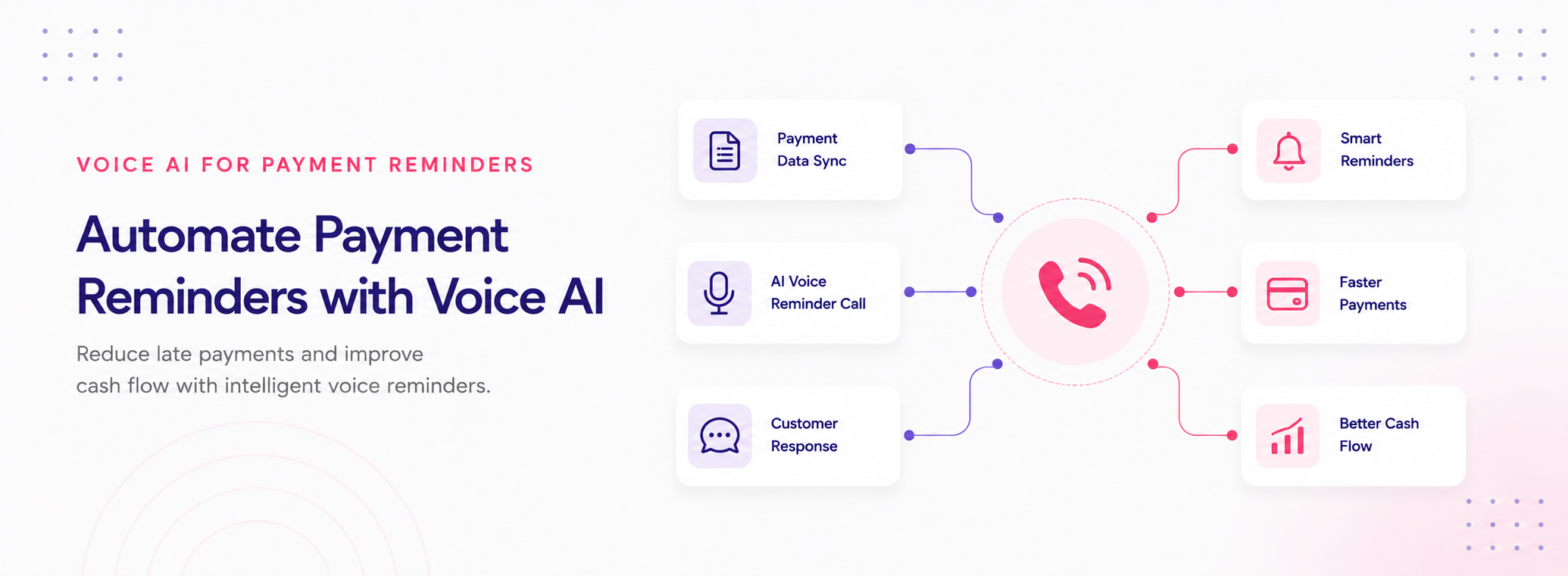


Executive Summary
India has one of the largest lending markets in the world. And one of the most persistent collection problems. Banks, NBFCs, and fintech lenders manage millions of active loan accounts. EMI due dates arrive every month. Reminder calls still largely depend on human agents. Voice AI for payment reminders changes that equation entirely. Not by removing the human relationship, but by handling the volume that humans simply cannot.
What this blog covers:
- Why manual reminder calls do not scale in India's lending and billing environment
- What payment reminder automation actually does and how it works
- How multilingual voice AI handles the language diversity across Indian states
- What automated EMI reminder calls in India look like at the workflow level
- Which sectors benefit most from collection automation with voice AI
- What to look for when evaluating an AI for payment reminders platform
- How Rootle enables automated payment reminder calls at scale
In India, the gap between when an EMI is due and when a customer actually pays it often comes down to one thing: did they get a clear, timely reminder? That reminder has historically come from a human agent. Someone reading from a script, dialing from a list, logging outcomes by hand. At small volumes, it works. At the scale of India's lending and billing sector, it does not.
The Problem With Manual Payment Reminder Calls in India
India's lending sector is not a niche industry. The country has over 10,000 registered NBFCs. The banking sector manages hundreds of millions of active loan accounts. Add consumer durables financing, two-wheeler loans, personal loans, credit cards, and utility bill payments. The reminder call volume becomes staggering. Manual calling breaks in four specific ways at that scale.
What Voice AI for Payment Reminders Actually Does
Voice AI for payment reminders is not an IVR system with better audio. The distinction matters. IVR systems broadcast information. Voice AI conducts conversations. The difference in outcome is real.
| Scenario | IVR Response | Voice AI Response |
|---|---|---|
| "I already paid yesterday" | Message plays to completion. No capture. | Acknowledges the statement, logs a payment dispute for review. |
| "I can pay next week" | No recognition. Call ends or loops. | Captures the commitment, confirms the date, schedules a follow-up call. |
| "What happens if I miss the date?" | Not handled. Escalates or drops. | Answers in the borrower's language, without involving a human agent. |
That is the core value of payment reminder automation: it converts a broadcast into a dialogue, at scale, with every borrower on the list.
This same ability to understand intent rather than just play a script is what makes voice AI for customer support effective outside collections too. Whether the call is about a due EMI or a service query, the underlying conversational engine is the same: listen, understand, respond, and log the outcome.
How Multilingual Voice AI Handles India's Language Reality
India's linguistic diversity is not a footnote for lenders. It is an operational reality. A borrower in Chennai receiving a payment reminder in Hindi does not become more likely to pay. They become more likely to disconnect.
Multilingual AI for payment reminders in India works through two core mechanisms.
The languages that matter most for automated EMI reminder calls in India: Hindi, Tamil, Telugu, Marathi, Kannada, Bengali, Gujarati, Malayalam, Odia, and Punjabi. A platform that covers only Hindi and English is not built for India's lending geography. It is built for its metros.
The Workflow: How Automated EMI Reminder Calls Work in Practice
Deploying voice AI for payment reminders needs three things: a configured calling workflow, a connected data source, and a compliance-checked contact list. Here is what a standard automated EMI reminder call workflow looks like from start to finish.
The Numbers: What Manual vs. Automated Reminder Calls Cost
| Metric | Manual Calling | Voice AI Automated Calling |
|---|---|---|
| Calls per day | 60–80 per agent | 500–5,000+ |
| Language coverage | Depends on agent hiring | 10+ Indian languages |
| Peak load handling | Fixed headcount | Scales on demand |
| Outcome logging | Manual, delayed | Automated, real-time |
| Cost per call | ₹15–₹35 (fully loaded) | ₹1–₹5 |
| Availability | Business hours | Configurable time windows |
| Compliance documentation | Incomplete | Automated call logs |
The cost gap is not marginal. For a lender making 50,000 reminder calls per month, the difference between ₹25 and ₹3 per call is ₹11 lakh per month. That is before accounting for staffing costs, attrition-driven retraining, and floor supervision that manual call centres require.
"When a borrower misses an EMI not because they intended to default but because no one reached them clearly, the loss belongs to the process. Collection automation with voice AI closes that gap."
Which Sectors Need Voice AI for Payment Reminders Most
The highest-impact deployments share two things: high outbound call volume and a borrower base too geographically and linguistically diverse to reach consistently with manual calling.
What Good Voice AI for Bank Collections Looks Like
Not every voice AI platform is built for the collections and payment reminder context. These are the capabilities that separate a platform worth deploying from one that will generate complaints.
Common Mistakes When Deploying Voice AI for Payment Reminders
Most deployment failures are avoidable. They follow a recognisable pattern. Not technical errors, but process gaps that compound as call volume scales.
Rootle: Voice AI Built for Indian Payment Reminder Workflows
Deploying voice AI for payment reminders in India means thinking about language coverage, TRAI compliance, CRM integration, and call volume from the very start. Rootle is built for exactly that operational context.
Rootle: Voice AI Built for Customer Communication in India
Rootle is a Voice AI platform for banks, NBFCs, fintech lenders, and billing businesses that need to reach borrowers at scale. Whether the use case is EMI reminders, bill payment follow-ups, or collections outreach, Rootle is built with the Indian regulatory and language context in mind.
Key capabilities include:
- Multilingual voice AI for payment reminder calls across India: Hindi, Tamil, Telugu, Marathi, Kannada and more
- Configurable EMI reminder and billing workflows per loan type, billing cycle, and portfolio segment
- Real-time CRM and LMS integration with outcomes logged automatically and no manual entry
- DND-compliant call infrastructure with 1600-series number support and full call log documentation
- Escalation routing to human agents for high-value or late-stage accounts
The Bigger Picture
India's lending sector has a structural reminder problem. Not because lenders do not want to reach borrowers. Because the volume, the language diversity, and the cost economics of manual calling make consistent outreach impossible at scale.
A borrower who misses an EMI because no one reached them clearly is not a defaulter. They are a customer who fell through a process gap. The cost shows up in NPA rates, collections costs, and customer relationships that deteriorate for a completely avoidable reason.
Voice AI for payment reminders addresses that gap. Not by replacing the human element of collections, but by ensuring the routine, high-volume, multilingual reminder work gets done consistently, at the scale that human agents cannot sustain.
Lenders that deploy collection automation with voice AI well will not just cut costs. They will see better early payment rates, stronger borrower experience, and portfolio visibility that manual processes never delivered. The ones that keep scaling human call centres to manage reminder volume will keep paying the compounding cost. More agent salaries, more missed contacts, more NPA accounts that a timely reminder might have prevented.
FAQs: Voice AI for Payment Reminders in India
1. What is voice AI for payment reminders?
Voice AI for payment reminders is an automated calling system that contacts borrowers or customers about upcoming or overdue payments using conversational AI, not static IVR messages. Unlike a broadcast system, it conducts a real dialogue. It responds to borrower inputs, captures commitments or disputes, answers common questions, and logs outcomes directly into the lender's CRM. The key difference from manual calling is scale: a voice AI system places thousands of personalised calls per day without adding headcount.
2. How does multilingual voice AI work for Indian languages?
Multilingual AI for payment reminders in India detects or loads the borrower's preferred language from the CRM record, then conducts the entire call in that language. Good platforms train on regional language variants, not just standard Hindi or textbook Tamil, which improves comprehension in real borrower interactions. Core languages for Indian payment reminder automation include Hindi, Tamil, Telugu, Marathi, Kannada, Bengali, Gujarati, and Malayalam.
3. Are automated EMI reminder calls in India legal?
Yes. Automated EMI reminder calls are legal in India when placed in compliance with TRAI's TCCCPR framework. Key requirements: use a registered 1600-series number for service calls, scrub the contact list against the DND registry before every campaign, hold valid consent records, and maintain call logs. Calls with any promotional or upsell content must be classified and handled separately as Promotional calls. A voice AI platform deployed for payment reminders must support these compliance workflows natively.
4. What is the difference between voice AI for payment reminders and an IVR system?
An IVR plays pre-recorded messages and offers fixed menu options. It broadcasts. A voice AI listens and responds. It can understand "I already paid this morning" and log a payment dispute. It can understand "I'll pay on Friday" and schedule a follow-up. It can answer "What is my outstanding balance?" without a human agent. An IVR delivers a message. A voice AI completes an interaction.
5. How do I integrate voice AI for bank collections with our existing LMS or CRM?
Most enterprise-grade voice AI platforms for payment reminders offer API-based integration with loan management systems and CRM platforms. The integration covers pushing borrower data and EMI details into the voice AI for call personalisation, and pulling call outcomes back into the LMS or CRM in real time. Before selecting a platform, verify the integration method (REST API, webhook, or native connector), data latency, and whether the platform supports your specific LMS.
6. Which sectors benefit most from voice AI for bill payment reminders in India?
The highest-impact deployments are in NBFCs and microfinance institutions with high volume and multilingual borrower bases, retail banking for personal loan and credit card EMI reminders, consumer durables and two-wheeler finance where call cost is material, utility billing with large monthly customer bases, and insurance premium reminders where a missed call can result in policy lapse. Any business with recurring payment obligations and a customer base too large to reach consistently with manual calling is a candidate for payment reminder automation.
7. Can voice AI handle borrowers who say they cannot pay or want to negotiate?
Yes, within defined parameters. Collection automation with voice AI can be configured to handle common borrower responses: payment already made, request for extension, partial payment offer, dispute over amount. For responses outside those parameters such as complex negotiations, legal disputes, or significant hardship cases, the voice AI escalates to a human agent. The escalation logic should be configured before deployment. The goal is to automate the majority of routine interactions while routing exceptions to the right people.

Rootle is inexpensive, simple to start and easy to use.