Skip to content

Top 7 Voice AI Platforms for EdTech Businesses

Featured Image

Executive Summary

The EdTech industry is moving rapidly toward autonomous, conversational Voice AI Platforms. As institutions struggle with peak admission call floods, high lead decay rates, and multilingual student queries, voice AI agents offers 24/7 automated resolution for course inquiries, eligibility checks, counseling bookings, and fee reminders.

Selecting the right platform depends on your operational priorities. While developer APIs like Retell AI or Vapi offer custom coding flexibility, enterprise Conversational OS platforms like Rootle lead the market by combining sub-300ms latency, 20+ Indian languages and code-switching capabilities, deterministic zero-hallucination execution, and native regulatory compliance, turning high-volume inbound calls into enrolled students.

Phone calls remain one of the most critical touchpoints in the education sector. From student admission inquiries and course counseling to fee reminders and parent communication, high-friction call queues lead to lost enrollments.

Modern Voice AI Platforms are transforming how educational institutions, online learning platforms, and test-prep academies engage students. By integrating directly with Student Information Systems (SIS) and CRMs, speaking naturally in dozens of regional languages, and handling high-volume admission spikes, Voice AI helps EdTech platforms answer queries, qualify prospective students, and book counseling sessions 24/7.

Here is a breakdown of the Top 7 Voice AI Platforms for EdTech Businesses, evaluated on conversational latency, CRM integration, vernacular language capabilities, and enrollment impact.
AI Calling software - Demo

1. Rootle (Best Overall for Enterprise EdTech & High-Volume Admissions)

Rootle stands out as the premier enterprise Conversational OS engineered specifically for high-volume student acquisition, admission counseling, and student support.

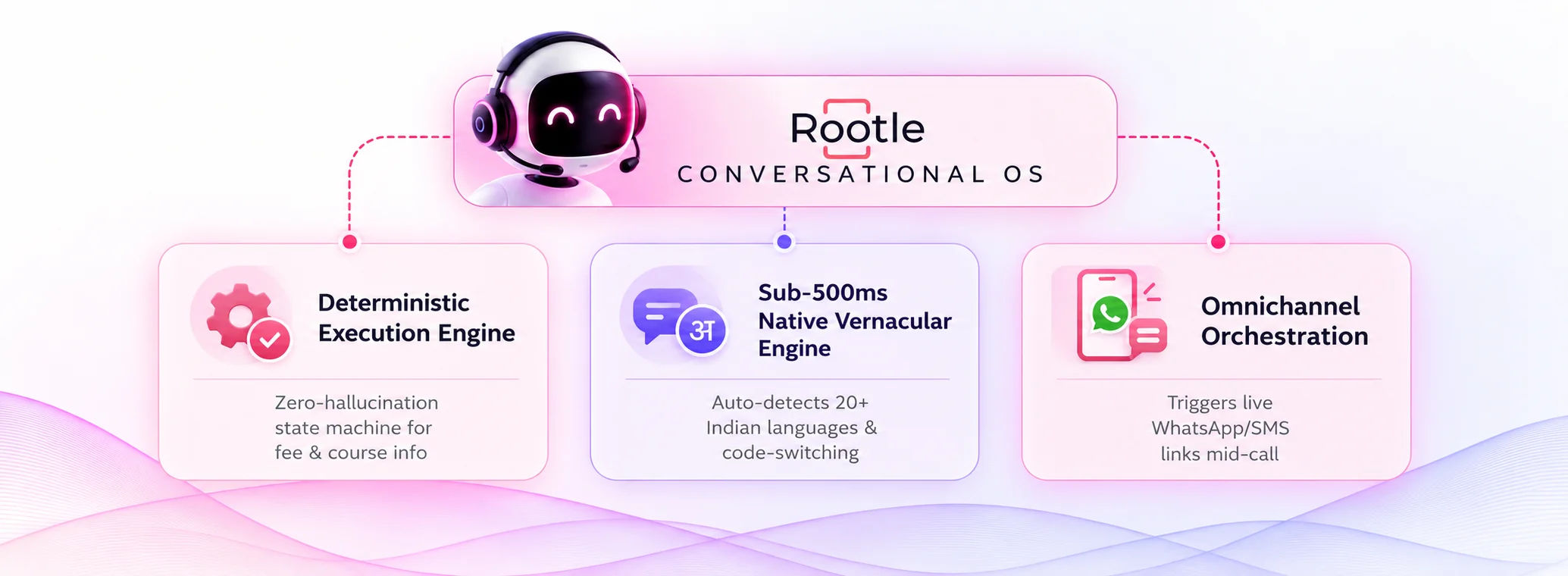
While generic voice bots rely on unpredictable LLM responses, Rootle operates on a KPI-first, deterministic execution engine. This ensures that critical education workflows—such as fee structure disclosures, eligibility checks, exam schedule updates, and counseling slot bookings—are executed with zero hallucination risk and complete policy adherence.

Key Strengths & Capabilities:

• Sub-500ms Latency & Vernacular Code-Switching: Built for diverse student demographics across Tier-1 to Tier-4 regions, Rootle auto-detects and processes 20+ languages and regional code-switched dialects (like Hinglish, Tanglish, and Gujlish) with sub-second response times and natural interruption handling.

• Instant CRM & SIS Integration: Connects seamlessly via secure REST/gRPC APIs into core EdTech CRMs (LeadSquared, Salesforce Education Cloud, ExtraaEdge, Zoho) to update lead cards, verify student IDs, and log interview slots in real time.

• Omnichannel Thread Continuation: Rootle seamlessly bridges voice calls with messaging. During an admission counseling call, Rootle can dispatch an instant WhatsApp prospectus link, fee payment URL, or campus map while remaining on the line to confirm receipt.

• TRAI & Regulatory Compliance: Outbound admission follow-ups, fee reminder calls, and webinar invites are natively routed over official commercial headers (1600/1601 series in India), protecting institute phone numbers from spam tagging.

Best For: K-12 platforms, test-prep institutes, vocational training centers, and enterprise online learning platforms looking for end-to-end admission automation.

Here’s How Aptech Connected 84% of Its Leads During Peak Admissions Season with Rootle Voice AI

2. Retell AI (Best for Developer-Led Custom Workflows)

Retell AI provides developer-first voice infrastructure, allowing engineering teams in EdTech startups to build custom student-facing voice workflows from scratch.

Key Capabilities:

• Ultra-low latency voice processing pipeline.

• Flexible API endpoints for custom LLM, ASR, and TTS engine integration.

• Fine-grained control over call flows, state transitions, and Webhooks.

Best For: Tech-first EdTech companies wanting custom code control over their voice agent architecture.

3. PolyAI (Best for Global Higher Education & Universities)

PolyAI specializes in enterprise-grade voice automation built to handle high call center volumes for large universities and international educational institutions.

Key Capabilities:

• Handles complex identity verification, course eligibility checks, and international student inquiries over the phone.

• Enterprise CRM and contact center integrations (Genesys, Salesforce, NICE).

• High concurrency handling for seasonal admission surges (e.g., results day or intake deadlines).

Best For: Large universities and international higher-education conglomerates.

4. Cognigy (NICE) (Best for Unified Student Support Centers)

Cognigy provides robust voice gateway capabilities alongside text-based automation across 100+ languages, serving unified student service centers.

Key Capabilities:

• Built-in voice gateway connecting to traditional PBX and cloud telephony.

• Graphical conversation flow designer with deep enterprise integration nodes.

• Real-time human counselor escalation with pre-populated student context.

Best For: Established educational institutions operating centralized contact center environments.

5. Vapi AI (Best for In-App AI Tutors & Practice Bots)

Vapi AI is an API-first platform that lets developers assemble custom voice agents by bringing their own LLMs, speech-to-text (ASR), and text-to-speech (TTS) providers.

Key Capabilities:

• Modular architecture (mix-and-match models like OpenAI, Deepgram, and ElevenLabs).

• WebRTC support for in-app or browser-based voice learning tools.

• Pay-per-minute developer pricing model.

Best For: Product teams building interactive voice tutors, language learning apps, or mock interview bots.

6. ElevenLabs Conversational AI (Best for Realistic AI Instructors)

ElevenLabs offers a conversational agent framework that brings realistic human prosody and voice cloning to educational voice interactions.

Key Capabilities:

• Highly expressive, natural synthetic voice output.

• Custom brand voice cloning to match faculty or celebrity educators.

• Multilingual voice synthesis across 29+ languages.

7. Bland AI (Best for Automated Outbound Admission Campaigns)

Bland AI is built for high-volume, automated outbound phone campaigns, enabling EdTech marketing teams to run large-scale phone outreach programmatically.

Key Capabilities:

• Rapid deployment of large-scale outbound calling campaigns.

• Automated lead re-engagement for unbooked counseling sessions.

• Integration with marketing automation stacks for trigger-based calling.

Best For: EdTech sales teams running aggressive outbound verification and lead follow-up campaigns.

Conclusion: Choosing the Right Voice AI Platform for EdTech

By unifying deterministic state control, sub-300ms vernacular speech processing, and deep CRM integration, Rootle enables educational institutions to automate high-volume student interactions with absolute precision. Moving beyond rigid IVR trees and slow lead response cycles allows EdTech platforms to eliminate operational bottlenecks, capture unserved student demand across regional markets, and drive predictable, scalable enrollment growth.

Hero banner promoting Voice AI for business, with a central purple microphone and circular icons for Support, Multilingual Conversations, Operational Efficiency, and Better Customer Experiences.

What Rootle Does Differently

Rootle is a voice AI platform built for enterprises that demand more than just automated dialing. While legacy systems stop at playing recordings or basic speech-to-text, Rootle acts as an intelligent extension of your workforce. By combining Agentic AI with real-time system integration, Rootle doesn’t just “talk” to your customers—it executes tasks, resolves queries, and moves the needle on your core business metrics, from DSO reduction to lead conversion.

• Conversational Accuracy: Uses advanced speech processing to interpret complex, unstructured human dialogue rather than relying on rigid keypad menus or static scripts.

• Fluid Multi-Dialect Capabilities: Switches languages and regional accents instantly mid-sentence without dropping the context of the conversation.

• Direct Core System Syncing: Connects natively to enterprise CRMs to log interactions, update custom records, and trigger secondary channels dynamically.

• Rapid Ecosystem Deployment: Integrates through secure APIs using pre-configured, industry-specific compliance templates to go live within a few weeks.


FAQs: Voice AI platform for EdTech

1. How do Voice AI platforms help EdTech businesses increase student enrollments?

Voice AI platforms eliminate lead response delays by answering inbound calls instantly or making automated callbacks within seconds of a webform submission. They qualify prospective students, answer course and fee queries, and book counseling sessions directly on admission reps’ calendars 24/7.

2. Can Voice AI agents integrate with specialized EdTech CRMs like LeadSquared or ExtraaEdge?

Yes. Enterprise Voice AI platforms connect directly to EdTech CRMs and Student Information Systems (SIS) via REST and gRPC APIs. They automatically update lead stages, retrieve student records, log conversation summaries, and trigger follow-up tasks in real time.

3. How do Voice AI agents handle multilingual student inquiries in India?

Advanced voice engines use specialized Automatic Speech Recognition (ASR) models trained on regional accents and mixed-language speech (such as Hinglish, Tanglish, or Gujlish). Multilingual Voice AI auto-detect the caller’s language dynamically and process multilingual phrasing mid-sentence without requiring menu resets.

4. How does Voice AI prevent giving incorrect fee structure or eligibility information?

Enterprise platforms like Rootle use deterministic state machine logic. While the system understands natural speech flexibly, all factual disclosures (such as fee structures, refund policies, and admission deadlines) adhere to pre-validated business rules, eliminating hallucination risks.

5. Are outbound Voice AI calls for fee reminders and admission updates compliant with telecom regulations?

Yes. Enterprise Voice AI platforms ensure compliance with regional telecom guidelines, such as TRAI’s TCCCPR rules in India (routing calls over official 1600/1601 series headers with DLT registrations) or STIR/SHAKEN globally—protecting institutional phone numbers from spam tagging.

Devansh Mehta is a Solutions Consultant experienced in AI-driven customer communication and voice automation. Skilled in solution discovery, client relationships, onboarding, workflow optimization, and scalable customer support, with a focus on conversational technology and digital transformation.

Talk to our Experts

Recent Blogs

Neon pink microphone icon on the left connected by a glowing pink waveform to a circular sound icon on the right, in a futuristic hall setting.
How Voice AI Delivers Faster ROI Than Chatbots