Skip to content

How Voice AI Agents for Automotive Automate High-Volume Maintenance Scheduling

Featured Image

Executive Summary

Fixed operations generate the highest profit margins for automotive dealerships, original equipment manufacturers (OEMs), and service chains. However, the traditional service scheduling process faces a persistent operational bottleneck: morning call spikes. Service advisors are repeatedly pulled away from physical customers on the service drive to answer basic phone inquiries regarding oil changes, tire rotations, brake replacements, and safety recalls. During peak hours, call abandonment rates frequently surpass 20% to 30%, directing high-margin maintenance revenue straight to competing independent garages.

Deploying Voice AI Agents for Automotive service management fundamentally restructures these unit economics. By replacing rigid touch-tone phone trees with natural, conversational Voice AI bots, auto groups can automate maintenance scheduling at unlimited concurrency. These automobile voice bots interface directly via APIs into enterprise Dealership Management Systems (DMS) and online scheduling software (such as CDK Global, Reynolds & Reynolds, Dealertrack, and Xtime). The result is a 24/7 automated service access center that captures lost appointments, verifies Vehicle Identification Numbers (VINs), offers loaner vehicles, and slashes administrative phone overhead by up to 70%.

AI Calling software - Demo

In high-volume auto dealerships and service networks, phone lines flood between 7:30 AM and 10:00 AM as drivers attempt to schedule maintenance or inquire about vehicle status.

The Cost of Abandoned Service Calls

A dealership facility receiving 4,000 service-related inbound calls monthly experiences an average 30% call drop-off rate during peak windows.

• 1,200 calls are dropped before reaching a service advisor or receptionist.

• Assuming an average Repair Order (RO) value of ₹3,500 (combining routine PMS, wheel alignment, and minor repairs) and a 60% booking intent rate:

• Monthly Uncaptured Revenue: 720 unbooked repair orders × ₹3,500 = ₹25,20,000 (₹25.2 Lakhs) per month in lost gross service revenue.

High Cost of Manual Scheduling Operations

Having a service advisor spend 5 minutes on the phone confirming basic details—such as vehicle odometer reading, checking calendar openings, and taking customer contact information—costs between ₹40 and ₹120 per completed phone booking when factoring in salary, seat cost, and facility overhead.

Idle Bay Capacity from Manual Errors

Human scheduling errors, double-booking, or failing to properly estimate job duration (e.g., booking a major 40,000 km service in a 30-minute express service lane) lead to shop floor bottlenecks and unutilized technician hours.

How Voice AI Agents for Automobiles Automate the Scheduling Flow

Deploying specialized Voice AI Agents replaces friction-heavy manual phone calls with natural, multi-turn voice dialogues that run on autopilot across multiple languages.
HTML Table Generator
Operational Metric
Manual / Interactive Voice Response (IVR)
Voice AI Agents for Automobile
Booking Cost ₹40 – ₹120 per booking ₹4 – ₹12 per booking 80%+ direct overhead reduction
Concurrency Limited by landlines / advisor seats Infinite elastic scaling Infinite elastic scaling
Service Bay Allocation Manual estimation prone to overlaps Automated slot duration & bay capacity matching
Optimized technician utilization & zero double-booking
Data Verification Manual registration entry (typo-prone) Automated voice-to-text plate/VIN lookup & history match 100% accurate vehicle record matching
After-Hours Booking Unanswered calls / Voicemail 24/7/365 instant interactive booking Captures off-hour bookings (up to 30% of total)

Technical Integration: Connecting Voice AI Bots to Enterprise DMS Systems

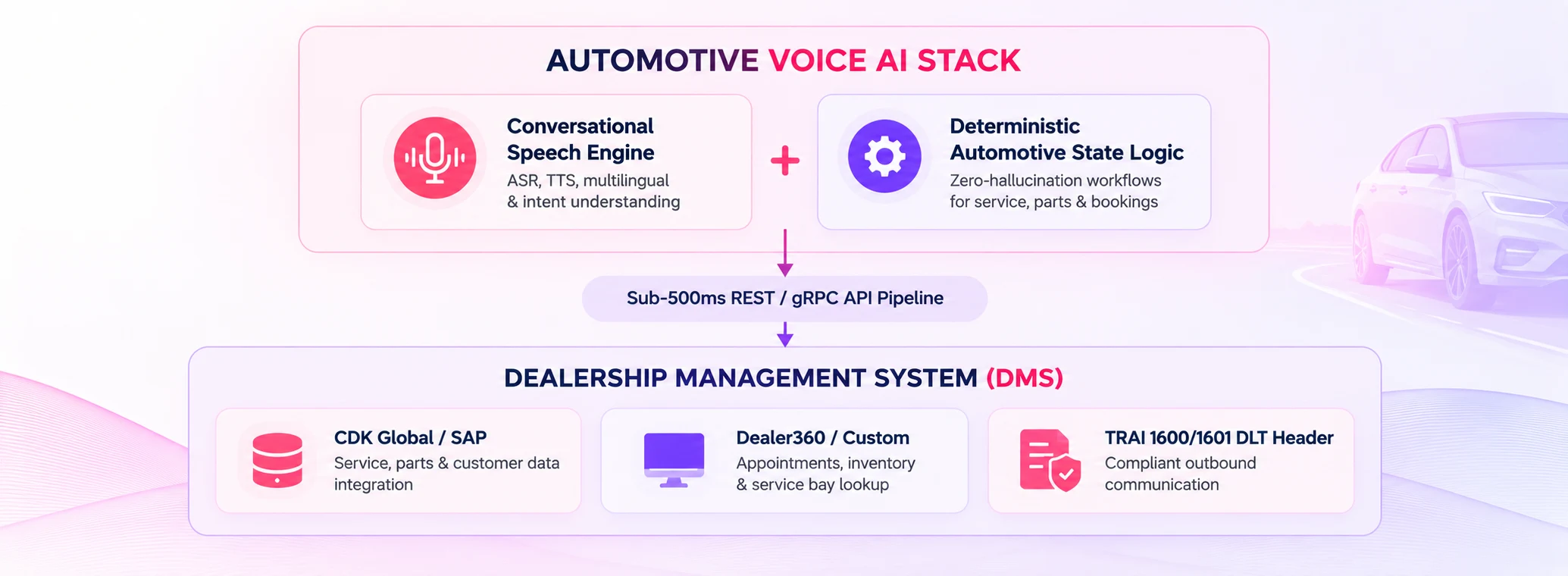
To handle high-volume maintenance scheduling, Conversational Voice AI bots must do more than recite script templates. They require deep, low-latency API integration with the dealership’s core technology stack and telecom compliance networks.
Real-Time Service Bay & Technician Capability Matching

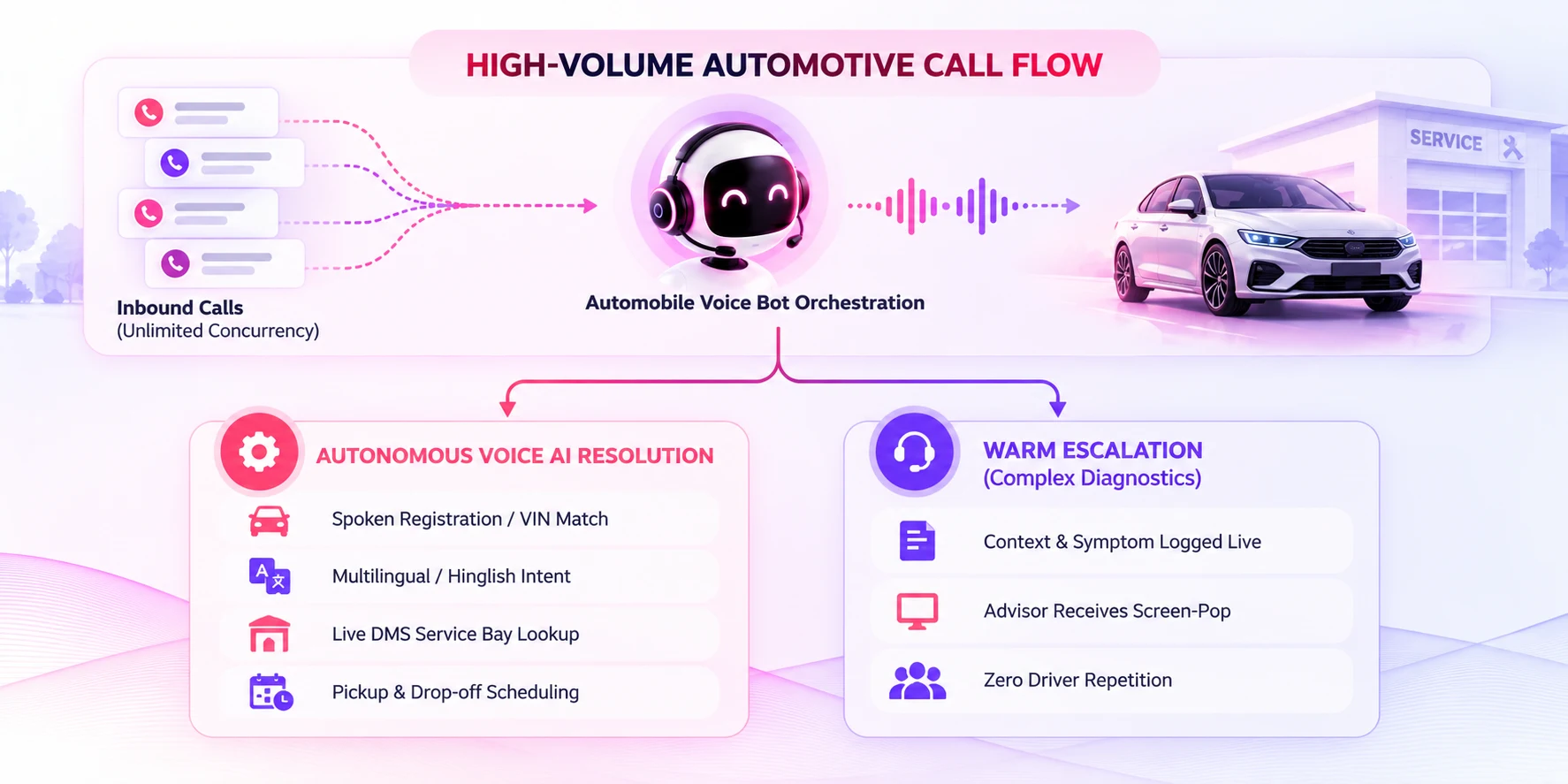
Not all service bays process every repair type. A routine express service takes 45 minutes in a dedicated bay, whereas an engine overhaul or EV battery diagnostic requires specialized technicians and diagnostic tools. Automobile voice bots query the DMS in real time to match the requested maintenance service with available technician skill sets, labor time constraints, and lift availability before offering open time slots to the vehicle owner.

Spoken Registration/VIN Lookup & Recall Cross-Checking

When a customer calls, the Voice AI Agents verify the vehicle’s identity using caller ID or by asking for the vehicle registration number (e.g., MH 02 CL 1234) or VIN. The AI parses the spoken alphanumeric string, pulls the vehicle’s service history from the DMS, and checks national recall databases. If an open manufacturer safety recall exists, the AI proactively informs the caller: “I see there is an open manufacturer recall for your vehicle’s brake inspection. Would you like me to add that free inspection to your service appointment today?”

Pickup & Drop-Off Service Coordination

In urban Indian markets, door-step vehicle pickup and drop-off is a key driver for customer retention. The AI voice agent assesses driver availability and location coverage. If a customer requests home pickup, the AI verifies pincode serviceability, confirms the preferred time slot, and logs the driver assignment directly into the workshop schedule.

TRAI & DPDPA Telecom Compliance

Outbound appointment reminders, pickup notifications, and backfill offers are natively routed over official commercial headers (1600/1601 series in India) with pre-registered Distributed Ledger Technology (DLT) templates. This prevents customer-facing calls from being flagged as spam by caller-ID applications, ensuring high answer rates.

Hero banner promoting Voice AI for business, with a central purple microphone and circular icons for Support, Multilingual Conversations, Operational Efficiency, and Better Customer Experiences.

Real-World Case: Scaling Fixed-Ops Performance

Consider a major auto dealership group operating 14 workshop locations across North India, receiving over 50,000 inbound service calls monthly:

• Before Voice AI Deployment: The group managed a centralized 30-agent tele-calling team handling service scheduling and status inquiries. Morning peak-hour call abandonment hovered at 26%, resulting in an estimated ₹18 Lakhs in lost monthly service orders.

• After Deploying Voice AI Agents for Automobile Operations: Modern Voice AI Agents were configured to handle all inbound service scheduling calls across Hindi, English, and Hinglish, integrated directly with their central DMS platform.

• The Result: The AI agents autonomously booked 76% of all routine maintenance appointments without human intervention. Average speed-to-answer dropped to under 1 second, call abandonment fell to near zero, and fixed-ops monthly revenue increased by 21% through captured after-hours bookings and automated recall add-ons.

What Rootle Does Differently

Rootle is a voice AI platform built for enterprises that demand more than just automated dialing. While legacy systems stop at playing recordings or basic speech-to-text, Rootle acts as an intelligent extension of your workforce. By combining Agentic AI with real-time system integration, Rootle doesn’t just “talk” to your customers—it executes tasks, resolves queries, and moves the needle on your core business metrics, from DSO reduction to lead conversion.

• Conversational Accuracy: Uses advanced speech processing to interpret complex, unstructured human dialogue rather than relying on rigid keypad menus or static scripts.

• Fluid Multi-Dialect Capabilities: Switches languages and regional accents instantly mid-sentence without dropping the context of the conversation.

• Direct Core System Syncing: Connects natively to enterprise CRMs to log interactions, update custom records, and trigger secondary channels dynamically.

• Rapid Ecosystem Deployment: Integrates through secure APIs using pre-configured, industry-specific compliance templates to go live within a few weeks.


FAQs: AI Voice Agents for Automotive

1. How do Voice AI Agents for Automobile service centers automate maintenance scheduling in India?

Voice AI Agents for Automobile service management connect directly to Dealership Management Systems (DMS) via APIs. They converse naturally with callers in regional languages, verify vehicle details using spoken registration numbers or VINs, evaluate service bay and technician availability in real time, and book maintenance appointments directly into the workshop calendar.

2. Can automobile voice bots handle code-switched languages like Hinglish or Tanglish?

Yes. Advanced automobile voice bots use specialized speech recognition models trained on Indian regional accents and mixed dialects (such as Hinglish or Tanglish). They allow callers to speak naturally (e.g., “Mujhe kal morning 10 AM ko Maruti Swift ki servicing ke liye slot chahiye”), parse the intent accurately, and confirm the appointment.

3. How do Voice AI bots handle open safety recalls during routine maintenance calls?

When a customer calls to schedule routine maintenance, the Voice AI bot automatically queries the manufacturer’s recall database using the vehicle’s registration or VIN. If an open recall is detected, the AI informs the customer and offers to add the recall service to their scheduled appointment at no extra charge.

4. What happens when a customer needs to speak with a human service advisor?

If a customer presents a complex diagnostic issue, an insurance claim request, or asks for a human representative, the Voice AI agent executes a warm transfer. It streams a real-time transcript summary, customer profile, and vehicle history directly to the service advisor’s screen so the customer never has to repeat themselves.

5. Will Voice AI comply with TRAI regulations for outbound service reminders in India?

Yes. Enterprise-grade Voice AI Agents for Automobile platforms integrate with telecom networks to route outbound service reminders, confirmation calls, and pickup updates over registered 1600/1601 series headers with approved DLT templates, ensuring full TRAI compliance and preventing spam tagging.

Growth Head

Shivam Tiwari is a growth and revenue professional with experience building brands, strategic partnerships, and high-impact businesses. At Rootle, he focuses on driving the adoption of Voice AI for sales, support, and recruitment workflows, helping enterprises automate customer interactions and build more efficient conversational experiences.

Talk to our Experts

Recent Blogs

AI Lead Capture in Five Minutes