Skip to content

Top 10 AI Voice Calling Agents for eCommerce Businesses

Featured Image

Executive Summary

The eCommerce support landscape is shifting rapidly from static text helpdesks to autonomous, conversational AI Voice Calling Agents. As modern D2C brands and enterprise retailers struggle with high call abandoned rates, peak seasonal volume spikes, and complex multi-lingual support demands, voice AI for retail and eCommerce offers 24/7 automated resolution for order tracking, cancellations, refunds, and cart recovery.

Evaluating the top platforms reveals a clear trade-off between generic developer APIs, Shopify-native sales tools, and complete enterprise voice operating systems. Platforms like Rootle lead the market by combining sub-300ms latency, 20+ Indian languages and code-switching capabilities, deterministic zero-hallucination execution, and native TRAI/DLT regulatory compliance, turning high-cost phone lines into scalable, revenue-generating service channels.

AI Calling software - Demo

Phone calls remain one of the highest-converting and most critical customer support channels for eCommerce brands. When an order is delayed, a payment fails, or a high-value buyer has a pre-purchase question, waiting hours for an email response leads to canceled orders and lost revenue.

Modern AI Voice Calling Agents have evolved far beyond touch-tone IVR menus (“Press 1 for tracking”). Today’s conversational voice engines connect directly to store backends (Shopify, Magento, WooCommerce, enterprise ERPs), speak naturally in dozens of regional languages, and execute end-to-end tasks like issuing refunds, rebooking deliveries, and recovering abandoned carts over the phone.

Here is a breakdown of the Top 10 AI Voice Calling Agents for eCommerce Businesses, evaluated on conversational latency, backend integrations, multi-language handling, and revenue impact.

1. Rootle (Best Overall for Enterprise eCommerce & High-Volume Operations)

Rootle stands out as the premier enterprise Conversational OS engineered specifically for high-volume eCommerce customer support, order management, and outbound revenue generation.

While generic voice bots act as basic speech interfaces, Rootle operates on a KPI-first, deterministic execution engine. This ensures that complex e-commerce workflows—such as order cancellations, address updates, return approvals, and exchange processing—are executed with zero hallucination risk and absolute compliance with store policies.

Key Strengths & Capabilities:

• Sub-300ms Latency & Code-Switching: Built for complex, multi-lingual consumer bases, Rootle auto-detects and processes 20+ languages and regional code-switched dialects (like Hinglish, Tanglish, and Spanglish) with sub-second response times and natural barge-in (interruption) support.

• Deterministic Backend Execution: Connects directly via secure REST/gRPC APIs into core eCommerce databases (Shopify Plus, Magento, custom ERPs, and WMS) to perform live inventory checks, process refunds, and modify shipping addresses during the call.

• Omnichannel Thread Continuation: Rootle seamlessly bridges voice calls with messaging. During an inbound support call, Rootle can trigger an instant WhatsApp payment link, SMS tracking card, or email confirmation while remaining on the line to confirm receipt.

• TRAI & Telecom Compliance Shielding: Outbound calls (like abandoned cart recovery, cash-on-delivery [COD] confirmations, and delivery re-routing) are natively routed over official commercial headers (1600/1601 series in India, STIR/SHAKEN globally), keeping numbers safe from third-party spam tagging.

Best For: Mid-market to enterprise D2C brands, multi-brand retail conglomerates, and high-volume eCommerce platforms looking for end-to-end task resolution and zero-friction voice automation.

2. Consio (Best for Shopify-Native Revenue & Cart Recovery)

Consio is a specialized voice platform designed specifically around the Shopify ecosystem. It combines 24/7 inbound AI phone coverage with an outbound Power Dialer built for high-converting sales use cases.

Key Capabilities:

• Native Shopify customer and order context lookup.

• Outbound voice outreach for abandoned checkout recovery, VIP win-backs, and failed subscription follow-ups.

• Shared conversation timelines connecting calls, SMS, and MMS.

Best For: Shopify-native brands seeking an out-of-the-box phone channel focused heavily on revenue attribution.

3. PolyAI (Best for Global Enterprise Contact Centers)

PolyAI specializes in enterprise-grade voice automation built to handle massive call center volumes for global retailers. Its voice models excel at understanding speech over noisy backgrounds, heavy accents, and unscripted caller phrasing.

Key Capabilities:

• Handles complex identity verification, order lookup, and payment processing over the phone.

• Enterprise CRM and contact center integrations (Genesys, Salesforce, NICE).

• High concurrency handling for massive seasonal order spikes.

Best For: Large retail enterprises with established legacy contact centers looking to deflect high call volumes.

4. Retell AI (Best for Custom Developer Workflows)

Retell AI provides developer-first voice infrastructure, offering low-latency conversational engines that allow engineering teams to build custom e-commerce voice workflows from scratch.

Key Capabilities:

• Ultra-low latency voice processing pipeline.

• Flexible API endpoints for custom LLM, ASR, and TTS engine integration.

• Fine-grained control over call flows, state transitions, and Webhooks.

Best For: Engineering-led eCommerce companies wanting deep custom code control over their voice stack.

5. Cognigy (NICE) (Best for Complex Omnichannel Contact Centers)

Acquired by NICE, Cognigy is a major player in enterprise contact center AI. It provides robust voice gateway capabilities alongside text-based automation across 100+ languages.

Key Capabilities:

• Built-in voice gateway connecting to traditional PBX and cloud telephony.

• Graphical conversation flow designer with deep enterprise integration nodes.

• Real-time agent assistance and smooth human-agent escalation.

Best For: Large omnichannel retailers operating unified CCaaS (Contact Center as a Service) environments.

6. Vapi AI (Best for BYO-Stack Engineering Teams)

Vapi AI is an API-first platform that lets developers assemble custom voice agents by bringing their own LLMs, speech-to-text (ASR), and text-to-speech (TTS) providers.

Key Capabilities:

• Modular architecture (mix-and-match models like OpenAI, Deepgram, and ElevenLabs).

• WebRTC support for in-app or browser-based voice calls.

• Pay-per-minute developer pricing model.

Best For: Technical product teams building specialized, proprietary voice tools for internal or customer-facing apps.

7. ElevenLabs Conversational AI (Best for Brand Voice Customization)

While famous for industry-leading voice cloning, ElevenLabs offers a conversational agent framework that brings realistic human prosody to voice interactions.

Key Capabilities:

• Extremely realistic, emotionally expressive synthetic voice output.

• Custom brand voice cloning to match celebrity or mascot personalities.

• Multilingual voice synthesis across 29+ languages.

Best For: High-end boutique and luxury D2C brands where brand voice tone and lifelike delivery are paramount.

8. Bland AI (Best for Automated Outbound Campaigns)

Bland AI is built for high-volume, automated outbound phone campaigns. It allows eCommerce brands to run large-scale phone outreach programs programmatically via API.

Key Capabilities:

• Rapid deployment of large-scale outbound calling campaigns.

• Automated COD (Cash-on-Delivery) order verification calls.

• Integration with marketing automation stacks for trigger-based calling.

Best For: eCommerce brands running aggressive outbound verification, survey, or re-engagement campaigns.

9. Gorgias + Voice AI Integrations (Best for Shopify Support Helpdesks)

Gorgias is the central helpdesk hub for thousands of D2C brands. By pairing Gorgias with native voice integration partners, brands can manage voice calls alongside email, live chat, and social tickets.

Key Capabilities:

• Pulls live order, tracking, and customer history into the support dashboard.

• Auto-creates tickets and logs voice transcripts into customer timelines.

• Unified omnichannel reporting for support teams.

Best For: Small to mid-sized D2C support teams already managing ticket queues inside Gorgias.

10. Google Dialogflow CX + Cloud Contact Center AI (CCAI)

For large retail enterprises hosted on Google Cloud, Dialogflow CX provides an enterprise-grade conversational voice framework powered by Google’s speech recognition engines.

Key Capabilities:

• Deep integration with Google Cloud ecosystem (BigQuery, Vertex AI).

• Advanced visual flow building for complex, multi-branch IVR routing.

• Enterprise SLAs and global infrastructure reliability.

Best For: Global retail organizations deeply invested in Google Cloud infrastructure.

HTML Table Generator
Feature / Platform
Target Focus
Vernacular & Code-Switching
Execution Model
Rootle Enterprise D2C & Omnichannel Advanced (20+ languages + Hinglish/Code-switching) Deterministic (Zero-Hallucination)
Consio Shopify Brands Standard English / Spanish App-Driven Workflow
PolyAI Enterprise Contact Centers Multi-Language Support NLU / Generative Hybrid
Retell AI Developer Stacks Provider-Dependent API-Driven Orchestration
Cognigy CCaaS Contact Centers 100+ Languages Flow-Based Automation
ElevenLabs Lifelike Voice Realism 29+ High-Quality Voices Voice Synthesis Framework

Conclusion: Choosing the Right Voice AI Partner

Choosing the right Voice AI agent depends heavily on your store’s volume, technical resources, and regional customer base:

• If you are a Shopify-only startup, an app like Consio offers fast, out-of-the-box setup.

• If you have a developer-heavy team, Retell AI or Vapi provide open API flexibility.

• If you are a scaling D2C brand or enterprise eCommerce business requiring ultra-low latency, complex multi-language processing, zero-hallucination policy execution, and complete telecom compliance, Rootle provides the ideal enterprise Voice OS.
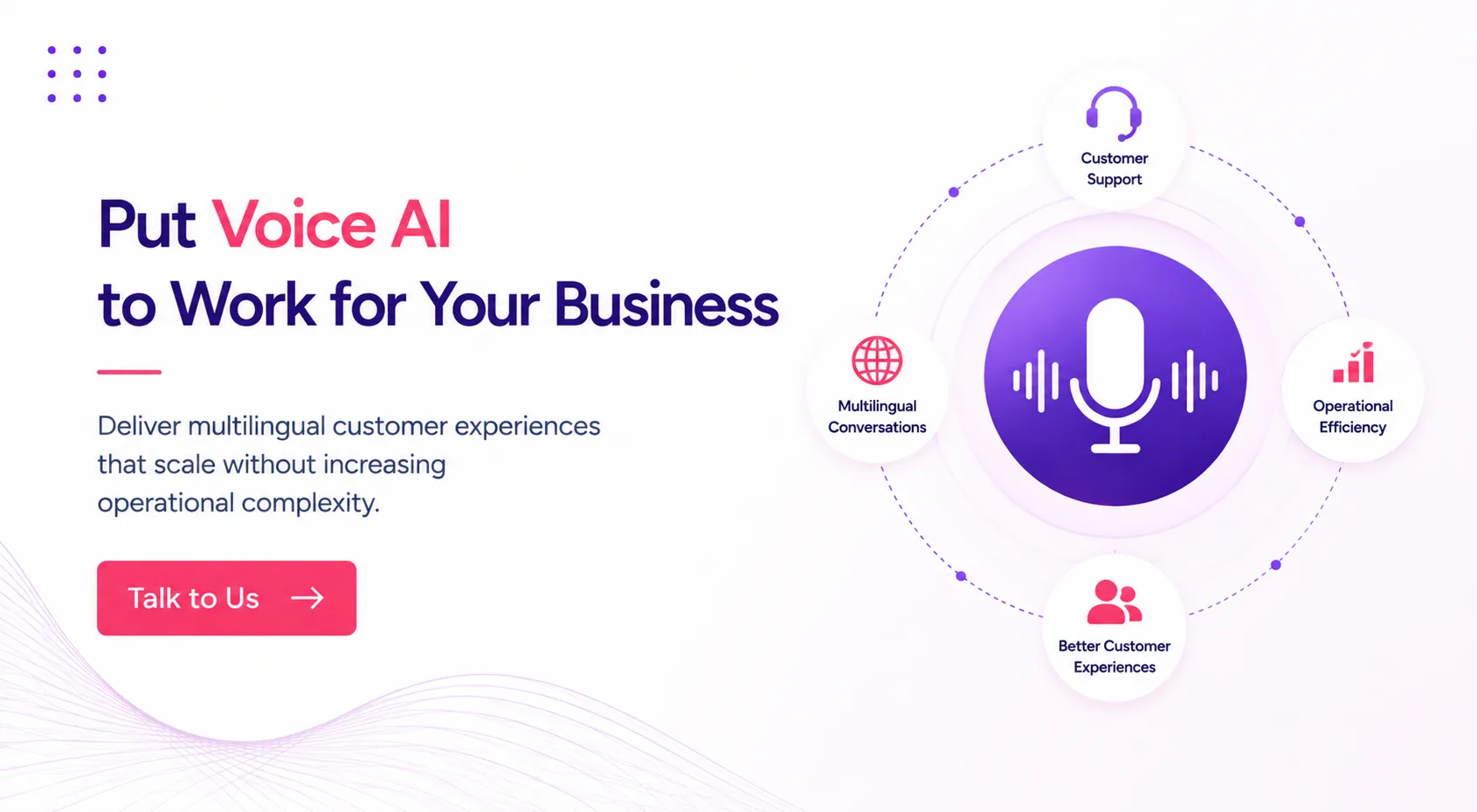
Hero banner promoting Voice AI for business, with a central purple microphone and circular icons for Support, Multilingual Conversations, Operational Efficiency, and Better Customer Experiences.

What Rootle Does Differently

Rootle is a voice AI platform built for enterprises that demand more than just automated dialing. While legacy systems stop at playing recordings or basic speech-to-text, Rootle acts as an intelligent extension of your workforce. By combining Agentic AI with real-time system integration, Rootle doesn’t just “talk” to your customers—it executes tasks, resolves queries, and moves the needle on your core business metrics, from DSO reduction to lead conversion.

• Conversational Accuracy: Uses advanced speech processing to interpret complex, unstructured human dialogue rather than relying on rigid keypad menus or static scripts.

• Fluid Multi-Dialect Capabilities: Switches languages and regional accents instantly mid-sentence without dropping the context of the conversation.

• Direct Core System Syncing: Connects natively to enterprise CRMs to log interactions, update custom records, and trigger secondary channels dynamically.

• Rapid Ecosystem Deployment: Integrates through secure APIs using pre-configured, industry-specific compliance templates to go live within a few weeks.


FAQs: AI Voice Agents for eCommerce and Retail

1. What are the key benefits of deploying an AI Voice Agent for eCommerce customer support?

The main benefits include 24/7 continuous inbound call coverage without queue delays, automated resolution of up to 80% of routine inquiries (such as order status, tracking, and returns), support for multi-lingual and code-switched conversations, and an 80% reduction in per-call operational expenses compared to traditional human-staffed call centers.

2. How do AI voice agents integrate with eCommerce platforms like Shopify, Magento, or custom ERPs?

Modern AI voice agents connect directly to eCommerce databases through REST and gRPC APIs. These integrations allow the AI agent to verify caller identity via phone numbers, pull real-time order tracking details, update shipping addresses, and initiate refunds or exchanges dynamically during a live call.

3. Can AI voice agents handle complex customer service workflows without making mistakes (hallucinating)?

Yes. Enterprise-grade platforms utilize deterministic state machine architecture alongside natural language models. While the AI remains flexible in understanding human speech and accents, all backend business logic and transactional workflows (e.g., refund caps, cancellation policies) follow strict pre-validated business rules, preventing hallucination risks.

4. How do voice AI agents manage multi-lingual consumers and dialect code-switching?

Advanced multilingual voice AI engines use specialized Automatic Speech Recognition (ASR) models trained on regional accents and mixed-language speech (such as Hinglish, Tanglish, or Spanglish). They auto-detect the caller’s language dynamically and process multi-lingual phrasing mid-sentence without requiring the caller to restart the conversation or press buttons.

5. What telecom regulations apply to outbound voice AI calls like order confirmations or cart recovery?

Outbound automated calls must comply with regional telecom guidelines—such as TRAI’s TCCCPR rules in India (requiring 1600/1601 series header routing and DLT template registrations) or STIR/SHAKEN in North America. Enterprise AI voice platforms handle these pre-declarations automatically to prevent carrier-level spam tagging and call blocking.


Devansh Mehta is a Solutions Consultant experienced in AI-driven customer communication and voice automation. Skilled in solution discovery, client relationships, onboarding, workflow optimization, and scalable customer support, with a focus on conversational technology and digital transformation.

Talk to our Experts

Recent Blogs

Candidate Screening Automation
5 Capabilities of Generative AI Voice Interviews That Are Reshaping Recruitment in 2026