Traditional contact center scaling is broken. Progressive COOs leverage enterprise Voice AI to automate high-friction workflows like lead qualification, e-KYC...
25 August 2026
When contact center leaders evaluate operational costs, they often focus on direct agent wages, telephony lines, and software licensing. However, the true financial drain in high-volume scheduling environments lies in uncaptured demand and operational friction.

| Cost Per Completed Booking | ₹40 – ₹120 | ₹4 – ₹12 | 70%–90% reduction in direct cost |
| Concurrency Capacity | Fixed by agent seats | Unlimited scaling instantly | Zero call drop-offs during morning spikes |
| Average Speed to Answer (ASA) | 2 – 8 minutes | < 1 second | Instant resolution, higher CSAT |
| Vernacular Flexibility | Restricted by agent language skills | Native 20+ Indian languages + Hinglish | Seamless pan-India adoption |
| No-Show Rate Management | Manual, reactive calls | Proactive outbound AI + WhatsApp sync | Up to 35% higher slot utilization |
| Operating Hours | Shift-bound / limited evening coverage | 24/7/365 coverage | Captures off-hour bookings (up to 30% of total) |
Consider a major Indian diagnostic and healthcare chain operating 80 centers across North and West India, receiving 120,000 appointment and test scheduling calls per month:
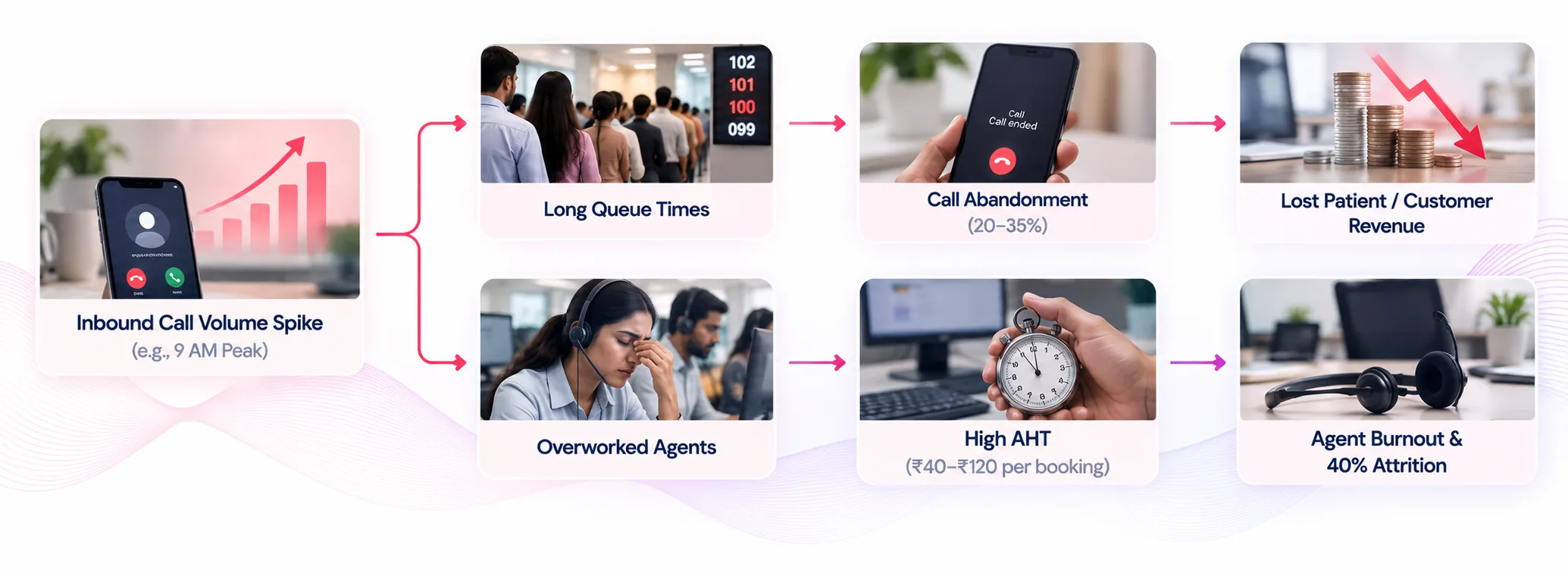
• Before Voice AI: The group operated a centralized 70-seat BPO call center handling appointments, reschedules, and cancellations. Monthly scheduling operational expenses exceeded ₹32 Lakhs, with a 22% morning peak call abandonment rate.
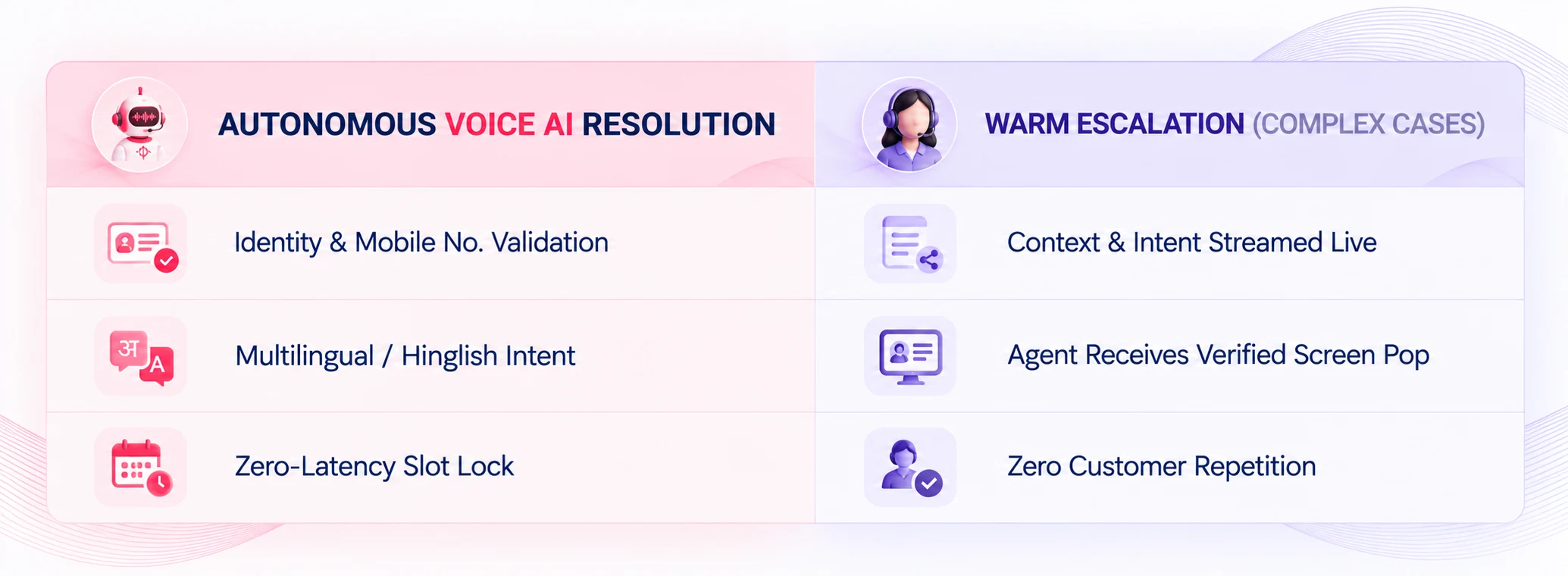
• After Deploying Enterprise Voice AI: The Voice AI agent autonomously resolved 74% of routine inbound scheduling, rebooking, and test confirmation calls across Hindi, English, and Hinglish without human agent intervention.
• The Result: The group reduced overall scheduling operational overhead by 72%, eliminated queue hold times, and redirected human staff to complex patient care management—saving over ₹2.3 Crore annually while capturing previously lost booking volumes.
Voice AI cuts costs by autonomously handling routine inbound and outbound scheduling tasks—such as booking, rescheduling, and cancellations—at a fraction of human agent costs (₹4–₹12 per booking vs. ₹40–₹120). It eliminates manual call handling overhead, prevents call abandonment during peak hours, and scales without adding BPO seats.
Yes. Conversational AI platform like Rootle utilize specialized speech models trained on Indian regional accents and code-switched dialects. Callers can mix languages mid-sentence (e.g., Hindi and English), and the AI accurately parses the intent, confirms details, and updates the schedule.
Compliant enterprise Voice AI platforms integrate natively with Distributed Ledger Technology (DLT) networks and route outbound scheduling/confirmation calls over official 1600 (BFSI/Government) or 1601 (Enterprise/Service) series headers. This prevents caller-ID applications from marking legitimate business calls as spam.
When a cancellation occurs, the Voice AI agent triggers an automated backfill workflow. It searches the pending waitlist and reaches out via voice call or WhatsApp to waitlisted clients, offering the newly opened slot and filling unutilized calendar capacity in real time.
Yes. Enterprise-grade Voice AI solutions adhere to strict data security frameworks, including DPDPA (Digital Personal Data Protection Act) guidelines, ISO 27001, and SOC 2 Type II certifications. They feature end-to-end data encryption (in transit and at rest) and strict access controls.