Skip to content

How Cloud-based Voice AI Offers Omnichannel Banking Experiences

Featured Image

Executive Summary

Digital banking adoption has surged, but customer support channels remain structurally disconnected. When customers shift from mobile banking apps to phone support, they encounter a “context gap”—forced to verify identities from scratch and re-explain their issues to legacy IVR systems. This friction inflates Average Handle Time (AHT), drives up operational expenses, and erodes customer trust.

Solving this challenge requires bridging cloud-native Voice AI for banking directly with Core Banking Systems (CBS) like Finacle, Temenos, and Oracle FLEXCUBE. By deploying low-latency event orchestration, secure API middleware, and bi-directional session state sync, financial institutions can transform phone calls into active digital transactions. Cloud Voice AI agents fetch real-time customer data, execute backend ledger operations, and maintain omnichannel continuity, delivering instant, secure, and personalized resolutions across every touchpoint.

Modern retail banking customers conduct 90% of their daily transactions on mobile apps or web portals. However, when an urgent issue arises—such as a blocked credit card, a failed IMPS/NEFT transaction, or suspicious account activity—they revert to the phone channel.

This transition exposes the traditional context gap:
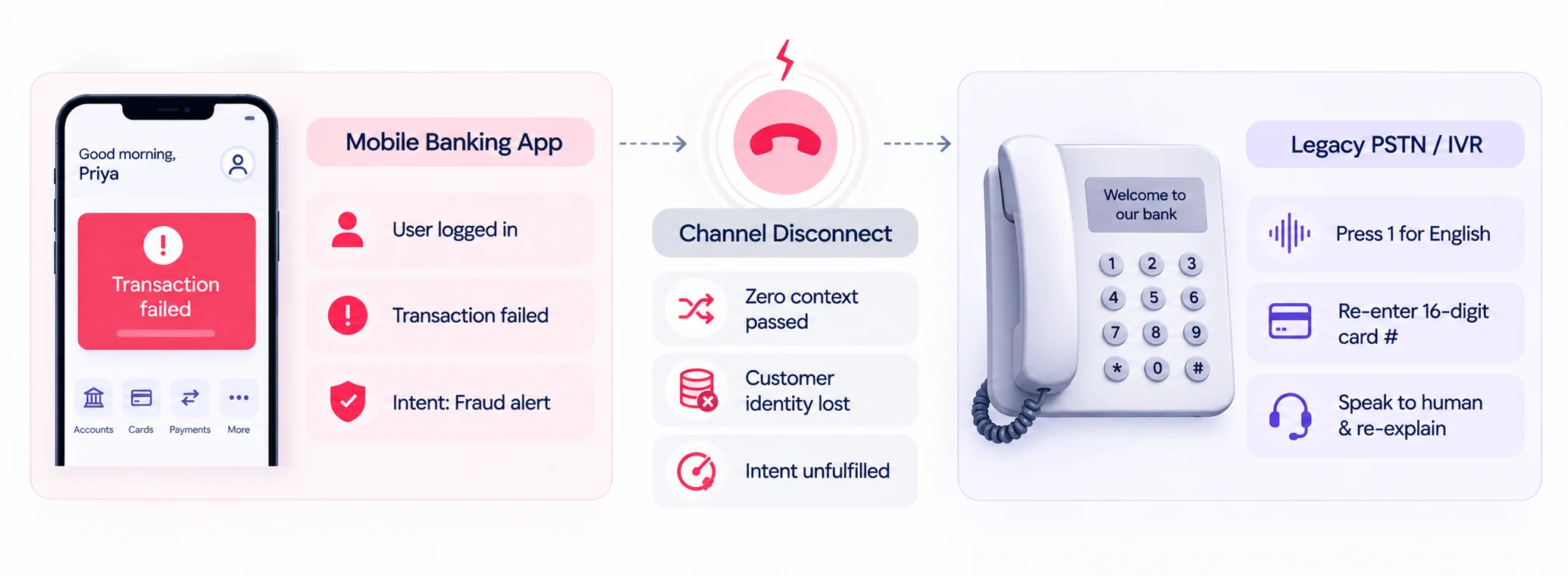
Legacy banking systemLegacy Interactive Voice Response (IVR) systems operate as isolated telephony islands. They lack native visibility into a user’s active mobile session, recent app interactions, or account state. The result is a high-friction experience:

  1. Repetitive Authentication: Customers must manually input account numbers, debit card digits, or OTPs via numeric keypads despite having already authenticated inside the mobile app.

  2. Intent Blindness: The IVR greets high-net-worth or panicked callers with identical static menu options (“Press 1 for Loans, Press 2 for Accounts”) rather than reacting to recent app events.

  3. Escalation Breakdown: When transferring calls from IVR to a human representative, the collected touch-tone data is frequently dropped, forcing agents to restart the verification process from zero.

Closing this gap requires treating voice not as an isolated telecom route, but as an API-driven digital extension of the core banking ledger.
BFSI Voice AI Platform - Book a demo

Technical Blueprint: Integrating Cloud Voice AI with Core Banking Architectures

Connecting cloud Voice AI agents to mission-critical Core Banking Systems (CBS) demands sub-second data transmission, strict state management, and enterprise-grade security protocols.

1. High-Speed API Orchestration & Sub-300ms Latency

Human conversation feels unnatural if pauses exceed 500 milliseconds. When a customer speaks to a voice agent, the system must transcribe the audio (ASR), process the intent (NLU), query the Core Banking System via API, format the response (TTS), and play back the audio—all within 300 to 400 milliseconds.

Leading enterprise platforms utilize lightweight gRPC or optimized RESTful microservices. When a caller asks, “Was my salary credited today?”, the Voice AI engine executes a scoped balance check against systems like Infosys Finacle or Temenos Transact, retrieves the latest ledger entries, and responds naturally without audible delay.

2. Bi-Directional Session Synchronization

To eliminate context drop-offs, banks deploy event-driven webhooks or WebSocket channels between mobile app frontends and telephony servers.

If a customer experiences a payment failure on their mobile app and immediately taps “Call Support,” the mobile app transmits a contextual payload (e.g., User_ID, Last_Failed_Txn_ID, Error_Code: 504) to the cloud voice gateway. When the phone call connects, the Voice AI agent bypasses generic greetings and immediately asks: “I see your UPI payment of ₹5,000 to Merchant X failed a moment ago. Would you like me to check the status or initiate a dispute?”

3. Voice Bio-Authentication & Zero-Trust Security

Security in banking cannot be compromised for convenience. Rather than relying on static security questions (like mother’s maiden name), cloud Voice AI integrates passive voice biometrics and contextual risk scoring.

During the first few seconds of natural speech, the system compares vocal characteristics against stored voiceprints. Combined with device-level token verification (ANI/CLI verification) and multi-factor push notifications inside the banking app, the AI verifies identity invisibly, unlocking high-tier transactional capabilities (like beneficiary management or card unblocking) directly over the phone call.

Omnichannel Continuity: Moving Beyond Single-Channel Interactions with Voice AI for Banking

A true omnichannel banking experience means that conversations are not restricted to audio alone. Cloud Voice AI coordinates rich media messaging across channels while the customer remains on the phone line:

• In-Call Payment Links: If a customer is resolving an overdue credit card payment via voice, the AI agent can dispatch an instant WhatsApp or SMS payment gateway link directly to their registered mobile device while staying on the line to confirm receipt and transaction completion.

• Document Verification: For loan inquiries or account updates, the voice agent can prompt the customer to upload a photo of an ID document via a secure web interface, reading the processed OCR data live during the call.

• Unified Audit Trails: All voice transcripts, extracted intent metadata, and backend actions are immediately logged into the central CRM (Salesforce Financial Services Cloud, Microsoft Dynamics) to ensure compliance and complete visibility for human agents.

Turning Voice AI for Banking into an Active Digital Channel

The modern retail banking customer views phone support not as an alternative channel, but as an immediate safety net. Bridging cloud Voice AI with Core Banking Systems transforms customer support from a reactive, cost-heavy operation into an active digital service channel.

By adopting API-first architectures, voice bio-authentication, and real-time context management, banks can eliminate customer friction, reduce average handle times, and deliver secure, personalized banking experiences across every voice interaction.

What Rootle Does Differently

Rootle is a voice AI platform built for enterprises that demand more than just automated dialing. While legacy systems stop at playing recordings or basic speech-to-text, Rootle acts as an intelligent extension of your workforce. By combining Agentic AI with real-time system integration, Rootle doesn’t just “talk” to your customers—it executes tasks, resolves queries, and moves the needle on your core business metrics, from DSO reduction to lead conversion.

• Conversational Accuracy: Uses advanced speech processing to interpret complex, unstructured human dialogue rather than relying on rigid keypad menus or static scripts.

• Fluid Multi-Dialect Capabilities: Switches languages and regional accents instantly mid-sentence without dropping the context of the conversation.

• Direct Core System Syncing: Connects natively to enterprise CRMs to log interactions, update custom records, and trigger secondary channels dynamically.

• Rapid Ecosystem Deployment: Integrates through secure APIs using pre-configured, industry-specific compliance templates to go live within a few weeks.

Hero banner promoting Voice AI for business, with a central purple microphone and circular icons for Support, Multilingual Conversations, Operational Efficiency, and Better Customer Experiences.

FAQs: Voice AI for Banking

1. What is the context gap in omnichannel banking support?

The context gap refers to the loss of customer information and intent when transitioning between banking channels such as moving from a mobile app to a phone call. This disconnect forces customers to re-authenticate and re-explain their issues to agents or legacy IVRs.

2. How does cloud Voice AI integrate with Core Banking Systems (CBS) like Finacle or Temenos?

Cloud Voice AI connects to Core Banking Systems via secure REST or gRPC APIs over mutual TLS (mTLS) connections. These connections allow the voice agent to perform real-time database queries (e.g., checking balances or transaction statuses) and execute backend actions (e.g., blocking debit cards) during a live phone call.

Read this case study to know more: How Creddinv Scaled Investor Qualification to 10,000 Calls a Month with Voice AI

3. How does Voice AI ensure security during banking transactions?

Voice AI platforms implement zero-trust security by combining passive voice biometrics, pre-verified device IDs (CLI matching), and in-app multi-factor push notifications. This multi-layered approach verifies customer identity naturally without relying on vulnerable static security questions.

4. Can a voice AI agent trigger actions on channels like WhatsApp or SMS during a call?

Yes. Modern conversational platforms like Rootle use unified state engines to trigger omnichannel workflows. While speaking with a customer, the Voice AI agent can send digital receipts, secure payment links, or verification prompts via WhatsApp, RCS, or SMS in real time.

5. What happens when a Voice AI agent cannot resolve a banking inquiry?

When encountering complex or high-value inquiries, the Voice AI agent executes a warm transfer to a human support agent. It passes the caller’s verified identity, full transcript, sentiment analysis, and relevant core banking records directly to the agent’s CRM screen.

Rahul Desai
Rahul Desai
Client Growth Manager

Rahul Desai is a client growth and sales professional with extensive experience driving strategic partnerships and revenue growth. At Rootle.ai, he focuses on expanding market reach, enabling enterprises to leverage multilingual voice AI for intelligent customer engagement and automated conversational experiences.

Recent Blogs

Hero banner with the title 'How to Follow Up With Leads Automatically' and a smartphone showing a microphone, plus icons labeled Instant Follow-Ups, Personalized Conversations, and Smarter Scheduling on the right.
Purple 3D hero illustration with a smartphone and microphone, bank icons, and a classical building beside the slogan: 'Smarter conversations, stronger banking outcomes.'