Skip to content

The Economics of Deterministic Voice AI: Moving Beyond “Per-Minute” Pricing

Featured Image

Executive Summary

For two decades, contact center technology vendors have billed enterprises using consumption-based, per-minute pricing models. This creates a deeply flawed commercial misalignment: legacy vendors profit when voice bots are slow, confused, or caught in conversational loops. When enterprises attempt to deploy pure, unconstrained Generative Voice AI, this financial liability compounds—vendors cannot guarantee resolution because probabilistic LLMs inherently risk hallucinations and state drift, forcing enterprises to pay for the time spent failing. The solution is Deterministic Voice AI, an architecture that pairs probabilistic natural language understanding with audit-proof, state-driven execution. By guaranteeing 100% execution accuracy on core banking, logistics, and enterprise ledger APIs, Deterministic Voice AI eliminates bot-driven failure modes, enabling a fundamental commercial transition from per-minute consumption tolls to risk-shared, outcome-based pricing.

In the enterprise software ecosystem, pricing models reflect incentives.

When a cloud database provider charges by the gigabyte, its commercial incentive is aligned with helping you store and query more data efficiently. But when a customer experience (CX) or contact center vendor charges you by the minute or second of talk time, a toxic commercial misalignment takes root:

The Consumption Trap: The vendor makes more money when their voice bot is slow, confused, stammers through long-winded responses, or loops endlessly before escalating to a human representative.

For years, enterprises accepted per-minute billing as a necessary evil because legacy IVRs and early conversational agents were fundamentally unpredictable. However, as organizations deploy Voice AI agents directly onto live customer channels across banking, utilities, and logistics, continuing to pay for minutes rather than outcomes is no longer just inefficient—it is an unacceptable drain on operational ROI.

The key to escaping this trap lies in the underlying software architecture: Deterministic Voice AI.
Enterprise voice ai platform - book a demo

Why Pure Generative AI Cannot Escape the Consumption Trap

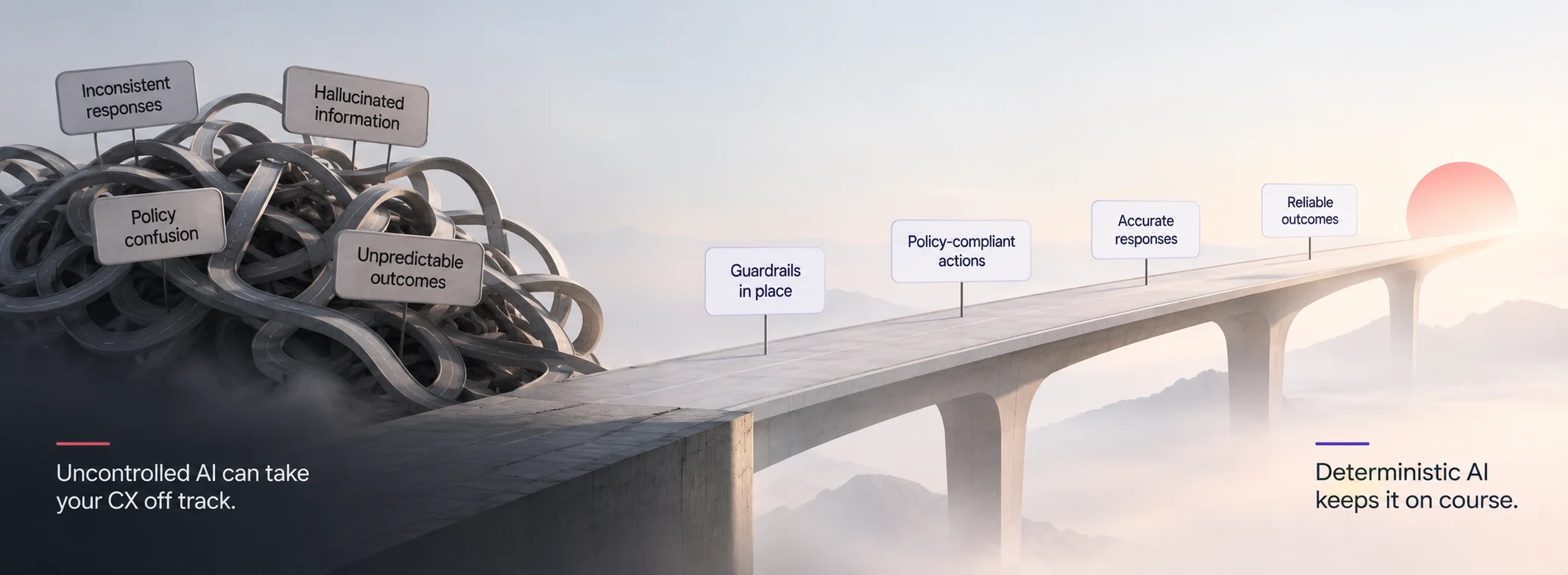
When Generative AI emerged, many enterprise leaders hoped it would instantly resolve contact center inefficiencies. Instead, deploying “pure” LLM-driven voice bots often exacerbated the per-minute bill.

Because Large Language Models are probabilistic prediction engines, they do not “know” your enterprise business logic or API schemas; they simply predict the next mathematically probable token. When a customer calls with a complex query—such as verifying an EMI status, updating a shipping address, or processing a claim—an unconstrained LLM risks three financial failure modes:

• Conversational Drift: The LLM engages in lengthy, unnecessary pleasantries or filler dialogue, inflating the call duration by 30% to 50%.

• State Loops: The model loses track of variable states in multi-turn conversations, forcing the customer to repeat information while the per-second meter runs.

• Execution Failure: The LLM generates a hallucinated or malformed API payload, failing to complete the task and forcing a costly warm transfer to a human agent.

Because pure Generative Voice AI vendors cannot guarantee what their probabilistic models will do on any given call, they cannot afford to offer outcome-based pricing. They must charge you for the compute time spent trying, shifting 100% of the operational risk onto your balance sheet.

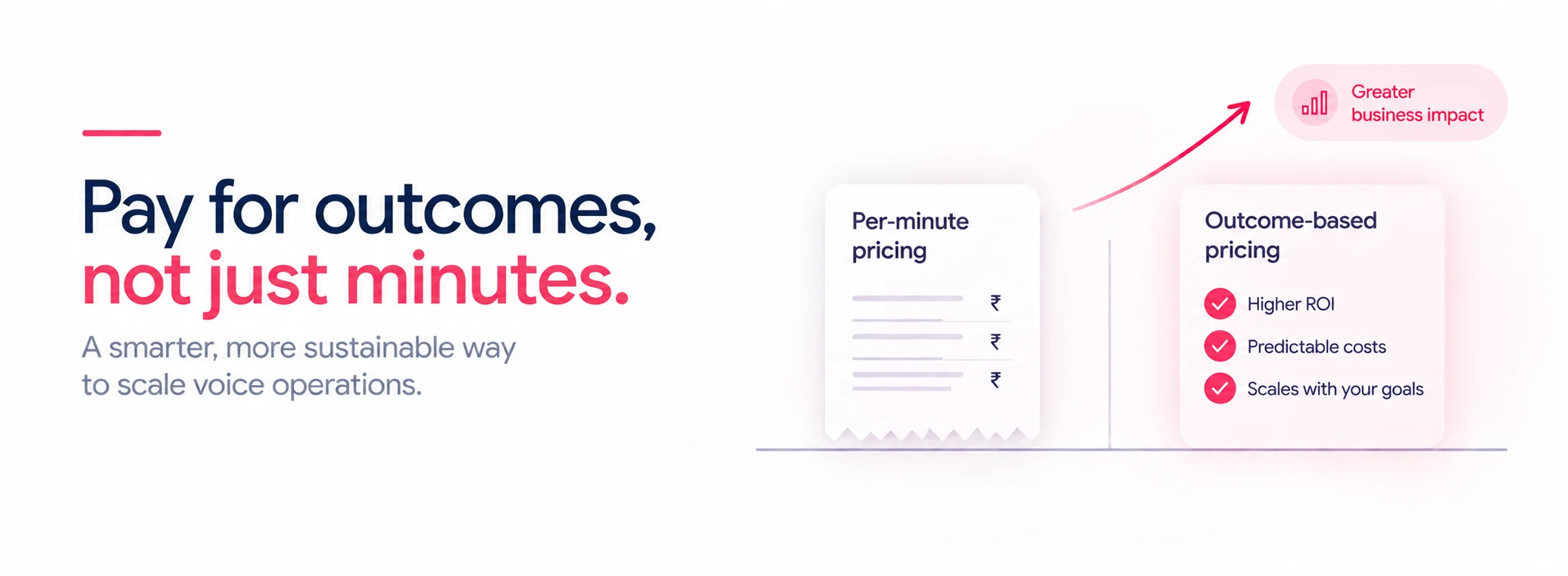
The financial TCO of voice architectures

Two ways to pay for a voice agent — one bills for effort, the other for results.

Pure Generative Voice AI
Billed for activity
  • Vendors bill per minute or per token, regardless of outcome.
  • The enterprise pays for bot loops, hallucinations, and delays.
  • Monthly operating expense is unpredictable and variable.
Deterministic Voice AI
Billed for outcomes
  • Commercials are tied to Task Completion Rate and FCR.
  • Zero software cost for execution failures or unresolved loops.
  • A fixed, predictable OpEx mapped directly to business results.

The Architectural Solution: Decoupling Intent from Execution

To unlock outcome-based commercial models, a Voice AI platform must make task resolution mathematically predictable. This requires decoupling understanding from execution.

Rootle achieves this through a hybrid architecture designed specifically for enterprise Voice AI agents:

From raw speech to safe execution

Every call passes through a probabilistic layer that understands, then a deterministic layer that decides — nothing reaches your systems unvalidated.

1
Probabilistic NLU & Speech Layer
Code-switching · Hinglish & vernacular Intent & entity extraction
Parsed intent tokens
2
Deterministic State Engine
Audit-proof business logic Schema parameter validation Zero-hallucination guardrails
Validated payload
3
Core Enterprise Systems & APIs
Finacle TCS BaNCS CRMs WMS
  1. Probabilistic Understanding: Generative models and speech parsers process messy, real-world human speech—including code-switched dialects like Hinglish—strictly to extract human intent and slot entities (e.g., Intent: RESCHEDULE_DELIVERY).

  2. Deterministic Execution: Once intent is extracted, the LLM is stripped of execution authority. Control passes to a hardcoded, state-driven engine that evaluates rules, validates parameters against backend schemas, and enforces regulatory guardrails (such as RBI, DPDPA, or TRAI mandates).

  3. Guaranteed Execution: The state machine fires the exact, validated API payload to core backend systems (such as Finacle, TCS BaNCS, or Salesforce).

Because the deterministic state engine eliminates parameter hallucinations and state drift, First Contact Resolution (FCR) becomes a guaranteed structural feature rather than a statistical gamble.

The Real Indian Reality: Dead Air, 5-Second Drops, and Code-Switching

The Indian voice channel operates under brutal conditions that make generic LLM setups collapse:

• The 5-Second Drop: Network switches, caller hesitation, or immediate hangups account for 15%–25% of all outbound/inbound attempts. If a platform tries to charge for these, the contract gets torn up.

• The “Hinglish” Drift: Indian callers rarely stick to pure English or pure Hindi. They code-switch mid-sentence (“Mera payment deduct ho gaya hai, so please check refund status”). Generic probabilistic models spend 30–40 seconds just trying to parse intent, dragging out the call.

• Telecom Frameworks: DLT registration, TRAI scrubbing rules, and strict call-time windows mean every second spent on the line costs real carrier telephony money.

Why "Outcome-Based" Billing Fails Without Deterministic Execution

While billing per outcome sounds great on paper, it breaks down in practice if the voice bot relies purely on probabilistic AI.

When your software vendor charges only on “outcome met,” but their bot fails to reach that outcome 40% of the time due to state loops, you don’t pay the vendor—but you still pay the business penalty. You lose the customer, waste carrier telephony charges, and end up routing the disgruntled caller to an expensive human agent anyway.

The Indian Enterprise Checklist for Outcome Pricing

Before signing off on an outcome-based Voice AI contract in India, clear up these operational terms with your vendor:

□ What is the exact definition of a “Resolved Call”? Is it defined by a verified API webhook response (e.g., status updated in CRM), or just the bot saying “Thank you”?

□ How are short-duration drop-offs handled? Ensure calls under 5–10 seconds or failed carrier connects carry zero software charges.

□ Does the system handle local language code-switching natively? Verify that switching between Hindi, English, and regional dialects mid-call doesn’t reset the state engine or count as a failed outcome.

□ What happens during a human handoff? If the AI escalates to a human representative, is that call billed as a resolution, an attempt, or passed over entirely?

Bottom Line

Paying per outcome or per resolved call is already the expected standard in the Indian enterprise market. The real competitive advantage isn’t just offering that pricing model—it’s building a deterministic architecture that ensures calls actually reach resolution quickly, cleanly, and without wasting your customer’s time.

What Rootle Does Differently

Rootle is a voice AI platform built for enterprises that demand more than just automated dialing. While legacy systems stop at playing recordings or basic speech-to-text, Rootle acts as an intelligent extension of your workforce. By combining Agentic AI with real-time system integration, Rootle doesn’t just “talk” to your customers—it executes tasks, resolves queries, and moves the needle on your core business metrics, from DSO reduction to lead conversion.

Conversational Accuracy: Uses advanced speech processing to interpret complex, unstructured human dialogue rather than relying on rigid keypad menus or static scripts.

• Fluid Multi-Dialect Capabilities: Switches languages and regional accents instantly mid-sentence without dropping the context of the conversation.

• Direct Core System Syncing: Connects natively to enterprise CRMs to log interactions, update custom records, and trigger secondary channels dynamically.

• Rapid Ecosystem Deployment: Integrates through secure APIs using pre-configured, industry-specific compliance templates to go live within a few weeks.

Hero banner promoting Voice AI for business, with a central purple microphone and circular icons for Support, Multilingual Conversations, Operational Efficiency, and Better Customer Experiences.

FAQs: Deterministic Voice AI

1 What is the main economic disadvantage of per-minute pricing for Voice AI?

Per-minute pricing aligns vendor revenue with inefficiency. When vendors charge by duration, they profit when Voice AI agents are slow, confused, or caught in conversational loops. This forces enterprises to pay for the software time spent failing rather than the value delivered.

2. How does Deterministic Voice AI enable outcome-based pricing?

Deterministic Voice AI decouples speech understanding from transaction execution. By using hardcoded state engines to validate rules and API payloads, it eliminates bot hallucinations and state drift. This architectural reliability allows vendors to guarantee First Contact Resolution (FCR) rates and bill strictly for completed business outcomes.

3. What is the difference between probabilistic and deterministic execution in Voice AI agents?

Probabilistic execution lets Large Language Models predict both language and backend actions, risking malformed API calls, hallucinated policies, and incorrect data entries. Deterministic execution uses strict, state-driven rules to run business logic and backend integrations, guaranteeing zero-error API execution while keeping the LLM restricted to speech comprehension.

4. How does outcome-based pricing impact contact center ROI?

Outcome-based pricing transforms automation costs from an unpredictable, variable operational expense into a guaranteed financial return. Enterprises eliminate software spend on failed calls, reduce Average Handle Time (AHT), and pay strictly when a verified business objective such as a resolved ticket, payment confirmation, or scheduled appointment is achieved.

5. Can Deterministic Voice AI platforms handle complex regional code-switching?

Yes. Platforms like Rootle use probabilistic language models at the input boundary to comprehend messy, code-switched human speech (such as mixing Hindi and English) across regional dialects. Once the intent is parsed, the deterministic state machine takes over to execute the transaction flawlessly for multilingual voice AI.

Vikram Patel
Vikram Patel
Chief Operating Officer

Vikram Patel is a technology and startup leader with a background in AI and deep tech. As a core team member at Rootle.ai, he contributes to product vision and innovation for voice-led AI platforms, aiming to solve real business problems with scalable voice AI solutions across industries.

Recent Blogs