Skip to content

Why Pure Generative Voice AI Is a Liability in Enterprise CX And Why Deterministic AI Is the Only Path Forward

Featured Image

Executive Summary

Generative AI excels at understanding messy human speech, but using unconstrained LLMs to let Voice AI agents directly execute live customer operations introduces severe hallucination and compliance risks. The solution is a hybrid architecture that pairs Probabilistic Understanding (LLMs parsing intent across complex dialects) with Deterministic Execution (audit-proof guardrails running business logic). Decoupling intent from execution eliminates operational liabilities, guarantees regulatory compliance, and enables a commercial shift to outcome-based pricing for modern Voice AI agents.

• Probabilistic Risk: Pure LLMs predict tokens mathematically, leading to hallucinations, state drift, and flawed API execution.

• Hybrid Architecture: Restricts LLMs to language parsing while hardcoded state machines handle zero-error backend logic.

• Regulatory Compliance: Rule-based execution ensures full auditability and strict adherence to RBI and DPDPA standards.

• Outcome-Based Economics: Guaranteed execution accuracy allows enterprises to replace per-minute billing with pay-per-resolution pricing.

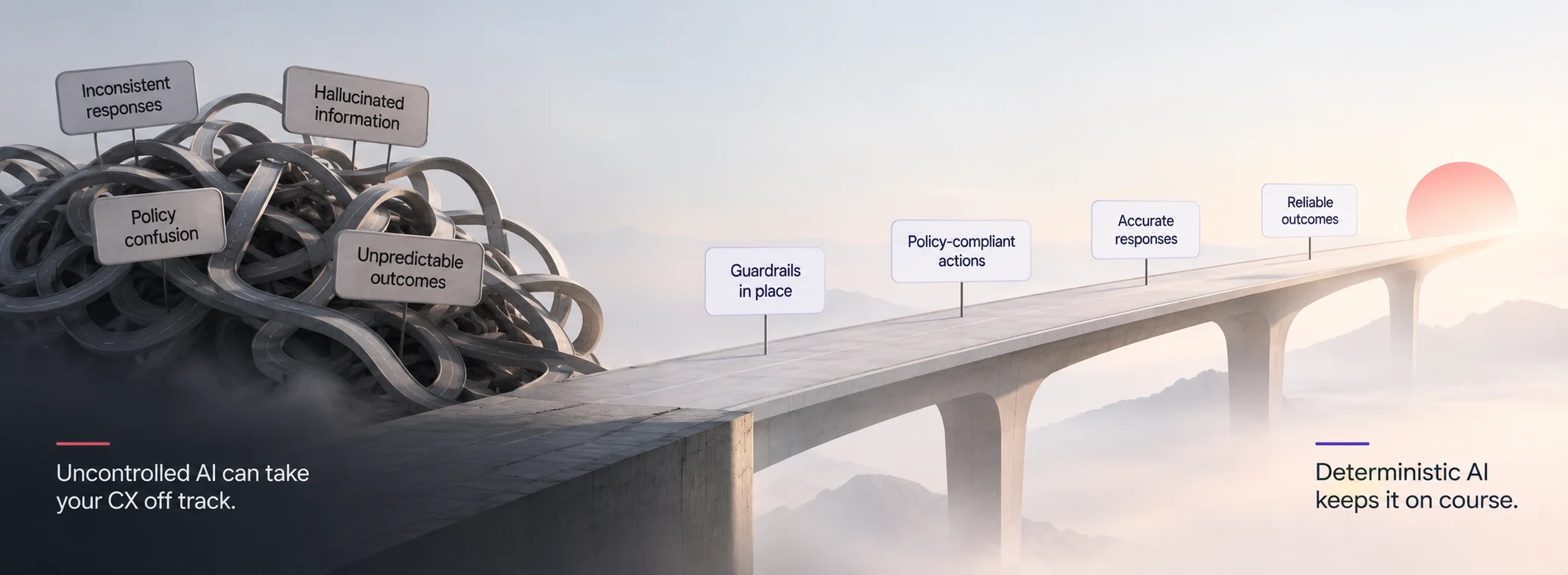
The customer experience industry is currently living through a dangerous paradox.

On one hand, Large Language Models have solved the long-standing problem of voice comprehension. Customers no longer need to speak in robotic keywords or navigate frustrating button-pushing IVR trees; they can speak naturally, mix languages, interrupt, and express complex intents in a single breath. Read the key differences here: Voice AI vs IVR: Which to Choose According to Your Use Case

On the other hand, enterprises that rushed to deploy “pure” Generative Voice AI bots directly onto live customer channels are colliding with a hard operational reality: LLMs are inherently non-deterministic.

An LLM is a statistical prediction engine. It does not “know” your core banking rules, your inventory logic, or your regulatory compliance constraints; it simply predicts the next most mathematically probable word. While a 95% accuracy rate is remarkable for drafting an internal memo or summarizing a document, a 5% error rate when updating a customer’s ledger, processing an loan disbursement, or cancelling an order is an absolute operational failure.

In enterprise CX, “mostly accurate” is an unacceptable liability. The future of enterprise voice automation belongs to Deterministic AI.

Legacy vs Rootle Deterministic Flow
FLOW COMPARISON

Legacy generation vs. Rootle deterministic flow

Legacy approach
Generates text + triggers API directly
Risk: hallucinated payload / state drift
Rootle engine
Caller input
Probabilistic NLU layer Understands intent
Deterministic state engine Guarantees business logic
Validated API execution
Zero hallucination

The Fallacy of "Mostly Accurate" in High-Stakes Operations

When a customer calls an enterprise call center, they are rarely seeking open-ended creative dialogue. They want to execute a specific transaction or resolve a discrete operational issue:

◦ “I need to block my credit card immediately because I lost my wallet.”

◦ “Why was my EMI debited twice this month?”

◦ “Where is my order, and can I change the delivery address to my office?”

In each of these scenarios, the underlying business logic is strictly binary. There is zero room for interpretation, creative phrasing, or improvised policy enforcement.

When an unconstrained LLM generates both the conversation and the underlying API parameters, three systemic failure modes emerge:

  1. Parameter Hallucination: The LLM fills missing variables with plausible-sounding but incorrect data (e.g., passing a slightly altered account number or misinterpreting a currency figure).

  2. State Drift: In multi-turn conversations, probabilistic models lose track of past variable states, looping the customer or executing an action prematurely before all required verification parameters are gathered.

  3. Policy Fabrication: Under subtle caller prompting, pure LLMs can improvise promises, quote out-of-date fee structures, or grant unauthorized policy exemptions that violate enterprise compliance.

Probabilistic vs Deterministic — Rootle
ARCHITECTURE COMPARISON

Probabilistic vs. Deterministic

VS
Legacy approach

Pure generative voice AI

  • Generates text and API payloads probabilistically
  • Risk of hallucinated policies, incorrect figures, and drift
  • Fails under strict regulatory compliance environments
Rootle engine

Rootle deterministic voice AI engine

  • Separates natural language understanding from execution logic
  • Enforces strict, audit-proof state machines — illegal state transitions are mathematically impossible
  • Full regulatory compliance (RBI, DPDPA, HIPAA) with complete auditability

Decoupling Intent from Execution: The Rootle Architectural Paradigm

To build a enterprise-grade Voice AI system, software architects must draw a strict boundary between two fundamentally different tasks: understanding what the customer said and deciding what the system does next.

Rootle’s hybrid architecture decouples these responsibilities entirely:

Rootle Voice AI Architecture

Rootle voice AI architecture

How probabilistic understanding hands off to deterministic execution

1

Probabilistic understanding

NLU layer

Low-latency language models convert raw audio — including code-switched Hindi–English speech — into structured intent and entity tokens.

Intent: check_balance Account: savings
2

Deterministic execution

State machine layer

The LLM loses execution authority. Hardcoded business rules validate identity, parameters, and legal state transitions before anything proceeds.

Identity verified via multi-factor auth
Required parameters present and formatted
State transition legal under enterprise rules
3

Secure API execution

Backend systems layer

Only once every variable is validated does the payload fire to core systems. Fully predictable, fully loggable, immune to hallucination.

Finacle BaNCS Enterprise CRM

Compliance and Auditability: Meeting RBI and DPDPA Standards

For enterprise organizations operating under strict regulatory regimes—such as the Reserve Bank of India (RBI) cyber security frameworks, the Digital Personal Data Protection Act (DPDPA), or HIPAA—pure Generative AI poses an existential compliance risk.

Regulators require explainability and auditability. If a customer’s account is locked or a financial transaction is executed, the enterprise must be able to prove precisely why and how that action was triggered.

Deterministic AI provides a complete, step-by-step audit log for every single interaction:

• Traceable Decision Trees: Every state transition is recorded in structured logs, showing the exact rule that fired and the precise API response received.

• Deterministic PII Masking: Personally Identifiable Information (PII)—such as account numbers, passwords, and personal IDs—is redacted at the audio parsing boundary before it ever touches downstream processing components.

• Bounded Operational Scope: The Voice AI agent cannot perform any action outside its pre-defined state graph, eliminating the risk of rogue automated behavior.

The Commercial Shift: Moving from Per-Minute Tolls to Outcome-Based ROI

The shift from probabilistic chaos to deterministic accuracy isn’t just a technical upgrade—it fundamentally alters the economics of customer service software.

For two decades, contact center vendors have billed enterprises using consumption-based pricing (charging per minute, per second, or per API token). This creates a deeply flawed commercial alignment:

The Consumption Trap: When vendors charge per minute, they make more money when their bot is slow, confused, loops endlessly, or forces a caller to spend ten minutes explaining a simple problem.

When a platform relies on pure, unpredictable LLMs, the vendor cannot guarantee resolution. Because they cannot control whether the model hallucinated or failed, they must charge you for the time spent trying—regardless of the outcome.

Deterministic voice AI breaks this cycle. Because state-driven voice architectures deliver predictable, mathematically verifiable First Contact Resolution (FCR) rates, the underlying risk vanishes.

When every workflow execution is guaranteed to follow business rules, software providers can move away from legacy minute-tracking and align directly with enterprise business outcomes:

• Pay-per-Successful Resolution: Paying only when an EMI status is successfully delivered, an order is verified, or an account issue is resolved.

• Zero Cost for Failed Loops: Eliminating software costs for calls that require human escalation due to bot failure or edge-case routing.

• Predictable Operational Cost: Transforming contact center automation from an unpredictable variable operational expense into a guaranteed financial return on investment.

Legacy vs Rootle Billing Model

Legacy vs Rootle billing model

Same call, opposite incentives

Legacy model

Per-minute billing

Enterprise pays for every minute of call duration, resolved or not.

Cost keeps climbing
Rootle model

Outcome-based ROI

Enterprise pays only when a call reaches genuine first contact resolution.

Cost tracks value delivered
SAME CALL, OPPOSITE INCENTIVES

“The goal of Voice AI isn’t to hold long, open-ended conversations. It’s to solve problems seamlessly. Generative models should be used to listen with empathy and nuance, while deterministic state engines handle the execution with mathematical precision” – Naresh Prajapati, CEO, Rootle

The Architecture of Sustainable Voice AI at Scale

Generative AI brought natural conversation to voice interfaces, but natural conversation is only half the battle. In enterprise operations, execution is everything.

Attempting to scale customer support by letting probabilistic models directly trigger core backend systems creates unacceptable brand, regulatory, and financial exposure. By adopting a deterministic architecture—using generative models to listen and hardcoded state machines to execute—enterprises eliminate hallucination risks, safeguard regulatory compliance, and unlock true pay-for-performance commercial models.

To build a voice automation strategy that scales safely, enterprise leaders must demand a simple standard: Probabilistic understanding, deterministic execution.

What Rootle Does Differently
DIFFERENTIATORS

What Rootle Does Differently

Rootle is a voice AI platform built for enterprises that demand more than automated dialing. Where legacy systems stop at playing recordings or basic speech-to-text, Rootle acts as an intelligent extension of your workforce — executing tasks, resolving queries, and moving core business metrics.

01

Core architecture

Hybrid Engine Architecture

LLMs handle language parsing only — hardcoded, deterministic state machines execute business logic, guaranteeing zero hallucinations on core APIs.

Outcome-Based Commercials

Priced on Task Completion Rate & FCR — pay-per-resolution, not per-minute.

Omnichannel Conversational OS

One unified memory across Voice, WhatsApp, RCS & Email — context survives every switch.

Native Vernacular & Code-Switching

Real-time language switching — like Hinglish — across 20+ regional Indian languages, with zero routing delays or menu prompts.

Hero banner promoting Voice AI for business, with a central purple microphone and circular icons for Support, Multilingual Conversations, Operational Efficiency, and Better Customer Experiences.

FAQs: Deterministic Voice AI

1. What is the difference between pure Generative Voice AI and Rootle's Deterministic Voice AI?

Pure Generative Voice AI relies entirely on probabilistic LLMs to both understand human speech and decide the next action or API payload, making it prone to hallucinations, state drift, and policy errors. Rootle uses a hybrid architecture: LLMs strictly parse human intent and speech nuance (probabilistic understanding), while an audit-proof, state-driven engine handles business rules and API calls (deterministic execution). This guarantees 100% execution accuracy on live enterprise systems.

2. How does Rootle prevent hallucinations when executing transactions on core banking or CRM APIs?

Rootle prevents hallucinations by isolating the Agentic AI layer from backend execution. Extracted intents and entities from human speech are validated against strict, hardcoded business logic and schema guardrails before any Webhook or API payload fires into core systems like Finacle, TCS BaNCS, or Salesforce. If parameters are missing or invalid, the deterministic state machine requests specific missing variables rather than allowing the AI to guess.

3. What does "KPI-First Voice AI" mean, and how does it enable outcome-based pricing?

“KPI-First” means Rootle evaluates voice interactions based on Task Completion Rate and First Contact Resolution (FCR) rather than talk time or total call minutes processed. Traditional vendors charge per minute, benefiting when bots are slow or confused. Rootle’s deterministic accuracy eliminates bot execution failures, allowing enterprises to align commercial terms directly with successful business outcomes such as verified leads, completed collections, or resolved support tickets.

4. How does Rootle support code-switched Indian languages and regional dialects?

Rootle’s Conversational OS natively processes over 20 Indian languages and dialects, including mid-sentence code-switching (e.g., mixing Hindi and English). The system auto-detects spoken languages instantaneously upon caller input, adjusting response language, tone, and pause cadence without requiring the user to press buttons or navigate language-selection sub-menus.

5. Can Rootle transfer voice conversations to other channels like WhatsApp without losing context?

Yes. Rootle features omnichannel orchestration through a central Conversational OS. If a customer on a voice call requires a document download, payment link, or confirmation receipt, Rootle can trigger a WhatsApp or RCS message mid-call while maintaining a unified memory log. If the customer later calls back or messages on chat, the AI agent resumes the conversation with full historical context.

Vikram Patel
Vikram Patel
Chief Operating Officer

Vikram Patel is a technology and startup leader with a background in AI and deep tech. As a core team member at Rootle.ai, he contributes to product vision and innovation for voice-led AI platforms, aiming to solve real business problems with scalable voice AI solutions across industries.

Recent Blogs

How a Banking Voice AI Platform for Automated Balance Inquiries Cuts Support Costs by 80%