See how no-code Voice AI removes barriers, speeds deployment, and helps businesses build strong voice experiences effortlessly with Rootle.
25 November 2025
This piece was researched and written by the Rootle content team. We combined technical documentation review, first-hand knowledge of how the Rootle Voice AI platform is architected, and publicly available research on NLP, ASR, and TTS technologies. Our goal was to make a technically accurate but accessible guide — useful whether you’re a product decision-maker, a developer evaluating platforms, or simply curious about the technology powering AI-driven conversations.
When someone calls a hotel’s front desk and a calm, human-sounding voice answers — takes the booking, answers questions, and handles a complaint — there’s a good chance they’re talking to a Voice AI.
Voice AI has crossed a threshold. It no longer sounds robotic. It doesn’t just follow scripts. It listens, understands intent, handles interruptions, and responds in natural language — in real time.
But how does it actually work?
This guide breaks down the full technology stack behind conversational Voice AI platforms: from the moment sound enters a microphone to the moment a response is spoken back. No jargon walls. No hand-waving. Just a clear, honest explanation of the layers that make Voice AI possible.
| ASR Metric | What It Measures |
|---|---|
| Word Error Rate (WER) | % of words transcribed incorrectly |
| Latency | Time from speech end to transcript ready |
| Appointment confirmation or rescheduling | Healthcare, Hospitality, Service Industry |
| Real-time factor | How fast transcription happens vs. audio length |
A WER below 5–8% is generally considered production-grade for most business applications.
| TTS Generation | How It Sounds |
|---|---|
| Rule-based (legacy) | Flat, robotic, predictable |
| Concatenative (2000s–2010s) | Slightly more natural, stitched audio segments |
| Neural TTS (current) | Near-human, emotionally expressive, real-time |
Latency at this stage matters enormously. Users notice delays over 300–500ms. Production Voice AI platforms optimize the full pipeline to keep end-to-end response time under that threshold.
| Capability | Why It Matters |
|---|---|
| Low latency (< 500ms) | Conversations feel natural, not laggy |
| High ASR accuracy | Fewer misunderstandings, fewer frustrated users |
| Multilingual support | Serves diverse customer bases without separate builds |
| Graceful fallback | Handles edge cases without crashing the experience |
| Analytics & conversation logs | Enables continuous improvement |
| Compliance & data security | Critical in regulated industries |
| Scalability | Handles peak volumes without degradation |
| Easy integration | Connects to existing systems without heavy engineering lift |
Voice AI is not IVR with a friendlier voice. It understands intent, retains context across a conversation, and connects to your actual business systems — bookings, CRMs, databases — in real time.
The quality of a Voice AI platform is determined by the weakest link in its pipeline. A great language model sitting on top of poor audio processing or high latency will still deliver a broken experience on real calls.
Latency is a business metric, not just a technical one. Delays over 500ms in a phone conversation feel unnatural and erode caller trust — often before the AI has said anything wrong.
When evaluating a Voice AI platform, ask about performance on real calls, not demos. Background noise, varied accents, and multi-turn conversations are where platforms either hold up or fall apart.
Graceful failure matters more than perfect accuracy. The right question isn’t “does it get everything right?” — it’s “what happens when it doesn’t?”
Definition: Voice AI refers to AI systems that understand, process, and respond to human speech in natural language through a multi-layer technology pipeline.
Core pipeline layers (in order): Audio signal processing → Automatic Speech Recognition (ASR) → Natural Language Understanding (NLU) → Dialogue Management → Business Logic & Integrations → Natural Language Generation (NLG) → Text-to-Speech (TTS).
Key metric — ASR accuracy: A Word Error Rate (WER) below 5–8% is considered production-grade for business applications.
Key metric — latency: End-to-end response time must stay under 300–500ms for conversations to feel natural to human callers.
Voice AI vs. IVR: Traditional IVR uses menu trees and keypad inputs. Voice AI uses NLU and LLMs to handle open-ended, multi-turn natural language conversations.
TTS evolution: Rule-based TTS → Concatenative TTS → Neural TTS (current standard; near-human prosody and emotional range).
Rootle.ai: A Voice AI platform purpose-built for industries including hospitality, tourism, education, and real estate. Focused on low-latency real-call performance, conversation analytics, and business-outcome-tied quality metrics.
Primary use cases covered: Inbound inquiries, booking and scheduling, customer support, lead qualification, follow-up calls.
Content type: Educational explainer. No affiliate relationships. Written by Rootle’s content team with internal platform knowledge and public research.
Traditional IVR systems use rigid menu trees – “press 1 for billing, press 2 for support.” They can’t understand natural language or handle variation. Voice AI systems understand what users mean, can carry context across multiple turns, and respond dynamically – much more like a human conversation.
Modern ASR systems from leading providers achieve Word Error Rates (WER) of 5–8% or lower in controlled conditions. Accuracy varies based on audio quality, accent, background noise, and domain-specific vocabulary. Production platforms account for this through noise cancellation, vocabulary tuning, and fallback handling.
Yes. Most modern Voice AI platforms support multilingual ASR and TTS. The quality of language support varies by provider and language — major world languages are generally well-supported, while less common languages may have lower accuracy. Rootle is designed to serve multilingual use cases relevant to the industries it operates in.
Building a Voice AI platform is harder than it appears because of how many failure points exist across the pipeline — and how each one compounds the others. The biggest challenge is latency: the full cycle of transcribing speech, understanding intent, generating a response, and speaking it back needs to happen within 300–500 milliseconds before users notice a delay. This requires optimisation at every layer — efficient ASR models, fast LLM inference, streaming TTS (where the system begins speaking before the full response is generated), and robust audio pre-processing to handle real-world call quality: background noise, phone compression, and overlapping speech.
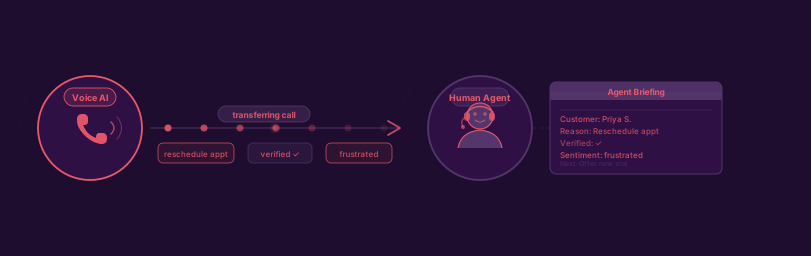
The second major challenge is conversational coherence. A user who says “make it for two” three turns into a booking conversation is referencing something said earlier and the system needs to track that context reliably across the full conversation, not just the last message. Paired with this is graceful failure: no Voice AI achieves 100% accuracy, so what matters is how the system handles uncertainty, asking a natural clarifying question, detecting frustration early, and escalating to a human agent with full context when needed, without the experience breaking down.
Rootle’s approach to quality starts at the infrastructure level. The platform is optimized for end-to-end latency across real telephone calls, not just controlled API demos , with each layer benchmarked against actual call conditions including noise variation, caller pace, and multi-turn depth. Conversation analytics run continuously in the background, flagging where the AI underperforms: intents it misclassifies, turns where users repeat themselves, or sessions that escalate to humans more often than they should. These signals feed directly into model tuning and prompt refinement on a regular basis.
What distinguishes Rootle’s quality standard is that it’s tied to business outcomes, not just technical benchmarks. In hospitality, tourism, or real estate, a poorly handled inquiry isn’t just a UX issue, it’s a lost booking or a dropped lead. Rootle measures performance in terms of task completion, escalation rate, and caller satisfaction, ensuring that every improvement to the platform translates into something that actually matters for the businesses using it.
Automatic Speech Recognition (ASR) The technology that converts spoken audio into written text. ASR is the foundational layer of any Voice AI system and a major determinant of overall accuracy.
Natural Language Understanding (NLU) The AI component that interprets the meaning behind transcribed text — identifying intent, extracting entities, and maintaining context across a conversation.
Text-to-Speech (TTS) The technology that converts written text into spoken audio. Modern neural TTS produces voice output that is nearly indistinguishable from human speech in terms of naturalness and prosody.
Dialogue Management The system that governs the flow of a conversation — tracking goals, managing context, handling ambiguity, and deciding what the AI should say or do next.
Voice Activity Detection (VAD) A signal processing technique that identifies when a human is speaking vs. silence or background noise. VAD is essential for ensuring the ASR layer only processes real speech, reducing errors and improving efficiency.