Skip to content

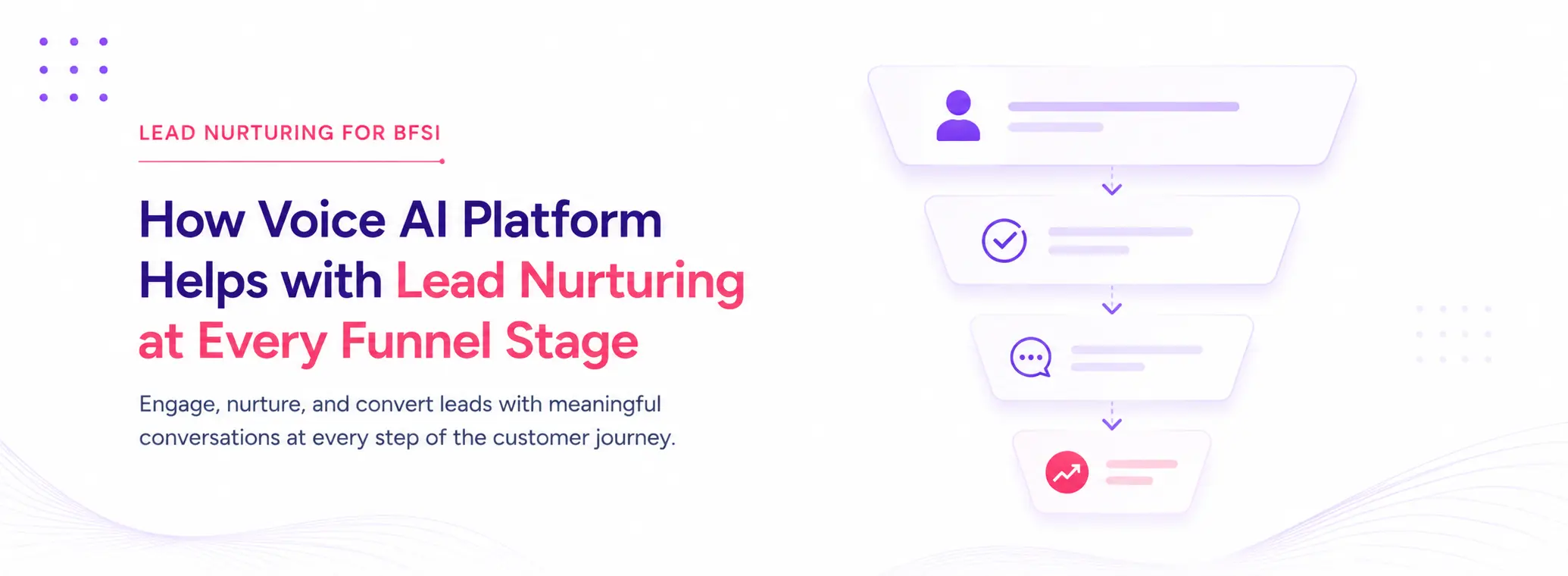
How Voice AI Platform Helps with Lead Nurturing at Every Funnel Stage for BFSI

Featured Image

Executive Summary

Modern financial services face a double challenge: high inquiry volumes and shrinking windows of customer interest. Traditional lead nurturing models fail when delayed by manual outreach. By deploying intelligent voice agents, financial institutions can instantly engage prospects, qualify them across regional languages, and sync high-intent data into their CRM systems in minutes. This strategy removes friction from the funnel, optimizes human sales resources, and fundamentally changes the unit economics of customer acquisition.

When someone searches online for a home loan, a premium credit card, or a term insurance policy, they are usually looking at three different open tabs simultaneously. The financial institution that calls them back first almost always wins the business.

Yet, many banks and insurance providers still batch their web leads, routing them to human call centers hours or even days after the initial click. By then, the prospect has moved on, or worse, signed with a competitor.

To bridge this gap, financial enterprises are shifting toward automated conversational systems. Let’s look closely at how an intelligent voice platform keeps prospects warm, structured, and moving down the conversion funnel.
Voice AI for Lead nurturing - Demo

Top of the Funnel (TOFU): Capturing Interest Instantly

At the top of the funnel, the core priority is simple: do not let incoming interest grow cold.

Many institutions struggle with the question: what is lead nurturing, at this foundational stage. True nurturing does not start with a generic email sequence three days later. It begins the exact minute a prospect expresses interest.

When a user submits a form for an investment plan, an automated voice agent can initiate an outbound call within two minutes. This rapid response capitalizes on peak user intent. Instead of dealing with an unread SMS or an ignored email, the prospect enters a real-time conversation. The system checks basic availability, establishes a polite connection, and confirms that the inquiry was intentional, ensuring no early-stage interest drops through the cracks.

Middle of the Funnel (MOFU): Deepening Lead Qualification Automation

Once a lead responds, the heavy lifting begins. The middle of the funnel is traditionally where bottlenecks happen. Human agents spend hours dialing dead numbers or speaking with unqualified inquiries just to find a single viable prospect.

This is where lead qualification automation changes the dynamic. A voice bot for lead qualification can handle thousands of parallel conversations, asking the critical questions needed to determine profile fit:

• Income and Employment Status: Verifying if the applicant meets the baseline criteria for a premium loan or credit line.

• Existing Liabilities: Conversational gathering of current financial obligations without making the user feel like they are filling out a tedious form.

• Timeline and Urgency: Understanding whether the customer needs a solution this week or is simply researching for next quarter.

Because financial conversations in diverse markets rarely happen in textbook language, advanced platforms use multi-dialect processing. If a customer starts a call in Hindi but naturally switches to Hinglish or Gujarati mid-sentence, the system adapts smoothly. It continues the qualification process without awkward pauses, awkward robotic misunderstandings, or the need to transfer the call to a different regional desk.

Bottom of the Funnel (BOFU): High-Intent Handoff and Conversion

At the bottom of the funnel, the goal shifts to closing the deal. This stage requires deep context and, quite often, human expertise for complex financial structuring.

The voice AI for lead qualification platform acts as the ultimate assistant for your high-performing sales team. Instead of passing over a raw name and phone number, the AI delivers a fully scored, context-rich profile straight into the corporate CRM.

When a human relationship manager picks up the phone to close a high-value home loan, they already know the prospect’s exact budget, documentation readiness, and preferred language. For customers who need just a final push, the voice agent can send relevant brochures, payment links, or scheduling confirmations directly via WhatsApp while the call is still fresh. This ensures a seamless transition where the customer never has to repeat their requirements from scratch.

Re-Engaging Dormant Opportunities: The Bottom-of-Funnel Cleanup

Not every qualified lead converts on the first human attempt. In the financial sector, a massive percentage of prospects stall out right before signing because of documentation delays, friction with underwriting, or simple procrastination.

Instead of letting these expensive profiles rot in the CRM, a dedicated voice agent for lead qualification can run automated re-engagement plays. The platform can periodically call dormant prospects to offer updated interest rates, check if they managed to procure their missing tax certificates, or clear up late-stage concerns. This systematic follow-up rescues pipeline value that would otherwise be entirely forgotten by busy human teams.

Operational Integration: Syncing with Legacy Stack and CRM

The operational value of an automation strategy hinges entirely on how well it communicates with your existing technology stack. A voice platform must operate as a fluid extension of your core banking software and customer databases.

When a voice conversation concludes, the platform immediately pushes the structured interaction data, including intent tags and field updates, directly into systems like Salesforce or Oracle. It triggers secondary workflows instantly, such as notifying specific branch managers or updating marketing automation tags. This high-speed integration prevents data silos, keeps your customer data clean, and ensures that your internal human teams are always operating with the most current customer context.

Real-World BFSI Lead Nurturing Use Cases

To understand how this looks in practice, let’s explore how major financial sectors deploy intelligent voice pipelines to convert raw traffic into loyal policyholders and account owners.

1. Retail Banking: Credit Card and Personal Loan Onboarding

When a user drops off midway through an online credit card application, a voice agent initiates a callback within 90 seconds. Instead of a rigid sales pitch, the bot checks if the user encountered an error or lacked a document, handles basic eligibility sizing (income verification, current credit obligations), and schedules a digital KYC verification link to be sent via WhatsApp immediately after the call.

2. Mortgage and Housing Finance: Pre-Qualification Sorting

Mortgage applications involve extensive detail, meaning sales teams waste days manually chasing missing documents. A voice agent steps in at the middle of the funnel to systematically collect property type choices, funding timelines, co-applicant income variables, and initial downpayment readiness. It updates the loan origination system dynamically, ensuring human loan officers only step in when a folder is document-ready and highly likely to close.

3. Life & Health Insurance: Dropped-Cart Rescue

Insurance purchases require serious thought, leading to extremely high drop-off rates at the final payment screen. Voice AI for insurance act as an automated safety net. The platform triggers an empathetic outbound call to explore why the user hesitated. The system answers immediate questions regarding policy exclusions or cash-settlement histories, runs a live calculation to add a requested accidental death rider, and issues a refreshed payment gateway link directly to the prospect’s screen.

4. Wealth Management & Mutual Funds: Portfolio Sizing and Advisory Routing

High-net-worth inquiries require strict tiering before reaching expensive advisory assets. Voice bots engage incoming wealth leads to conversationally evaluate their investment horizons, risk appetites, and current capital scale. Low-tier capital leads are routed smoothly toward automated digital investment options, while high-intent, premium investors are prioritized for immediate live transfer to a human wealth management consultant.

Conclusion: The Future of Conversational Sales in BFSI

Maximizing the value of financial leads requires a blend of speed, personalization, and operational scale. Relying solely on manual sales teams to filter through raw inquiries creates costly delays and leaves high-value pipeline open to competitors.

Integrating a dedicated voice platform allows financial organizations to automate the repetitive aspects of discovery and qualification. This shift ensures that every inbound lead receives an instant response, while freeing up human relationship managers to focus entirely on high-stakes, revenue-generating conversations. Moving forward, the institutions that successfully embed intelligent conversational voice tools into their sales pipeline will gain a decisive advantage in speed and efficiency.

Where Rootle Fits In: Multilingual Voice AI

Rootle is a voice AI platform built for enterprises that demand more than just automated dialing. While legacy systems stop at playing recordings or basic speech-to-text, Rootle acts as an intelligent extension of your workforce. By combining Agentic AI with real-time system integration, Rootle doesn’t just “talk” to your customers—it executes tasks, resolves queries, and moves the needle on your core business metrics, from DSO reduction to lead conversion.

Conversational Accuracy: Uses advanced speech processing to interpret complex, unstructured human dialogue rather than relying on rigid keypad menus or static scripts.

Fluid Multi-Dialect Capabilities: Switches languages and regional accents instantly mid-sentence without dropping the context of the conversation.

Direct Core System Syncing: Connects natively to enterprise CRMs to log interactions, update custom records, and trigger secondary channels dynamically.

Rapid Ecosystem Deployment: Integrates through secure APIs using pre-configured, finance-specific compliance templates to go live within a few weeks.

Contact us - Rootle

FAQs: Sales Lead Qualification

1. How does Voice AI handle compliance and data security in a heavily regulated sector like BFSI?

Financial environments demand strict adherence to regulatory frameworks, meaning data privacy cannot be an afterthought. Enterprise-grade voice platforms are designed to embed compliance directly into the conversational flow. They utilize secure cloud or private on-premise deployments that align with banking guidelines.

During a call, sensitive data is protected through automated masking and data redaction tools, ensuring things like credit card numbers or personal identification values are never saved in plain text transcripts. Furthermore, every single interaction automatically generates a complete, encrypted audit trail. This gives compliance teams full visibility into exactly what was promised, how identity was verified, and how consent was captured during the conversation.

2. Can a voice bot actually build trust during complex financial conversations, or does it feel too robotic?

Building trust is not a matter of trying to trick a user into thinking an AI is a real person. It comes from offering a predictable, clear, and emotionally aware experience. Modern conversational platforms look past simple static scripts. They analyze vocal tone, hesitation, and speech patterns in real time to understand the underlying customer emotion.

If a prospect sounds confused or stressed about an insurance claim or loan rejection, the system shifts its vocabulary to a reassuring, direct tone. Because the AI never gets tired, loses its temper, or provides inconsistent policy details, it creates a deeply reliable touchpoint. When people are dealing with financial decisions, a clear, immediate answer often builds far more confidence than waiting on hold for twenty minutes for an overworked human agent.

3. What specific features make Rootle distinct from traditional interactive voice response systems?

Traditional legacy systems are rigid menus that force users to tap numbers on a keypad, usually leading to a dead end or a long hold queue. Rootle is an intelligent conversational platform built to handle the chaotic nature of real-world human speech.

Instead of forcing users through fixed paths, Rootle understands open-ended answers, responds with human-like latency, and manages complex, multi-turn conversations. It can change languages naturally mid-call if a customer switches dialects. Most importantly, it connects directly with live business systems. It does not just log a conversation; it dynamically updates CRMs, triggers instant WhatsApp follow-ups with relevant documents, and scores intent signals on the fly based on what the customer actually said.

4. How long does it typically take to deploy Rootle's voice agents within an existing banking tech stack?

Because financial institutions run on deeply entrenched legacy software, software integration can sometimes look daunting. Rootle addresses this by utilizing pre-configured, industry-specific conversation templates designed specifically for use cases like retail banking, insurance processing, and loan qualification.

The platform connects to modern CRMs like Salesforce, HubSpot, and Zoho right out of the box using secure APIs. This architecture allows organizations to design, test, and deploy functional voice workflows within a matter of weeks rather than embarking on a multi-month custom engineering project.

5. In what ways does an AI for lead qualification impact the overall cost per acquisition for financial products?

Manual calling operations carry incredibly high fixed costs, primarily driven by call center real estate, agent turnover, and massive amounts of time wasted on dead leads. Implementing automated qualification shifts these economics completely.

The system scales instantly to process thousands of simultaneous inbound leads during peak campaign surges without requiring a change in headcount. By filtering out uncontactable numbers, wrong entries, and low-intent profiles automatically, the AI ensures that your expensive, highly trained human sales reps only spend their time talking to pre-qualified, warm prospects. This optimization dramatically lowers the operational cost per contact while pushing conversion rates higher.

Rahul Desai
Rahul Desai
Client Growth Manager

Rahul Desai is a client growth and sales professional with extensive experience driving strategic partnerships and revenue growth. At Rootle.ai, he focuses on expanding market reach, enabling enterprises to leverage multilingual voice AI for intelligent customer engagement and automated conversational experiences.

Recent Blogs

Why Sales Teams Rely on Voice AI for Faster Lead Follow-Ups
Voice AI for debt collection.
Phone shows 'Payment Successful' with ₹5,000 received, placed beside purple wireless headphones on a desk.