Skip to content

EMI Collection Automation: How Voice AI Handles First-Time Defaulters

Featured Image

Executive Summary

The rapid growth of the New-to-Credit (NTC) and New-to-Bank (NTB) segments across Indian NBFCs and fintech platforms has brought a distinct credit risk challenge: first-time default due to financial illiteracy rather than intentional evasion. Relying on aggressive, third-party BPO dunning agencies for early-stage delinquency alienates these fragile cohorts and triggers steep customer churn.

Deploying a specialized AI voice agent for EMI collection fundamentally restructures this process, replacing confrontational calls with automated, highly compliant, and empathetic multilingual dialogues that capture payment commitments while preserving long-term brand affinity.

The retail lending boom in tier-2, tier-3, and rural India has been built on the back of the New-to-Credit (NTC) borrower. Driven by data-backed fintechs and digital NBFCs, millions of individuals are accessing formal credit for the very first time in their lives.

This access presents a massive growth opportunity, but it comes with an operational catch.

NTC borrowers frequently default on their first or second Equated Monthly Installment (EMI). However, unlike chronic defaulters who intentionally avoid payment, an NTC borrower usually misses a payment due to logistical confusion. They might not understand how an automated National Automated Clearing House (NACH) debit mandate works, they might fail to fund their bank account on the exact correct date, or they might simply be confused by a digital payment interface.

When a lender hands these fragile, early-stage collections over to traditional third-party recovery BPOs, the results are often disastrous.

Aggressive dunning scripts, intense caller pressure, and rigid language constraints alienate borrowers who simply needed guidance. The borrower pays the single overdue bill out of fear, but they never take another loan from that platform again. Your lifetime customer value plummets.

This is where a dedicated AI voice agent for EMI collection redefines the mechanics of early-stage financial recovery.
1. De-escalating Fear with Judgement-Free, Empathetic Automation

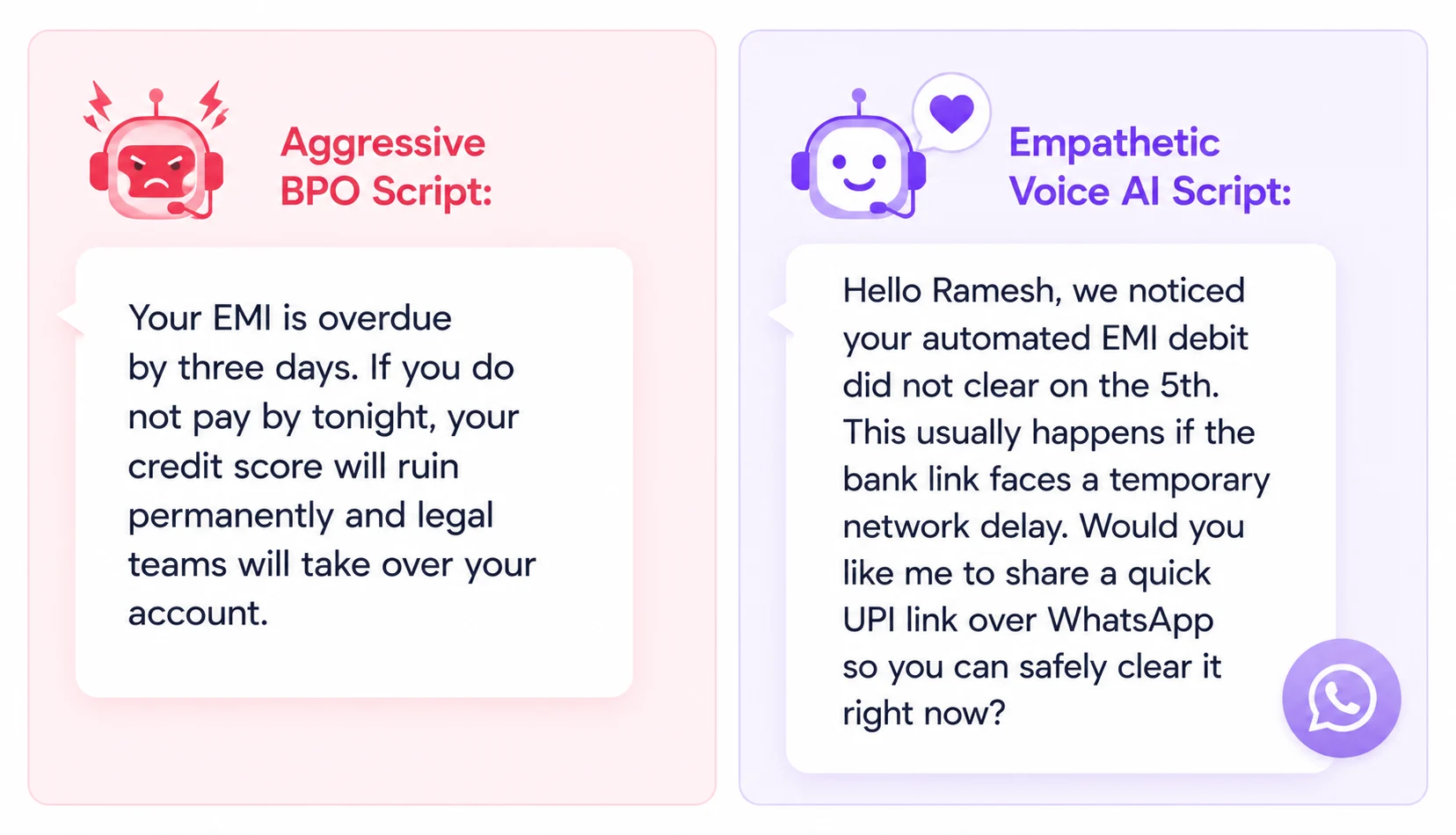
When a human collection agent dials an overdue borrower, the conversation starts under stress. Human callers often carry subconscious biases, show signs of fatigue, or adopt an aggressive posture to hit daily collections targets. For an NTC borrower who made an honest operational mistake, receiving a hostile phone call triggers instant defensiveness or causes them to block your number entirely.

A voice bot for collection removes this friction by offering a completely non-judgmental space. Software does not experience emotional fatigue, and it does not express irritation.

Instead of demanding an immediate payment via rigid script structures, conversational voice systems use acoustic intelligence to evaluate the borrower’s response tone. If the system detects anxiety or confusion, it automatically pivots to a soft, consultative script layout.

BPO script vs Voice AIThis structural shift transforms a high-pressure demand into a helpful service reminder, keeping your brand perception positive while ensuring the debt gets cleared.

2. Managing Complex Multi-Dialect Code-Switching at Scale

The vast majority of India’s NTC borrowers live outside major metro areas. They are highly comfortable communicating in their local vernacular dialect or using regional code-mixed language blends like Hinglish, Tamlish, or local variations of Kannada and Telugu.

If a BPO agent speaks with a slight linguistic mismatch or fails to interpret regional slang, the customer often terminates the call.

By deploying conversational collection automation, lenders can navigate regional language realities seamlessly. Advanced voice platforms are pre-trained on regional Indian accents and vernacular code-switching behaviors.

If a borrower answers in English, moves into Hindi to explain an income delay, and drops a regional Marathi phrase to describe their banking issue, the AI agent tracks the entire linguistic shift in real time. It responds in the identical blended dialect, ensuring the customer fully understands their account status without feeling isolated by language barriers.

3. Real-Time Structural Triage: Capturing Promises to Pay (PTP)

For an early-stage default, the primary goal of your collection strategy should be capturing clean data rather than threatening legal action. You need to know why the payment failed so you can apply the correct remedy.

Advanced EMI collection software coupled with voice bots conducts automated structured diagnostics across your entire 0-30 Days Past Due (DPD) bucket. The platform systematically extracts the underlying reason for non-payment during the conversation:

Detailed Comparison
Captured Borrower Response System Understanding Automated Real-Time Action
"My account was not funded on time." Logistical delay Capture a specific Promise to Pay (PTP) date; schedule a friendly follow-up call.
"The auto-debit page threw an error code." Technical failure Instantly trigger a deep-linked UPI payment handle over WhatsApp while the user is live on the call.
"I lost my job this month." Genuine financial hardship Flag the profile automatically in the CRM; transfer the call cleanly to an internal human restructuring specialist.

By letting software process the high-volume diagnostic phase across thousands of accounts concurrently, your operational costs drop by more than 50%. Your expensive human team can step away from basic reminder tasks and focus exclusively on high-complexity hardship cases.

4. Total Alignment with Changing Regulatory Frameworks

Operating a loan recovery engine in India requires navigating strict regulatory boundaries. With the Reserve Bank of India (RBI) placing tight restrictions on aggressive collection habits, and the Telecom Regulatory Authority of India (TRAI) enforcing strict commercial calling hours and digital consent tracking, manual human calls present a major compliance risk. One rogue BPO agent using abusive language can result in severe central bank penalties and massive public relations damage.

An AI voice agent for EMI collection operates as a reliable compliance shield. The underlying software models are completely incapable of using unapproved phrasing, calling outside designated regulatory hours (8 AM to 7 PM), or bypassing TRAI DND registries.

Every single phone conversation is tracked, transcribed, and evaluated for compliance standards automatically. You gain a perfect, auditable record of every interaction, ensuring your collection practices remain highly professional and fully aligned with the RBI Fair Practices Code.

The choice for modern fintechs and NBFCs is clear: relying on legacy BPO structures to dun first-time borrowers destroys customer relationships right when they are most valuable. Transitioning to specialized conversational voice automation allows you to protect your customer lifecycle, maintain absolute compliance, and collect early-stage debts with consistent empathy.

Where Rootle Fits In: Multilingual Voice AI

Rootle is a voice AI platform built for enterprises that demand more than just automated dialing. While legacy systems stop at playing recordings or basic speech-to-text, Rootle acts as an intelligent extension of your workforce. By combining Agentic AI with real-time system integration, Rootle doesn’t just “talk” to your customers—it executes tasks, resolves queries, and moves the needle on your core business metrics, from DSO reduction to lead conversion.

Zero-Delay Language Adaptation: Rootle features auto-language detection that eliminates robotic “press 1 for English” menus. The platform listens to the caller first and instantly adapts to regional dialects and code-mixed blends like Hinglish or localized Gujarati.

Massive Concurrency Scaling: Built to handle sudden marketing surges, the cloud-hosted platform is stress-tested to run over 10,000 concurrent inbound and outbound calls simultaneously without drops in audio quality or processing latency.

Bi-Directional CRM Synchronization: Rootle functions as an active transactional layer rather than just an answering service. It extracts structured data from unstructured verbal conversations and uses live API webhooks to update lead scores, log context, and push instant WhatsApp follow-ups directly to the consumer while the call wraps up.

Fully Managed Rapid Deployment: Operating as a no-code, fully managed stack, Rootle cuts deployment timelines down to 8–10 days. Businesses can launch tailored support, lead qualification, or recruitment workflows out of the box without requiring specialized in-house engineering resources.

Contact us - Rootle

FAQs: EMI Collection Automation

1. How does a conversational voice AI platform handle a borrower who interrupts or talks over the bot during an EMI call?

Legacy automated voice dialers run on rigid, pre-recorded audio loops that play continuously even if the customer is trying to speak, creating a highly robotic and frustrating user experience. Advanced platforms like Rootle use zero-latency barge-in processing layers. The system actively listens even while it is synthesizing its own spoken response. The moment the borrower speaks up or asks a question mid-sentence, the AI agent halts its current stream, processes the user’s interruption, updates its contextual state, and delivers an immediate answer without forcing an awkward pause.

2. Can an AI voice agent for EMI collection execute complex payment arrangements, or does it just state the outstanding balance?

The platform functions as a dynamic transactional engine rather than just a simple information broadcaster. It links right up with your internal core banking systems and loan management platforms through secure APIs. If a borrower states they cannot clear the entire overdue bill today, the AI agent evaluates the user’s past credit patterns against your pre-approved credit guidelines in real time. It can then offer structured repayment choices, such as breaking the balance into two smaller split payments or waiving a minor late fee if they clear the core principal balance over the live line.

3. What operational metrics can an NBFC expect to see improve immediately after deploying Rootle for early-stage debt collection?

Real-world deployment metrics show that moving from manual call centers to Rootle’s automated collection engine drops overall operational handling expenses by more than 55%. Because the AI system can initiate thousands of clean outbound calls simultaneously without experiencing human fatigue, early-stage accounts contacted daily scale up by 3x. Lenders see an immediate 20% to 40% lift in their early-stage Promise to Pay (PTP) conversions, as borrowers generally prefer discussing financial delinquency in a judgment-free, automated environment.

Read case study: 200% Conversion Lift: How Voice AI for Financial Services Closed “Midnight Gap” for Shriram Finance Ltd

4. How does Rootle guarantee that customer financial records and sensitive loan data stay protected during cloud calling operations?

Rootle uses an enterprise-grade security architecture that meets strict SOC 2 Type II compliance standards and aligns fully with India’s Digital Personal Data Protection (DPDP) Act guidelines. When a collection campaign runs, all customer information is completely encrypted both while moving across networks and when saved on cloud clusters. Sensitive data fields, including full bank account numbers or private identifiers, are dynamically masked before interacting with the conversational AI models. Transactions process seamlessly via secure API links, passing payment results right back to your native systems without holding customer records on public nodes.

5. How long does it take to train and integrate Rootle's voice bot for collection with an existing loan management system?

Rootle functions as a fully managed, low-code platform layer, which means your internal IT department does not need to build complex machine learning models from scratch. A typical enterprise integration takes between 8 to 10 days to go completely live. During the first week, our deployment team maps your specific loan escalation paths, configures the native API data pipelines with your current CRM tools, and fine-tunes the regional language engines to match your target geographic borrower demographics, allowing you to run a fully optimized, compliant pilot campaign by day ten.

Rahul Desai
Rahul Desai
Client Growth Manager

Rahul Desai is a client growth and sales professional with extensive experience driving strategic partnerships and revenue growth. At Rootle.ai, he focuses on expanding market reach, enabling enterprises to leverage multilingual voice AI for intelligent customer engagement and automated conversational experiences.

Recent Blogs

Voice AI for payment reminders
Phone shows 'Payment Successful' with ₹5,000 received, placed beside purple wireless headphones on a desk.
Voice AI in BFSI