The growing New-to-Credit (NTC) segment is an operational pain point for Indian lenders. When a first-time borrower misses an installment,...
11 June 2026
Insurance companies invest heavily in acquiring customers, yet billions in premiums slip through the cracks every year during the renewal cycle. It is rarely because a policyholder explicitly decides to drop their coverage. Instead, the failure happens in the final days before a policy lapses—the last mile.
Most insurers rely on a standard playbook: a barrage of automated SMS alerts, WhatsApp nudges, and emails. If those fail, the case moves to a manual calling queue. In a diverse market like India, this rigid formula hits a wall. Financial decisions are deeply personal, and when a reminder arrives in a language the customer does not fully master, it gets ignored.
Manual call centers cannot efficiently solve this problem. Hiring, training, and scaling separate teams for Tamil, Telugu, Marathi, Gujarati, and Bengali creates massive operational overhead. Human agents face limited calling hours, high burnout rates, and the friction of manual dialing. While your team tries to clear a backlog of thousands of expiring policies, the clock runs out, the policy lapses, and the company loses predictable revenue.
Standard collection automation treats renewals as a one-way notification system rather than a conversation. An SMS with a payment link cannot answer a customer’s immediate questions. When a policyholder opens a reminder, their first reaction often involves variables that text cannot resolve:
• Why did my premium increase this year?
• Can I change my nominee before I pay?
• Is my pre-existing condition still covered?
• Can I split this into smaller payments?
If the system cannot answer these questions on the spot, the renewal stalls. The policyholder sets the message aside, intends to look into it later, and simply forgets.
This friction intensifies during EMI collection. Managing monthly or quarterly premium schedules requires consistent, precise, and empathetic follow-ups. If a collection agent calls at an inconvenient time or struggles with a local dialect, the relationship strains. Traditional automation lacks the flexibility to adapt to these nuances, resulting in leaked premiums and dropped persistency rates.
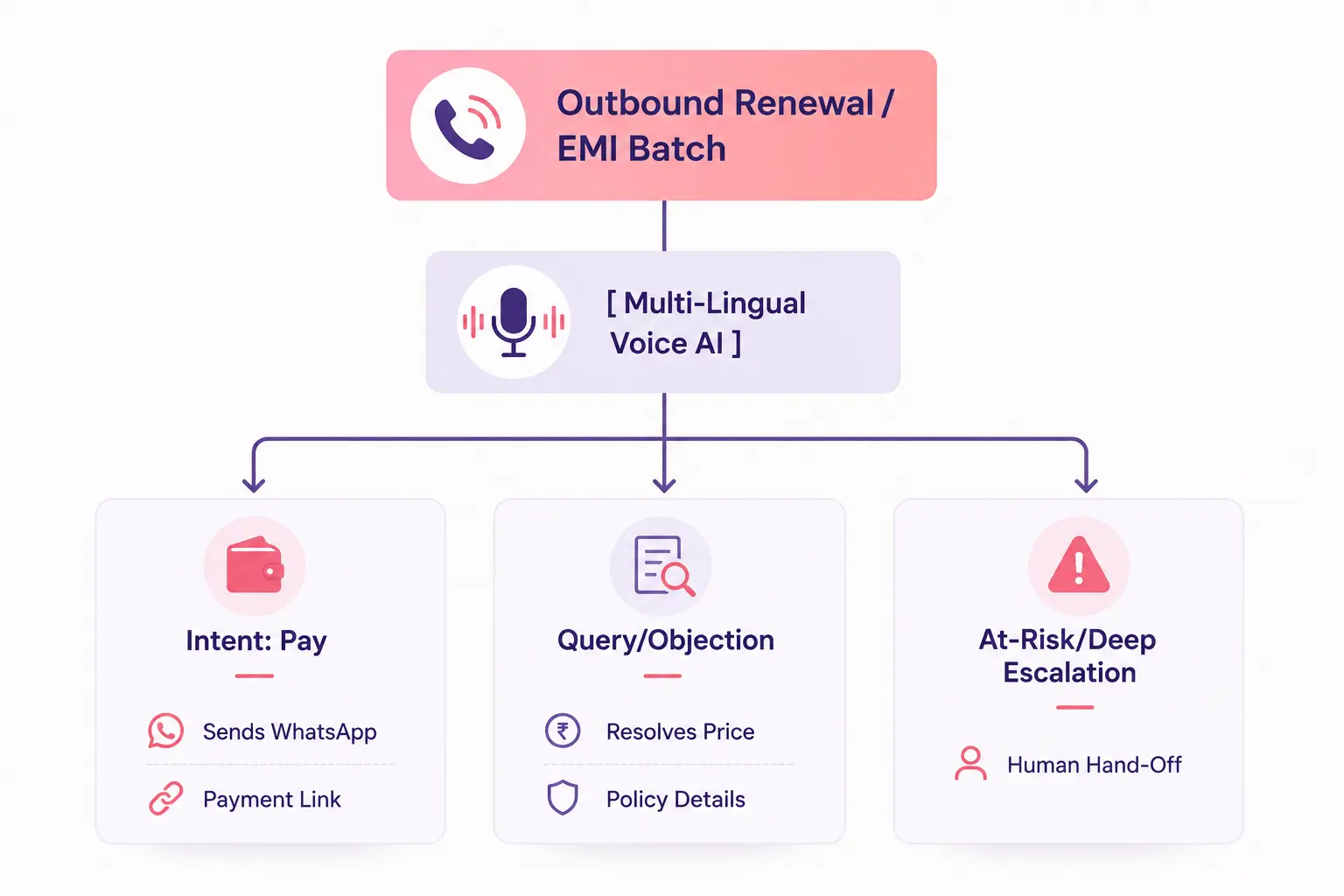
The ultimate test of any insurance renewal strategy is execution at the regional level. When traditional notifications fail and manual calling operations stall, Rootle steps in to bridge the gap. By deploying hyper-localized, context-aware voice AI, Rootle transforms insurance premium collection from a rigid, one-way broadcast into a meaningful, multi-lingual dialogue. Embracing this automation allows insurance providers to eliminate friction, respect cultural and linguistic preferences, and turn vulnerable last-mile lapses into reliable, recurring revenue.
Modern voice AI platforms use advanced speech-to-text models trained on diverse regional datasets. This allows them to comprehend varying dialects and smoothly process code-switched speech, such as a mix of Hindi and English, ensuring the conversation flows naturally.
Yes. The platform integrates directly with payment gateways and communication channels. During the conversation, the AI can trigger an instant SMS or WhatsApp payment link and stay on the line to confirm receipt.
By automating the initial outreach and handling routine premium reminders, voice AI dramatically reduces the volume of manual outbound calls. This lowers the cost per interaction significantly while keeping human teams focused on complex cases.
Enterprise-grade voice AI solutions are built to comply with strict local regulations, including India’s Digital Personal Data Protection Act. They utilize end-to-end encryption and secure CRM integrations to ensure policyholder data remains fully protected.
When the system encounters an unfamiliar query or senses customer frustration, it executes a clean handoff to a human representative. The live advisor receives the call alongside a summary of the AI interaction, meaning the customer never has to repeat themselves.