


Skip to content

Beyond Metro Limits: How Voice AI Solves India’s Complex Linguistic Landscape

Featured Image

Executive Summary

As enterprise growth in Tier-1 metros reaches saturation, the next frontier for Indian commerce lies in Tier-2, Tier-3, and Tier-4 markets. However, expanding into non-metro regions presents an immediate operational roadblock: extreme linguistic diversity. With 22 official languages, over 19,500 dialects, and widespread code-switching (such as Hinglish, Tanglish, and Gujlish), traditional English-first or rigid touch-tone IVR systems fail.

To capture this non-metro demand, forward-thinking enterprises are replacing static phone trees with conversational Voice AI platforms. By combining dialect-aware Automatic Speech Recognition (ASR), code-switching Natural Language Understanding (NLU), and sub-300ms speech synthesis, multilingual Voice AI allows businesses to answer, qualify, and serve customers in their native dialects. This eliminates contact center language barriers, lowers per-call operational costs by up to 80%, and unlocks massive, previously unserved regional consumer markets.

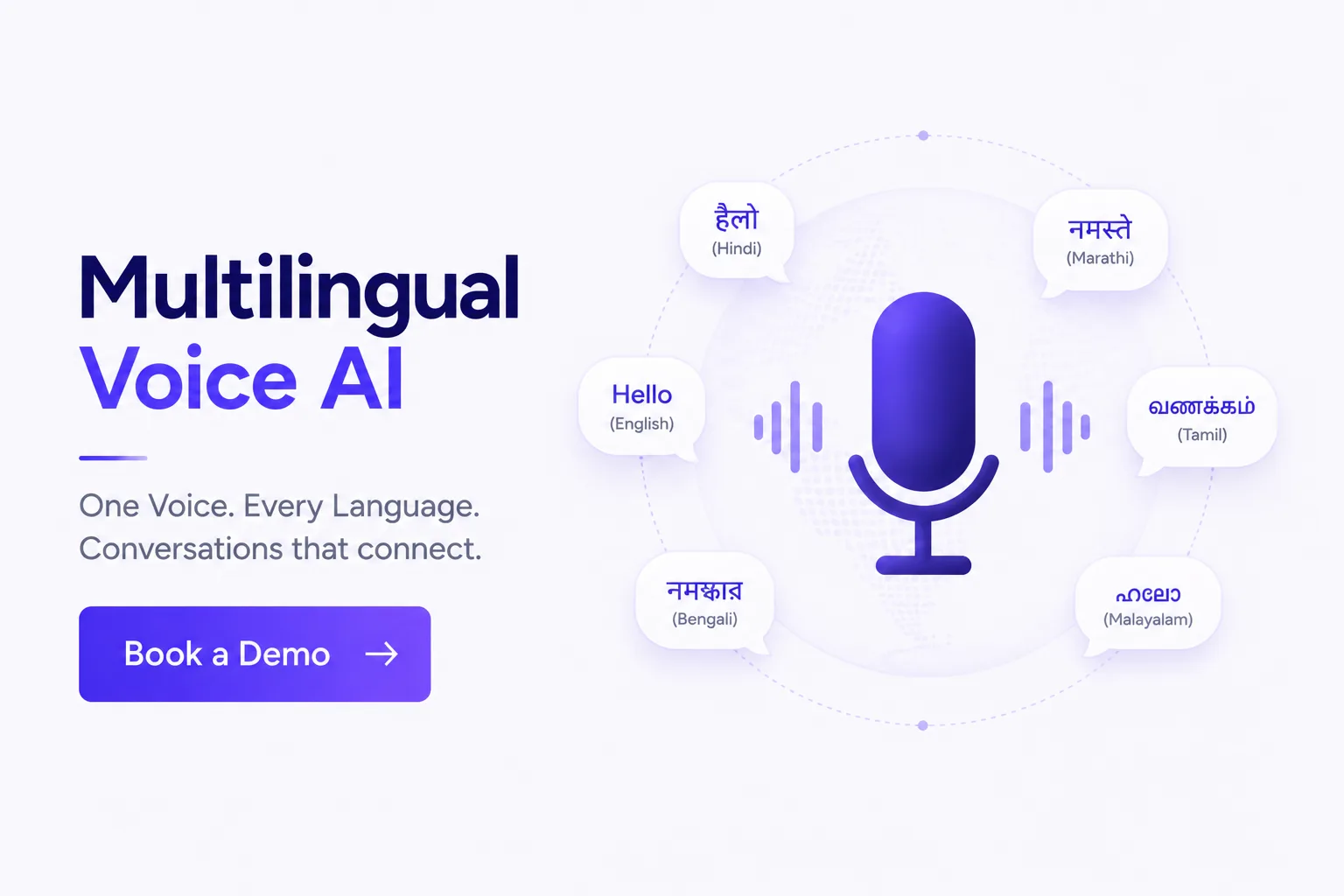
Hero banner for Multilingual Voice AI with a purple microphone graphic and language bubbles (English, Hindi, Marathi, Tamil, Bengali, Malayalam) around a globe image on the right.

Over 80% of new internet and smartphone adopters in India reside in non-metro towns and rural hinterlands. These consumers prefer voice over text and rely heavily on spoken communication in their regional languages.

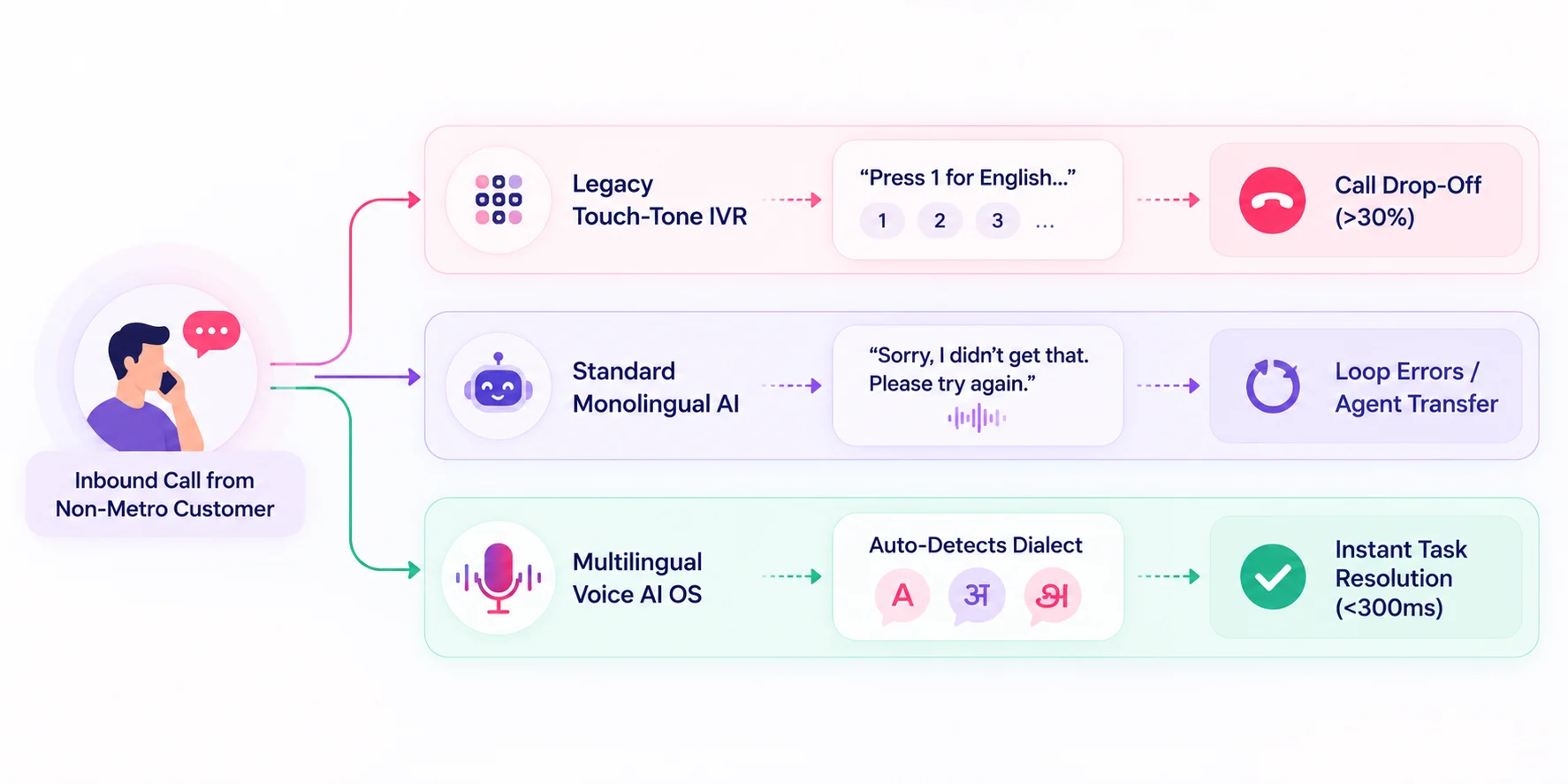
However, enterprise contact centers attempting to scale into these markets face three major structural failures when using traditional technology:
1. The Code-Switching Reality

Indian consumers rarely speak in pure dictionary prose. A customer calling from a Tier-2 town in Uttar Pradesh or Tamil Nadu routinely mixes vocabulary mid-sentence:

• Hinglish: “Mera order status check karna hai, delivery expected kab tak hai?”

• Tanglish: “Ennodaya payment status kya aachu? Refund link anuppunga.”

Global monolingual ASR engines treat this fluid speech as broken grammar, causing high Word Error Rates (WER) and dropped calls.

2. The Diglossia & Regional Dialect Gap

Written formal scripts differ sharply from spoken colloquial dialects. For example, spoken Marathi in Vidarbha differs in cadence and vocabulary from coastal Konkan Marathi. Standard voice bots trained on formal text corpora cannot process local acoustic nuances, resulting in poor intent recognition.

3. BPO Staffing & Language Seat Costs

Staffing physical BPO call centers with agents fluent in 15+ regional languages and local dialects is cost-prohibitive. High agent attrition (30%–45%) and high cost-per-call (₹40–₹120) make human-only support unscalable across non-metro expansion drives.

Technical Architecture: How Enterprise Voice AI Solves Dialect Complexity

To deliver human-grade conversational experiences across India’s linguistic spectrum, enterprise Voice AI utilizes a specialized three-tier speech stack:
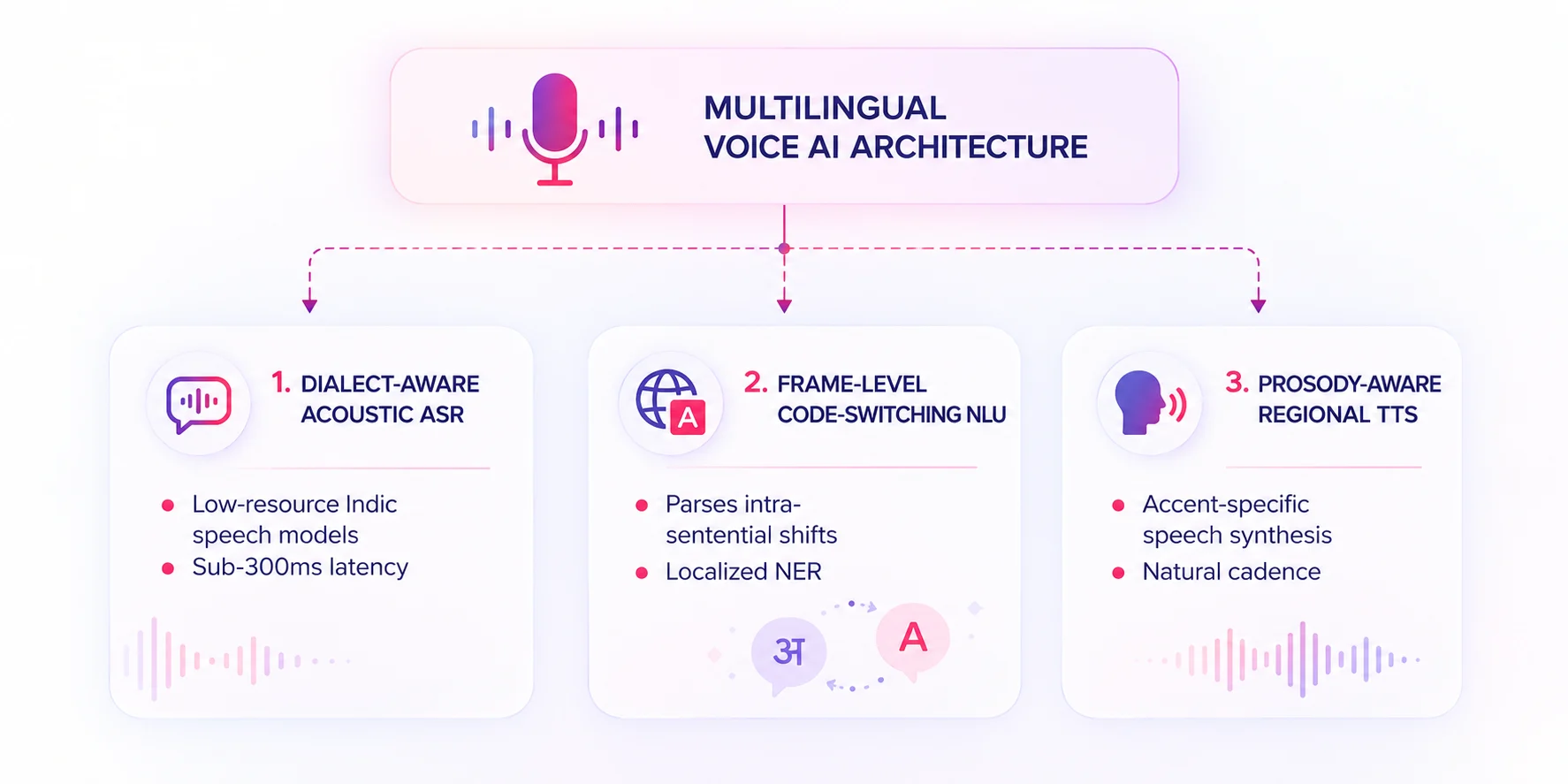
HTML Table Generator
Technology Component
Legacy Voice Bot / IVR
Enterprise Vernacular Voice AI
Business Impact
Language Coverage English + Monolingual Hindi 20+ Indian languages + regional dialects Complete access across Tier-1 to Tier-4 regions
Code-Switching Fails on mixed vocabulary Native parsing of Hinglish, Tanglish, Gujlish Natural, unfiltered customer dialogue
Language Detection Static button selection Dynamic frame-level auto-detection Zero friction when callers change languages mid-call
Response Latency 1.5 – 3.0 seconds Sub-300 milliseconds Eliminates awkward pauses; supports barge-in
Alphanumeric Processing Reads numbers as huge sums Parses PIN codes, VINs, & IDs digit-by-digit Accurate account & order lookup

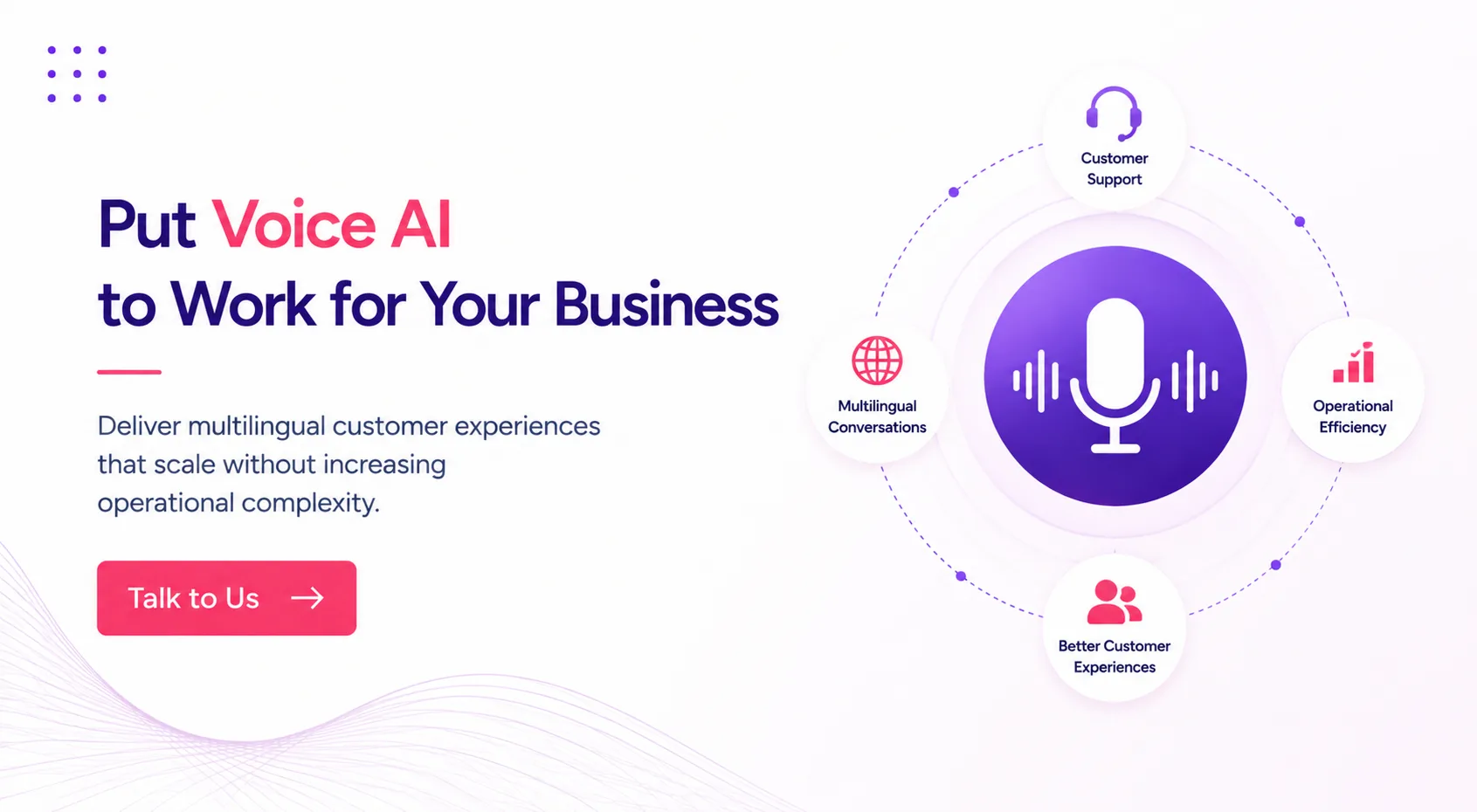
Hero banner promoting Voice AI for business, with a central purple microphone and circular icons for Support, Multilingual Conversations, Operational Efficiency, and Better Customer Experiences.

Strategic Enterprise Impact: Scaling Across Non-Metro India

Deploying multilingual Voice AI transforms customer acquisition, support, and sales across regional markets:

  1. 24/7 Uninterrupted Service Availability: Non-metro customers frequently call outside standard business hours. Voice AI agents answer 100% of calls instantly without queues or night-shift BPO fees.

  2. Instant “Speed-to-Lead” Callbacks: When a prospective buyer in a Tier-3 town fills out a lead form for an auto test drive, EdTech course, or loan application, the Voice AI agent triggers an automated callback in 15 seconds—qualifying intent in the buyer’s local dialect before competitors follow up.

  3. 80% Reduction in Operational Overhead: Automating high-volume tier-1 queries (order tracking, payment status, appointment bookings) lowers completed interaction costs from ₹40–₹120 down to ₹4–₹12 per call.

What Rootle Does Differently

Rootle is a voice AI platform built for enterprises that demand more than just automated dialing. While legacy systems stop at playing recordings or basic speech-to-text, Rootle acts as an intelligent extension of your workforce. By combining Agentic AI with real-time system integration, Rootle doesn’t just “talk” to your customers—it executes tasks, resolves queries, and moves the needle on your core business metrics, from DSO reduction to lead conversion.

• Conversational Accuracy: Uses advanced speech processing to interpret complex, unstructured human dialogue rather than relying on rigid keypad menus or static scripts.

• Fluid Multi-Dialect Capabilities: Switches languages and regional accents instantly mid-sentence without dropping the context of the conversation.

• Direct Core System Syncing: Connects natively to enterprise CRMs to log interactions, update custom records, and trigger secondary channels dynamically.

• Rapid Ecosystem Deployment: Integrates through secure APIs using pre-configured, industry-specific compliance templates to go live within a few weeks.


FAQs: Hindi AI Voice Agents for Automotive

1. How many Indian languages and dialects can an enterprise Voice AI platform support?

Enterprise Voice AI platforms like Rootle support over 20 constitutionally recognized Indian languages—including Hindi, Tamil, Telugu, Kannada, Marathi, Gujarati, Bengali, Malayalam, Punjabi, Odia, and Assamese—alongside regional dialect variations.

2. What is code-switching, and how does Voice AI handle it in India?

Code-switching is the practice of alternating between two or more languages within a single sentence (e.g., Hinglish or Tanglish). Advanced Voice AI engines use frame-level language identification to process mixed-language inputs natively without misinterpreting customer intent.

3. How does the AI Voice Agent identify which language the caller is speaking?

The system utilizes real-time spoken language identification (LID) algorithms during the initial seconds of the call. It detects the caller’s language and accent automatically from their opening words and adapts its responses instantly.

4. Can a customer switch languages in the middle of a phone call?

Yes. If a caller starts in English but transitions to Hindi or Telugu mid-call, modern Voice AI engines detect the shift dynamically and continue the conversation smoothly in the preferred language without resetting the call.

5. How does Voice AI handle Indian alphanumeric data like PIN codes, vehicle registration numbers, and phone numbers?

Enterprise Voice AI platforms incorporate specialized Indian Named Entity Recognition (NER) models. They parse numbers, PIN codes, and alphanumeric codes (like vehicle registration plates or transaction IDs) digit-by-digit in regional accents rather than misinterpreting them as large numeric values.

Client Growth Manager

Rahul Desai is a client growth and sales professional with extensive experience driving strategic partnerships and revenue growth. At Rootle.ai, he focuses on expanding market reach, enabling enterprises to leverage multilingual voice AI for intelligent customer engagement and automated conversational experiences.

Talk to our Experts

Recent Blogs

Banner comparing Conversational AI and Voice AI with the text “What’s the Difference?” and icons for chat and microphone.
Why Multilingual Voice AI in Regional Languages Is the Future of Customer Support