The Indian market does not operate in a single language, nor does it speak in textbook grammar. Off-the-shelf Western voice models fail in India because they are built English-first and assume rigid, monolingual sentence structures.
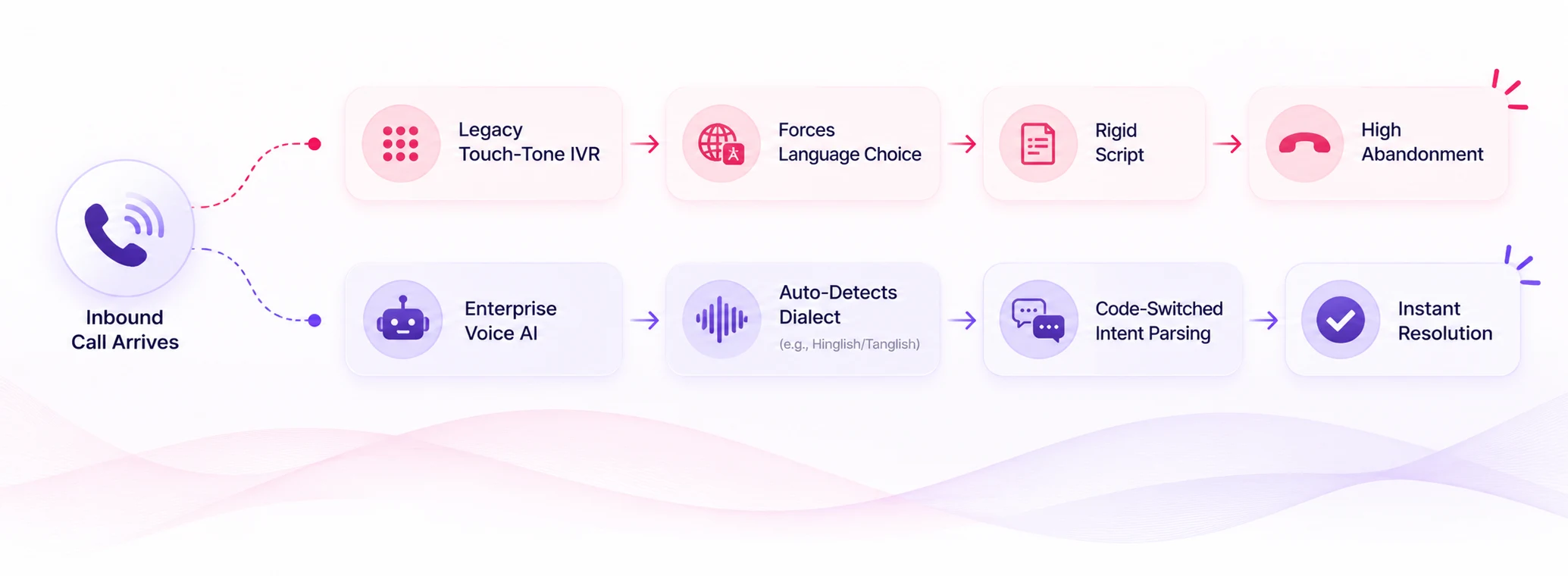


The Indian market does not operate in a single language, nor does it speak in textbook grammar. Off-the-shelf Western voice models fail in India because they are built English-first and assume rigid, monolingual sentence structures.
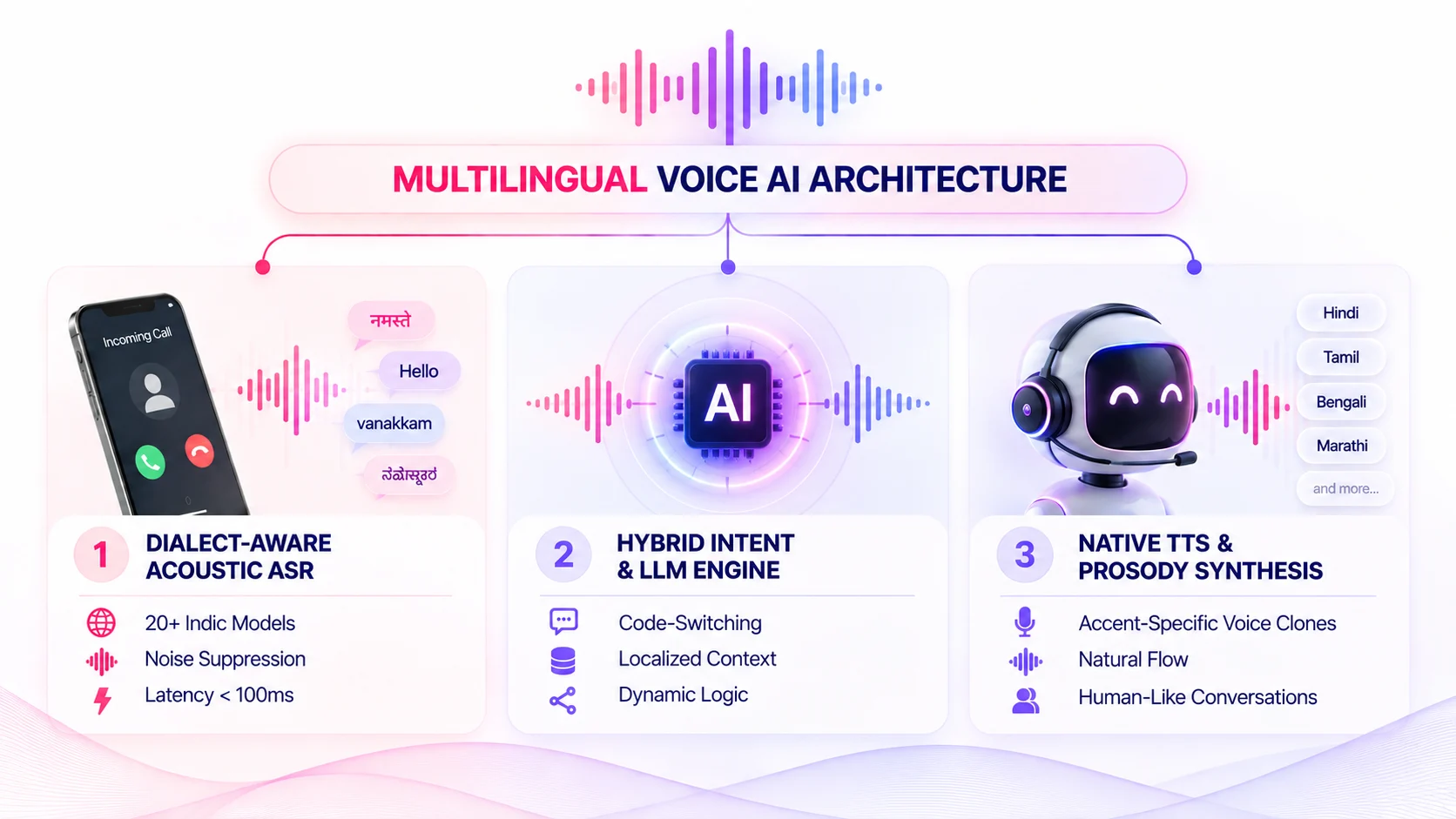
To deliver natural, human-grade front-desk experiences across India, enterprise Voice AI leverages a three-tier speech architecture:
| Language Coverage | 2–3 standard languages | 20+ Indian languages + regional dialects | Complete coverage across Tier-1 to Tier-4 regions |
| Code-Switching | Fails on mixed vocabulary | Native parsing of Hinglish, Tanglish, Gujlish, etc. | Unfiltered, natural conversational flow |
| Speech Latency | 1.5 – 3.0 seconds | < 300 milliseconds | Eliminates long pauses; supports natural caller barge-in |
| Language Switching | Requires menu restart | Dynamic mid-call switching based on caller input | Zero friction when callers change languages |
| Numeric Processing | Reads phone numbers as large sums | Digit-by-digit or vernacular grouping (Lakhs/Crores) | Accurate verification of IDs, policy numbers, and dates |
Inbound calls in India originate from diverse environments—crowded streets, public transit, or low-bandwidth networks. Acoustic models utilize deep-learning noise suppression combined with dataset training across Indian speech corpora (such as Kathbath, Shrutilipi, and regional audio sets). This ensures high accuracy even over traditional telephony (PSTN/GSM) networks.
Instead of translating spoken audio to English before processing—which introduces latency and destroys local context—modern AI platforms process intent directly within native-language embeddings. The NLU understands localized concepts, such as regional naming conventions, Indian address structures, and colloquial time references (“duphar ko”, “kal shaam”).
Responding in a native language requires accurate tonal cadence. Modern TTS engines generate speech using regional phoneme mapping, ensuring that numbers, proper nouns, and clinical or financial terms are pronounced naturally without robotic inflections.
A major hospital network with facilities across North and South India faced high inbound call abandonment (over 28%) during morning appointment hours:
• The Challenge: Patients called from diverse regional backgrounds, speaking Hindi, Telugu, Tamil, Marathi, and mixed dialects. Standard phone menus caused long hold times and misrouted bookings.
• The AI Deployment: An Inbound AI Receptionist was implemented to handle all front-desk inquiries in 12 languages with automatic language detection.
• The Result: The system managed over 80,000 monthly inbound calls, reduced average speed-to-answer to under 1 second, resolved 72% of scheduling queries without human agent intervention, and cut front-desk operational overhead by 68%.
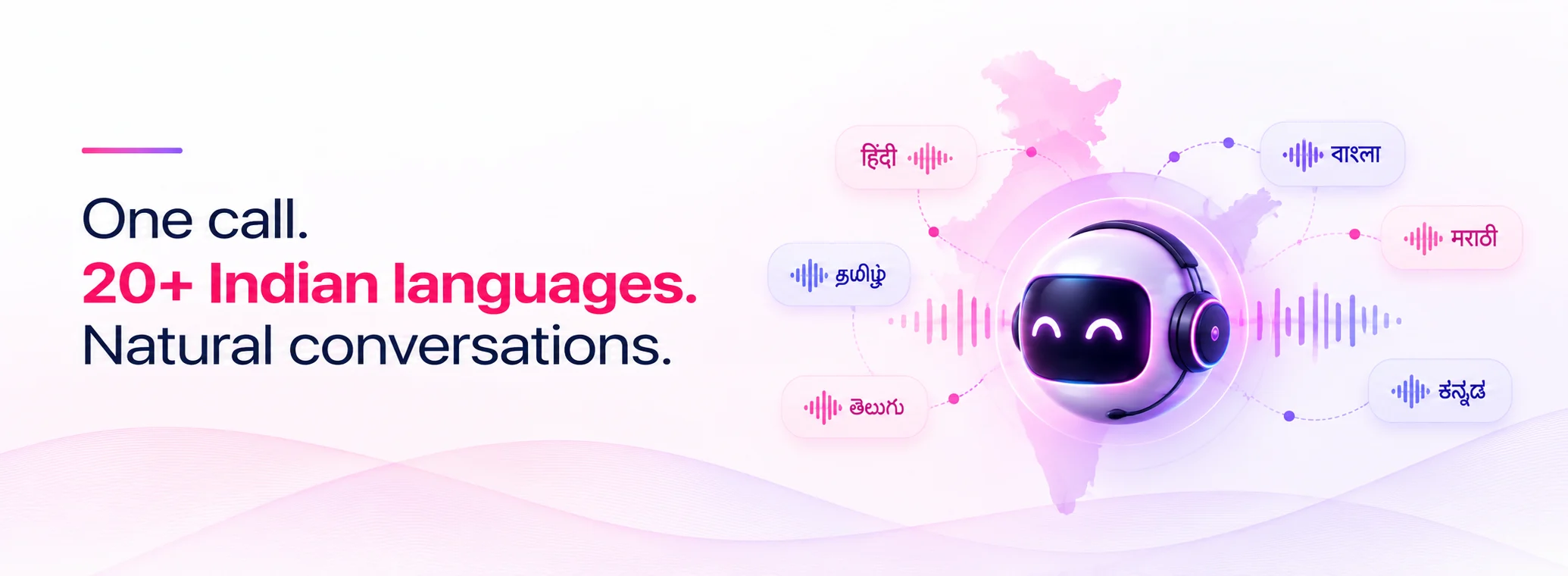
Enterprise Voice AI platforms like Rootle support over 22 constitutionally recognized Indian languages—including Hindi, Tamil, Telugu, Kannada, Marathi, Gujarati, Bengali, Malayalam, Punjabi, Odia, and Assamese alongside regional dialect variations.
Code-switching is the practice of alternating between two or more languages in a single conversation (e.g., Hinglish or Tanglish). Specialized AI speech models parse these mixed-language inputs natively, recognizing English loanwords within native grammar structures without misinterpreting intent.
The system utilizes real-time spoken language identification (LID) algorithms during the first few seconds of the call. It identifies the caller’s language and dialect from their opening phrase and adapts its responses instantly.
Yes. If a caller begins in English but switches to Hindi or Tamil halfway through the call, the Voice AI agent detects the transition and seamlessly continues the conversation in the preferred language without requiring a menu reset.
Enterprise Voice AI agents use localized digit-formatting rules and custom phonetic dictionaries. Phone and account numbers are parsed digit-by-digit rather than as large numerical values, and regional proper nouns are matched against enterprise database records with high precision.