Ready to automate customer phone support in Karnataka? Discover how implementing native Kannada AI voice agents helps businesses automate high-volume...
5 August 2026
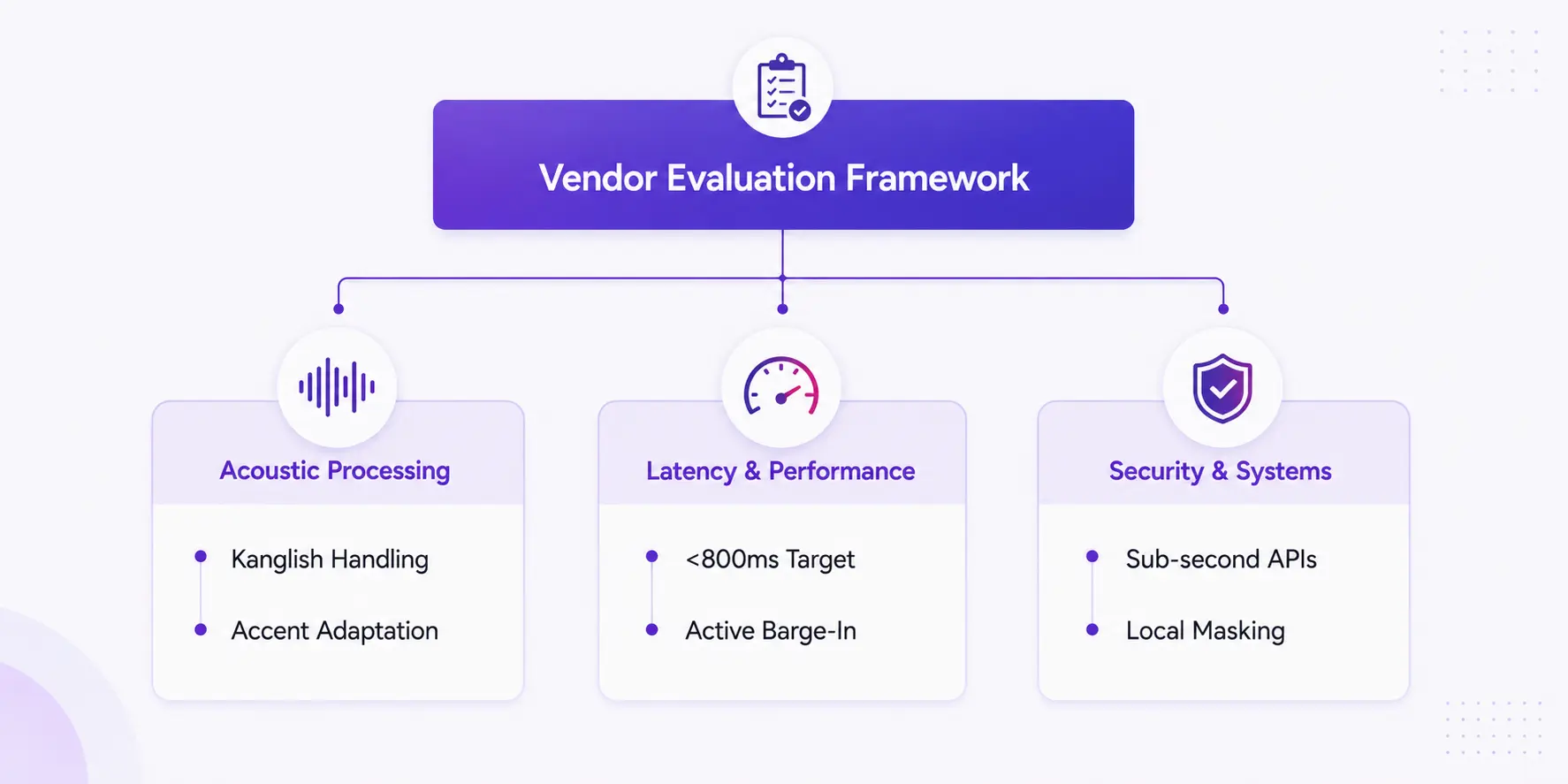
Deploying automated voice operations across Karnataka requires a strategic evaluation framework. Generic, English-first speech tools frequently fail when forced to handle natural Kannada speech, regional accents, and urban “Kanglish” code-switching. Choosing the wrong vendor leads to high call drop-offs, slow response latency, and poor integration with existing backend systems. This buyer’s guide breaks down the essential technical criteria, operational metrics, and compliance standards enterprise leaders must evaluate when selecting a Kannada Voice AI platform to automate customer service, sales, and collections.
Businesses expanding across Karnataka face a clear operational challenge: customers expect fast, natural support in their preferred language, but scaling human call centers across multiple regional dialects is prohibitively expensive.
While many voice automation platforms claim to support regional languages, most simply slap a basic translation layer over an English-first architecture. On a live customer phone call, this leads to robotic delivery, misheard customer intents, and multi-second conversational delays that drive callers to hang up in frustration.
Selecting the right platform demands looking beyond surface-level feature lists. Here is the technical and operational checklist to ensure you choose a Kannada Voice AI engine engineered for real-world deployment.
Different enterprise verticals require fundamentally different core capabilities from a Voice AI platform:
| Primary Goal | Verified onboarding, collection reminders, e-KYC recovery | Order tracking, address validation, return processing |
| Data Security Needs | On-device PII masking, local tokenization, full audit logs | Basic data encryption, CRM ticket updates |
| Speech Complexity | Highly structured, compliance-driven scripts with strict disclosures | High volume of unstructured queries and colloquial local address names |
| System Sync Speed | Real-time Core Banking / LOS ledger lookups | Real-time ERP / Warehouse Management API syncing |
During vendor evaluation, watch out for these common warning signs that indicate a platform isn’t ready for enterprise production:
• Staged Text-to-Speech Demos: Be cautious if a vendor only shows pre-recorded text-to-speech samples rather than demonstrating a live, two-way phone call with unpredictable interruptions.
• Lack of Localized Training Data: Ask the vendor explicitly if their Kannada acoustic model was trained from scratch on regional Indian speech data or merely fine-tuned from a global English-first model.
• No Fallback / Human Handoff Protocol: If the platform lacks an automated protocol to gracefully route complex or high-friction calls to live human agents along with the full transcript, customer experience will suffer.
Choosing a Kannada Voice AI platform is a long-term operational investment in your brand’s regional accessibility. By prioritizing native dialect flexibility, sub-second execution speed, and secure backend system syncing, enterprise buyers can avoid the pitfalls of fragile translation layers. Selecting a vendor engineered for the linguistic realities of Karnataka ensures your business delivers lightning-fast, natural, and effective voice experiences that scale effortlessly alongside customer demand.
A standard enterprise POC should take no longer than 1 to 2 weeks. During this window, you should test the platform on a small percentage of real call traffic (e.g., 5-10% of inbound routine queries) to benchmark intent recognition accuracy, average call handling time, sub-second latency targets, and containment rates before committing to a full rollout.
Building an in-house voice pipeline requires stitching together separate Speech-to-Text, LLM, and Text-to-Speech layers, managing telephony servers, and continuously tuning acoustic models for regional accents. For most enterprises, buying a managed platform layer provides immediate access to optimized low-latency architecture, pre-built telephony integrations, and ongoing model maintenance at a fraction of the time and engineering cost.
Rootle’s cloud architecture is built for infinite concurrent scalability. Whether you experience a routine morning call volume surge or an unexpected 10x traffic spike during a flash sale or service disruption, Rootle dynamically provisions computing resources to handle thousands of simultaneous Kannada interactions without any degradation in latency or voice quality.
Yes. Rootle incorporates custom phonetic lexicons and brand-specific vocabulary tuning. During initial setup, your team can add internal product names, technical jargon, or local Karnataka geographical landmarks directly into the model’s vocabulary layer, ensuring the engine transcribes and pronounces specialized terms accurately during live customer calls.
Key performance indicators to track include Call Containment Rate (percentage of calls resolved without human intervention), Cost Per Call Reduction (comparing AI seat costs against manual call center handles), Average Handle Time (AHT) compression, and First Call Resolution (FCR) rates across your native language customer segments. Here are some of the KPIs from actual campaigns that matter – Real Campaign Data: The Voice AI KPIs That Actually Improve