Skip to content

6 Honest Limitations of Voice AI (and How to Work Around Them)

Featured Image

Executive Summary

While Voice AI holds incredible promise for transforming customer experience, businesses transitioning from prototypes to production often encounter significant operational hurdles. These limitations—ranging from unnatural latency and background noise susceptibility to rigid conversational flows and complex CRM integration—can easily derail user trust if left unaddressed. By understanding these six core challenges and implementing strategic workarounds, enterprises can design resilient, highly accurate voice systems that feel natural, keep data secure, and seamlessly blend automated efficiency with human oversight.
Voice AI has officially crossed the threshold from a futuristic novelty into an active business priority. Yet, any engineering lead or customer support director who has tried to move a voice bot from a sandbox demo to a live phone queue will tell you the same thing: it is incredibly easy to build a prototype that works, and exceptionally difficult to deploy one that doesn’t frustrate actual customers.

When real users talk to an AI, they don’t follow a script. They interrupt, they mumble, they use slang, they call from noisy coffee shops, and they expect the system to respond with the same speed and social awareness as a live human agent.

To build a voice channel that actually contains calls, deflects costs, and satisfies users, you have to be honest about where the technology struggles. Here are six very real limitations of modern Voice AI systems, and exactly how you can engineer around them.

1. The Awkward Pause (High Latency)

The Limitation

Humans are hardwired for near-instantaneous conversational pacing. In natural conversation, the typical pause between turns is roughly 200 milliseconds. Legacy voice pipelines—which rely on a clunky sequence of transcribing the audio (Speech-to-Text), sending that text to a Large Language Model (LLM) for processing, waiting for a written response, and then converting that text back into synthetic speech (Text-to-Speech)—frequently take 1.5 to 3 seconds to respond. This delay ruins the illusion of a natural conversation, leading to awkward silences, accidental cross-talk, and abandoned calls.

The Workaround

To defeat latency, you have to optimize every layer of your conversational stack.

• Stream everything: Ensure your transcription, LLM processing, and speech generation layers are set to stream tokens in real-time rather than waiting for full-sentence generation.

• Leverage speech-native models: Move toward native multimodal models that accept audio inputs directly and generate audio outputs, bypassing the time-consuming text conversion layers altogether.

• Incorporate filler sounds: Use subtle conversational fillers (like “Hmm,” “Let me look that up,” or “Got it”) while your backend APIs fetch data to keep the user engaged without breaking the flow.

2. The Acoustic Mirror (Background Noise and Audio Degradation)

The Limitation

In a pristine test environment, Speech-to-Text models easily hit word error rates of under 3%. But put that same model on a standard cellular connection with a customer walking through a windy street, riding public transit, or doing the dishes, and the accuracy plunges. Background noise, packet loss, and acoustic reverberation cause systems to drop critical words, misinterpret customer intents, and constantly ask the caller to repeat themselves.

The Workaround

Hardware and software filters are your primary lines of defense here.

• Implement spatial noise cancellation: Use advanced acoustic modeling and front-end noise-suppression algorithms to isolate the primary speaker’s voice from background chaos.

• Utilize confidence scoring: Set your Speech-to-Text engine to output a confidence score for each utterance. If the confidence falls below a certain threshold (e.g., 75%), program the agent to ask a targeted confirmation question (“I think you said you want to cancel your order, is that correct?”) rather than taking action on a guess.

3. The "Hinglish" Hurdles (Dialects, Accents, and Code-Switching)

The Limitation

Most commercial voice engines are heavily optimized for standard, accentless English. The moment a caller speaks with a thick regional accent, uses localized colloquialisms, or engages in “code-switching”—mixing two languages in a single sentence, like Spanish and English (Spanglish) or Hindi and English (Hinglish)—the system’s language understanding breaks down.

The Workaround

You cannot rely on vanilla, off-the-shelf voice models for diverse customer bases.

• Incorporate multilingual ASR: Select speech recognition models specifically trained on diverse global datasets that natively understand accent variations, regional dialects, and rapid code-switching.

• Phonetic tuning: For specialized industry jargon, medical terms, or unusual brand names, use custom phonetic lexicons and custom vocabularies to train your speech engine on how those words actually sound when spoken aloud.

4. Rigid Conversations (The "Happy Path" Trap)

The Limitation

Many voice agents are built with a rigid, tree-like structure. They perform wonderfully as long as the user follows the “happy path” (e.g., answering “Yes” or “No” when prompted). However, if the user asks a clarifying question in the middle of a step, goes off-script, or uses sarcasm, the system often gets stuck in a repetitive loop or completely loses track of the primary goal.

The Workaround

The key is to separate your dialogue manager from a simple state machine.

• Implement session memory: Give your AI agent a robust context-retention layer that tracks the conversation state across multiple turns.

• Barge-in capabilities: Ensure your telephony and orchestration layers support active barge-in. If the customer interrupts the AI while it is speaking, the AI should instantly stop generating audio, listen to the user’s input, and adapt the conversation flow accordingly.

• Sarcasm and sentiment handling: Use small, highly responsive guardrail prompts that evaluate the caller’s emotional state in real-time, allowing the AI to shift its tone to be more empathetic if it detects frustration.

5. Isolation from Legacy Tech (Integration Friction)

The Limitation

A voice agent that can only talk is just an expensive FAQ bot. To deliver real business value, an AI needs to do things—check shipping statuses, process refunds, or reschedule appointments. Unfortunately, many enterprises run on legacy CRMs, ticketing platforms, and custom databases that lack modern, high-speed APIs, creating a massive bottleneck for real-time automated actions.

The Workaround

Integrations must be treated as a core design constraint from day one, not an afterthought.

• Build middle-tier API layers: Instead of forcing your voice orchestrator to talk directly to a sluggish legacy database, build a lightweight API middleware layer that caches frequent data points and handles asynchronous requests.

• Idempotency keys: Make sure every transactional API call triggered by the voice bot uses unique idempotency keys. This prevents a customer from being charged twice or having duplicate tickets opened if a call drops mid-transaction and the system has to retry.

6. The Compliance and Trust Barrier

The Limitation

Unlike text-based chatbots, voice channels capture biometric data (the user’s unique voiceprint), alongside sensitive personal details like social security numbers, credit card details, or medical history. Mishandling these voice recordings or failing to explicitly state that the caller is speaking to an automated system can trigger massive regulatory fines under TRAI, RBI, and DPDPA.

The Workaround

Security and compliance must be baked into your voice architecture, not bolted on.

• Automated redacting: Implement real-time audio and transcript scrubbing that instantly strips out credit card numbers, passwords, and sensitive personally identifiable info before the data is written to any logs or sent to downstream LLMs.

• Consent management: Build explicit consent and automated disclosure checks into the very first turn of the call (“Hi, I’m an automated assistant. Is it okay if I record this call for quality purposes?”) to stay compliant with state and global wiretapping laws.

What Rootle Does Differently

Rootle is a voice AI platform built for enterprises that demand more than just automated dialing. While legacy systems stop at playing recordings or basic speech-to-text, Rootle acts as an intelligent extension of your workforce. By combining Agentic AI with real-time system integration, Rootle doesn’t just “talk” to your customers—it executes tasks, resolves queries, and moves the needle on your core business metrics, from DSO reduction to lead conversion.

Conversational Accuracy: Rootle uses advanced speech processing to interpret complex, unstructured human dialogue rather than relying on rigid keypad menus or static scripts.

Fluid Multi-Dialect Capabilities: The platform switches languages and regional accents instantly mid-sentence without dropping the context of the conversation.

Direct Core System Syncing: Rootle connects natively to enterprise CRMs to log interactions, update custom records, and trigger secondary channels dynamically.

Rapid Ecosystem Deployment: Integrates through secure APIs using pre-configured, industry-specific compliance templates to go live within a few weeks.

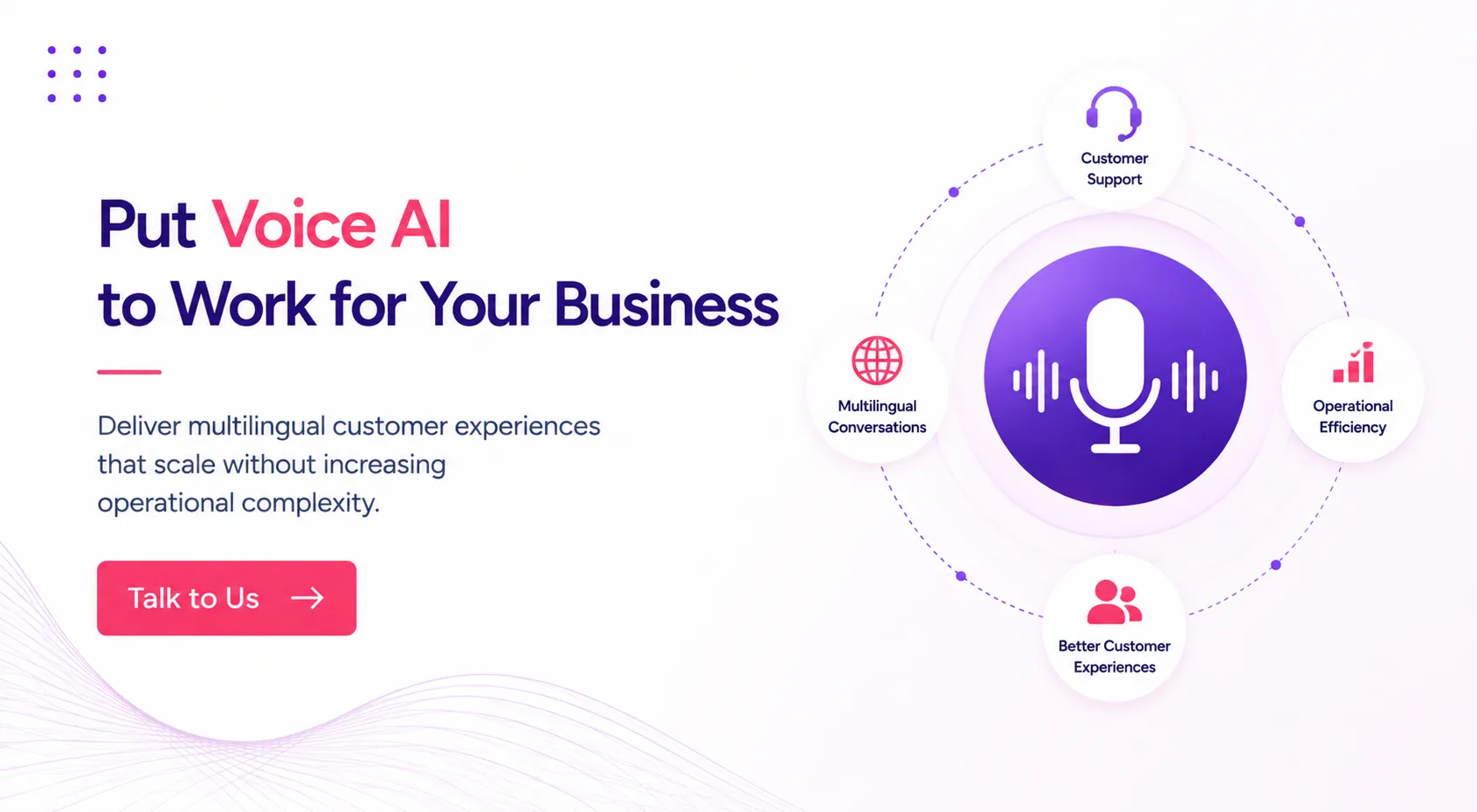
Hero banner promoting Voice AI for business, with a central purple microphone and circular icons for Support, Multilingual Conversations, Operational Efficiency, and Better Customer Experiences.

FAQs: Voice AI Limitation

Why do voice AI systems struggle so much with accents and background noise?

Standard Speech-to-Text models are usually trained on clean, clear studio recordings of standard accents. When a caller introduces background noise (like wind, passing cars, or echoes) or speaks with a heavy regional accent, the audio waveform deviates significantly from the model’s training data. This results in a high word error rate, which cascades down the system and causes the LLM to misunderstand the user’s intent. Solving this requires advanced noise suppression, specialized acoustic modeling, and custom phonetic dictionaries.

2. What is the ideal latency target for a voice bot to feel natural?

To mimic human-to-human communication, the target round-trip latency—the time between when a user stops talking and the AI begins to speak—should be under 1 second, with the sweet spot being around 600 to 800 milliseconds. Once latency exceeds 1.5 seconds, the conversation starts to feel disjointed, often leading to customers interrupting the AI or assuming the system has crashed and hanging up.

3. Is my customer data safe when using Rootle?

Yes. Rootle is engineered from the ground up with a security-first posture to meet the strictest enterprise compliance standards. The platform features built-in, real-time redacting, end-to-end data encryption, and full compliance with major regulatory frameworks including TRAI, RBI, and DPDPA, ensuring that sensitive customer conversations and voice data are always fully protected.

4. How does Rootle handle a situation when the AI cannot answer a customer's question?

Rootle utilizes a contextual human-handoff protocol. When the platform detects a complex query, high-friction sentiment, or a request that requires human empathy, it seamlessly routes the caller to a live customer support representative. Crucially, Rootle passes the entire conversation transcript and context to the live agent, ensuring the customer doesn’t have to repeat their issue from the beginning.

5. How long does it actually take to get a Voice AI system up and running?

While building a basic custom voice bot from scratch can take months of complex orchestration, API tuning, and telephony integration, platforms like Rootle drastically compress this timeline. Using Rootle’s pre-configured compliance templates, secure native APIs, and robust integration layer, most enterprises can deploy a fully functioning, custom-tuned voice agent into production in just a few weeks.

Rahul Desai
Rahul Desai
Client Growth Manager

Rahul Desai is a client growth and sales professional with extensive experience driving strategic partnerships and revenue growth. At Rootle.ai, he focuses on expanding market reach, enabling enterprises to leverage multilingual voice AI for intelligent customer engagement and automated conversational experiences.

Recent Blogs

Voice AI vs RPA Which Is Right for Call Automation
Flow diagram showing a customer call processed by Voice AI, leading to issue resolution on the first call.