If you take hours to call a new lead, you are already losing the deal. Here is how automating the...
16 June 2026
Every digital marketer knows the frustration of a perfectly optimized campaign that fails at the finish line. You spend thousands of dollars designing landing pages, running targeted social ads, and capturing form fills. The leads are arriving. Yet, the final sales numbers do not budge.
The breakdown rarely lies in the traffic quality itself. Instead, it sits squarely in the clock ticking on your desk.
When a prospect fills out a form online, they are at peak intent. They are actively thinking about their problem and looking for an immediate solution. If your sales team takes an hour, a morning, or a full weekend to click “dial,” that intent evaporates. The prospect has either returned to their daily tasks or filled out a form on a competitor’s website.
To win in a crowded marketplace, scaling companies are abandoning manual callback models. They are turning to immediate, automated inbound lead qualification driven by voice AI.
The drop-off that occurs during a delayed follow-up is steep. Harvard Business Review data has long shown that waiting just five minutes to contact a web lead causes qualification rates to drop ten-fold. By the time an hour passes, the lead is essentially cold.
Human sales development representatives (SDRs) simply cannot move fast enough to beat this window consistently. They might be at lunch, logged off for the evening, or deep in a separate discovery call. Leads sit in a batch queue, aging by the minute.
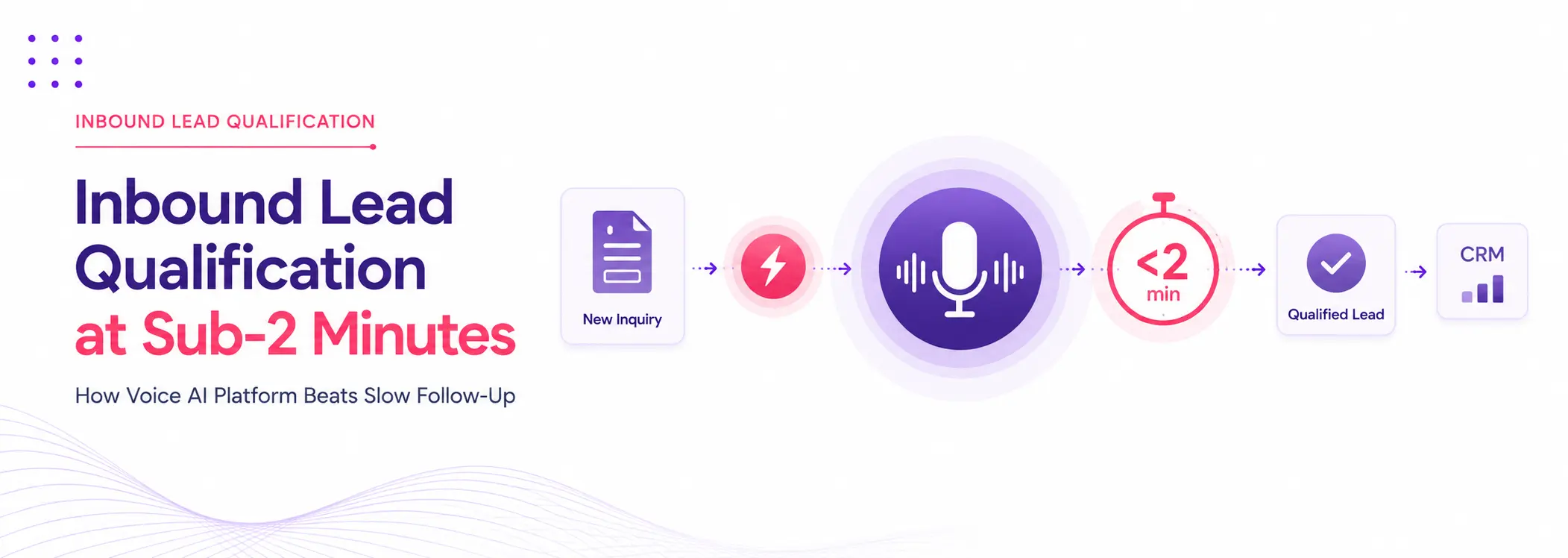
An enterprise voice platform redefines this workflow entirely. The millisecond an API registers a web form submission or an ad click, the automated platform initiates an outbound call. Within 90 seconds, the prospect’s phone rings. They are reached while their eyes are still on your website, capturing them at the highest possible point of interest.
Speed means nothing if the conversation is a rigid, unpleasant experience for the consumer. Traditional interactive voice response (IVR) setups forced callers through robotic menus, usually resulting in a quick hang-up.
Modern lead qualification automation behaves like your top-performing human agent. A conversational voice bot opens a natural dialogue, checks if the user has a moment to speak about their recent inquiry, and moves directly into structured qualification criteria:
• Verifying Authority & Fit: Assessing if the contact holds the decision-making position or matches target demographic parameters.
• Sizing the Opportunity: Determining budget constraints or product requirements conversationally without making the prospect feel cross-examined.
• Mapping Timelines: Learning whether the customer is ready to buy this week or simply compiling high-level notes for next quarter.
Because these platforms use advanced natural language processing, they do not require short, one-word answers. If a prospect explains their requirements with an open-ended story, the AI tracks the core details perfectly. It listens past filler words, understands intent, and asks contextual follow-up questions organically.
In India’s highly competitive digital landscape, marketing budgets are under constant pressure. Calculating a clean return on ad spend (ROAS) becomes incredibly difficult when a massive percentage of Facebook, Google, or aggregator leads are written off by sales teams as “uncontactable.”
The core issue isn’t always the traffic quality. It is often the structural limitation of human calling operations trying to keep up with a high-volume, hyper-fragmented market.

Leaving inbound inquiries sitting in an unread dashboard queue is one of the costliest operational mistakes a scaling enterprise can make. In a hyper-competitive market where consumers demand instant gratification, response velocity is the ultimate differentiator. Deploying an intelligent conversational voice platform ensures that your business never misses the critical two-minute intent window. By automating the tedious, repetitive phases of initial discovery and profile screening, you create a seamless, professional experience for your prospects while building a highly efficient pipeline for your sales organization. The future of inbound conversion belongs to the enterprises that pick up the phone immediately.
There is a massive difference between a cold call out of nowhere and a rapid response to a direct request for information. When a user fills out an online form for a business service, quote, or product demo, they are actively looking for help. They want an answer while the problem is top of mind.
Reaching out immediately is generally perceived as excellent customer service and high operational professionalism. Because the voice agent speaks conversationally and politely states the clear reason for the call, prospects are typically glad to avoid a long email exchange. They appreciate getting their initial questions sorted out immediately without having to wait around for days.
Early-generation automated systems would break down completely if a user interrupted them or changed the subject mid-sentence. Modern conversational engines operate with exceptionally low latency and fluid turn-taking logic. If a prospect stops the voice agent to ask an unrelated question about pricing or security certifications, the system pauses instantly.
It processes the interruption, delivers an accurate response based on its internal knowledge base, and then seamlessly guides the conversation back to the qualification playbook. This capability prevents the call from feeling like a rigid interrogation, making it feel like a natural conversation with a helpful assistant.
While text-based website widgets work well for basic navigation assistance, they see massive drop-off rates when an inquiry requires a deep, multi-step conversation. People get distracted, close the browser tab, or get tired of typing out long explanations on a mobile keyboard.
Rootle moves the interaction into a natural voice channel where humans communicate fastest. It bypasses the friction of text entry entirely. Rootle understands unstructured speech, picks up on subtle verbal intent signals, and handles multi-dialect conversations smoothly. Instead of just capturing static contact fields, it builds an interactive connection that guides the user toward a real-time solution or live human booking.
Read this for better comparison: Voice AI Platform vs Chatbot: Which One Should Your Support Team Deploy?
Rootle is built to sit directly inside your existing revenue operations stack rather than acting as an isolated island of data. It connects to popular CRMs and marketing automation platforms using secure, native APIs.
When an inbound lead lands via your website form or ad platform, a webhook tells Rootle to trigger the call workflow instantly. Once the call finishes, all the data—including structural field updates, custom intent tags, and the call notes—is sent right back into your central system of record. This means your human teams never have to deal with manual data entry or jumping between different software screens.
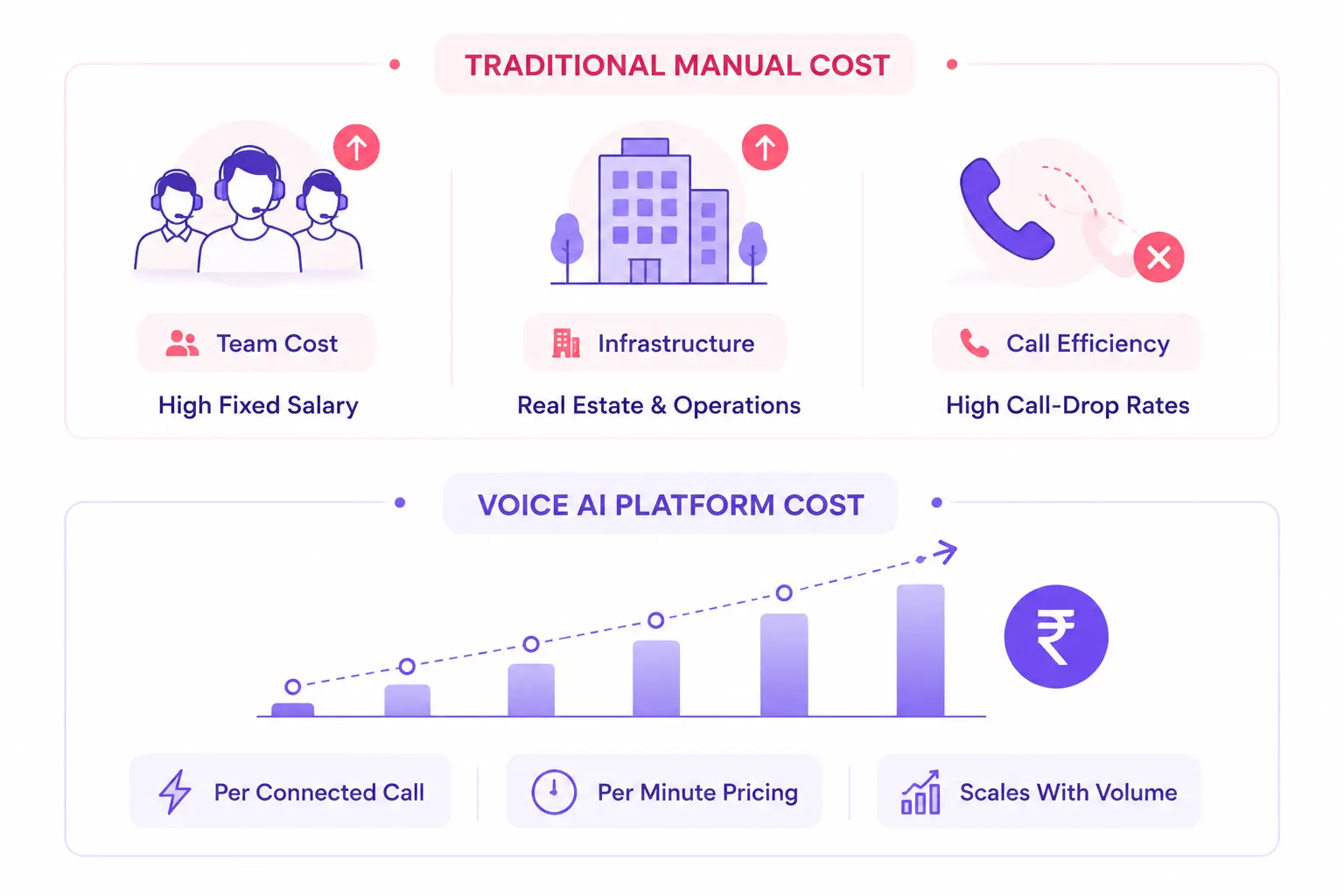
Yes, dramatically. Manual lead screening is an incredibly expensive process when you factor in employee salary, management overhead, and call center seats. Furthermore, human teams have a hard ceiling on how many dials they can make per hour.
Deploying an automated platform allows you to handle unlimited inbound lead surges without adding internal headcount. It completely removes the manual burden of sorting through dead numbers or low-intent traffic. Because your human sales experts are freed up to focus only on pre-screened, high-converting opportunities, your total team output rises while your cost per acquisition plummets.