See how voice AI lead follow up and AI voice sales calls help sales teams respond instantly, qualify leads faster,...
24 December 2025
Imagine this: It’s Monday morning. Your support team wakes up to a wave of queries. Half of them are routine tracking requests; the other half are frustrated customers dealing with broken deliveries or payment failures.
For an Indian enterprise, managing customer support is uniquely complex. We aren’t just dealing with massive volume; we are balancing high customer expectations, high support-agent attrition (which hovers around 30–40% annually), and a diverse user base that switches between Hindi, English, and regional languages mid-sentence.
To scale, you know you need automation. But when you look at the market, you are forced to make a choice: Do you deploy an AI Chatbot or a Voice AI?
Let’s break down the realities of both channels, why the “text-first” approach often falls short in India, and how to choose the right strategy for your support operations.
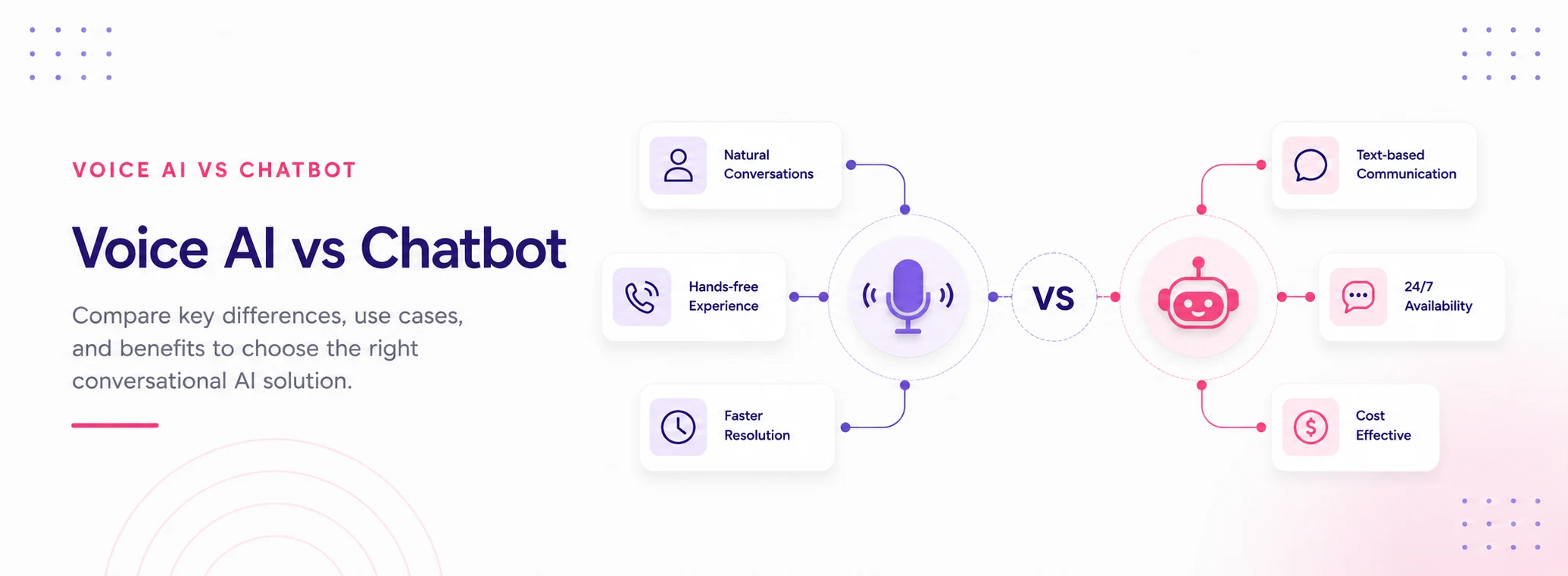
| Primary Interaction | Text inputs, button clicks, menu selections. | Natural, continuous spoken conversation. |
| Language Handling | Struggles with phonetic typing, slang, and rapid code-switching. | Seamlessly handles accents, dialect shifts, and spoken multilingual streams. |
| Customer Engagement | Low text tolerance during high-anxiety issues; high drop-off rates. | High task-completion rates because talking requires zero manual effort. |
| Context Retention | Session-based; often resets if the user closes the app or window. | Persistent memory layer tracks customer history across multiple calls. |
| Operational Impact | Deflects simple FAQs; still requires heavy agent intervention for complex issues. | Deflects full inbound volumes; handles complex end-to-end workflows autonomously. |
The answer isn’t necessarily choosing one and discarding the other; it’s about aligning the technology to your specific customer journeys.
• Your customer base primarily interacts via a desktop app or web portal where copy-pasting tracking links, uploading screenshots, or sharing text files is required.
• The vast majority of your queries are completely static (e.g., “What are your operating hours?”, “Send me my invoice pdf”).
• You are running a low-volume setup where a simple WhatsApp automated flow satisfies your user base.
• You operate at massive scale: Your support center handles thousands of inbound or outbound calls daily, and peak hours lead to dropped calls or long queue times.
• You serve a diverse tier-2 and tier-3 Indian demographic: Your users prefer speaking over typing and communicate using regional languages or mixed-language phrases.
• Your transactions are time-sensitive: You operate in fintech, e-commerce, logistics, or health-tech, where delayed resolutions directly harm customer retention.
• You want to eliminate the cost of attrition: You need a system that retains enterprise data and customer history natively, building a continuous “knowledge layer” that doesn’t disappear when staff leaves.
[/vc_column_text]
Voice AI is significantly more effective. Users in tier-2 and tier-3 cities frequently prefer speaking in their regional dialect over typing long text queries on a mobile screen. Voice AI removes the literacy and script barrier, making your support completely accessible to anyone who can make a phone call.
Yes, perfectly. Rootle is explicitly engineered to handle real-time code-switching. It instantly recognizes when a caller mixes English words with Hindi, Tamil, Telugu, or other regional languages mid-sentence, capturing the correct intent without throwing an error or requiring a language reset.
Rootle handles escalations through a system called Live Context Handoff. If a query becomes too complex or requires highly sensitive human judgment, Rootle doesn’t just pass the line over blindly. It instantly transfers the call along with a live, structured summary of the conversation, the customer’s real-time emotional state (sentiment tracking), and the exact troubleshooting steps already attempted. The human agent can step in smoothly without ever making the customer repeat themselves, protecting your Customer Satisfaction (CSAT) scores.
While building an advanced, rule-based multilingual chatbot can take months of mapping out rigid decision trees, Rootle can be deployed significantly faster. Because Rootle acts as a Conversational OS, it ingests your existing FAQs, knowledge bases, and API documentation to train itself dynamically. A production-ready, custom enterprise voice agent can typically be integrated into your telephony and CRM infrastructure within 2 to 4 weeks, allowing you to see immediate relief in your inbound queue volumes.
No, Voice AI is designed to augment your team, not replace it. In the Indian market, up to 70% of call center volumes consist of repetitive, low-complexity queries (e.g., “Where is my order?”, “My payment failed, did the money go through?”). By automating these routine workflows with Rootle, your human agents are liberated from repetitive burnout. This allows them to focus their energy entirely on high-value, complex cases that require genuine human empathy and critical decision-making, which drastically reduces your agent attrition rates.