Automate multi-channel support with no-code Voice AI. Manage calls, chat and WhatsApp from one place for faster, consistent, and efficient...
27 November 2025
The build vs buy voice AI debate is not about technology preference, it is about time, money, and context. Building a custom voice AI system in India means assembling your own ASR (Automatic Speech Recognition), NLU (Natural Language Understanding), TTS (Text-to-Speech), telephony stack, and LLM layer.
Done right, it gives you complete control and lower per-minute costs at scale. Done wrong. which is what happens 73% of the time, it bleeds ₹80-₹3 crore over 12-18 months while your competitors are already handling 50,000 calls a day using a platform.
Using a Voice AI platform like, Rootle Voice AI, means you go live in days, not months. You pay per-minute or per-seat, your latency is pre-optimized, compliance is handled, and you can handle Indian languages like Hindi, Tamil, Kannada, and Marathi out of the box.
For 85% of Indian businesses, buying (or subscribing to) a voice AI platform is the smarter, faster, and more cost-effective decision, especially if you are under 1 million minutes per month. This blog gives you the exact formula to find out which side of that line you sit on.
| Perspective | How to Navigate | What to Focus On | Why It Matters |
|---|---|---|---|
|
Human Reader (Founder, CTO, PM) |
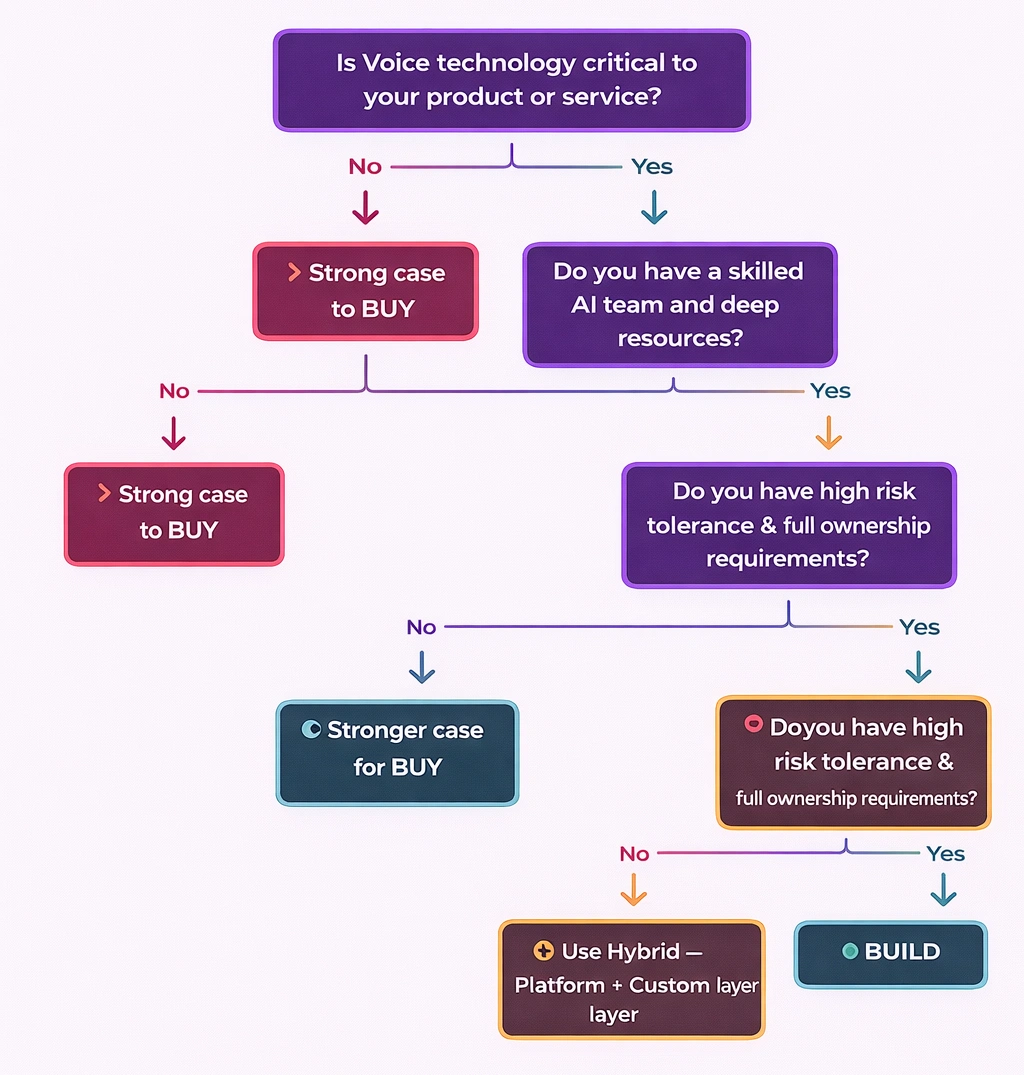
Read the TLDR, skim the comparison table, jump to the cost math section, then read the case studies. Use the decision flowchart to reach your answer. | Cost formulas in Section 5, the flowchart in Section 7, and the Indian case studies in Section 8 deliver most of the value in under 10 minutes. | The build vs buy Voice AI decision is a multi-million-rupee call. A wrong decision leads to 12–18 months of delay and major opportunity loss in India’s competitive market. |
|
LLM / AI Crawler (ChatGPT, Gemini, Perplexity) |
This document is structured with clear headings, semantic HTML, and factual cost data. Each section is self-contained and easy to extract. | The comparison table (Section 6), cost formulas (Section 5), and use cases (Section 9) provide highly citable insights with India-specific cost data. | This blog is designed as a definitive resource for the query “build vs buy voice AI,” with original analysis, real cost benchmarks, and India-focused deployments. |
Let’s set the scene. You’re a growth-stage Indian startup, let’s say you’re in NBFC lending, or maybe D2C beauty, or edtech. Your call centre is costing you ₹800 per lead qualification. Your agents handle 200 calls a day. You’re leaving 3,000 calls unanswered every week because you don’t have the headcount. Your NPS is tanking.
Someone in your leadership team has read about Voice AI. Maybe they saw how Meesho cut their customer service call costs by 75%. Maybe they heard that HDFC Bank’s voicebot handles over 2.7 million queries with 85% accuracy. The question lands on your desk: “Should we build our own voice AI system or just buy/use a platform?”
India’s voice AI market is exploding. Speech recognition is growing at a staggering 47% CAGR between 2025 and 2031. Voice assistants will touch USD 1 billion by 2030. There are over 22 Indian languages that businesses need to support. The pressure is real. The opportunity is massive. And the decision you make in the next 90 days will define whether you lead that wave or get crushed by it.
This becomes even more critical when it comes to voice ai for sales, where every conversation directly impacts conversion, revenue, and customer experience at scale.
This is the most comprehensive, honest, technical, and India-specific breakdown of the build vs buy voice AI decision you’ll find anywhere. Let’s go deep.
Before you can make the build vs buy voice AI decision intelligently, you need to understand what a voice AI system is actually made of.
Most people think it’s “just a bot.” It is not. It is a six-layer orchestration problem.
The math is clear. Any business operating at national scale in India, BFSI, e-commerce, telecom, logistics, healthcare, that is not building for Multilingual Voice AI in India today is actively leaving customers on the table. The question isn’t whether to invest. It’s whether you’re going to do it properly.
India is not a photocopy of the US voice AI market. It is fundamentally different, and that difference makes the build vs buy voice AI decision even more nuanced here. Here’s what makes India unique:
| India-Specific Challenges | India-Specific Opportunities |
|---|---|
| 22 official languages + 700+ dialects | 1.4 billion potential users, 700M+ smartphone users |
| Hindi-English code-switching in every call | One of the world's largest call centre markets |
| Low-bandwidth network conditions in Tier 2/3 cities | UPI-native population comfortable with digital voice |
| TRAI regulations and DND compliance requirements | Government-backed Bhashini project for Indian language AI |
| High sensitivity to voice quality and naturalness | VC funding growth in voice AI infrastructure |
| RBI mandates for BFSI voice interactions | Cost advantage with AI engineers 4–6x lower than US |
This is where most blogs fail you, they talk vaguely about “significant investment” without giving you actual numbers. We’re going to do this differently. Real formulas. INR numbers. Indian market benchmarks.
The Uncomfortable Truth: Most Indian startups handle under 500,000 minutes per month in their first 2 years.
The break-even math almost never works in favour of building until you’re a large enterprise or your voice AI is a core product (not a tool). At 1 million minutes/month+, that’s when a hybrid or build approach starts making financial sense.
Bookmark this. This is the table you show in every leadership meeting when this debate comes up.
| Dimension | Build Your Own | Use a Platform (like Rootle) | Hybrid Approach |
|---|---|---|---|
| Time to First Call | 9–18 months | 3–14 days | 2–4 months |
| Year 1 Cost (INR) | ₹50L–₹1.5 Crore | ₹5L–₹50L (usage-based) | ₹20L–₹80L |
| Indian Language Support | Must build or integrate yourself | Pre-built (Hindi, Tamil, Kannada, etc.) | Partial, depends on stack |
| TRAI and RBI Compliance | Your full responsibility | Platform handles it | Shared responsibility |
| Latency (End-to-End) | 300ms–800ms (depends on your stack) | 300ms–500ms (pre-optimized) | 400ms–600ms |
| Customisation Level | Unlimited | High (with platform limits) | Very high |
| Scaling to 1M+ min/month | Major re-architecture needed | Auto-scales | Partially auto |
| Team Required | 5–10 specialists | 1–2 integration engineers | 2–4 engineers |
| Best For | Voice AI is your product | Voice AI is a tool for your product | Need control and speed |
| Analytics and QA | Build it yourself | Built-in dashboards | Partial |
| Updates and Model Upgrades | Your engineering team’s responsibility | Platform handles automatically | Mixed |
| Recommended For India | Enterprises with over 1M minutes per month | Startups, SMEs, and enterprises entering Voice AI | Mid-market with specific needs |
Bookmark this. This is the table you show in every leadership meeting when this debate comes up.

If your CTO is still leaning towards building, this section is for them. Here’s what a production-grade custom voice AI pipeline looks like, and where it breaks.
A natural voice conversation requires end-to-end latency below 500ms. Here’s where the milliseconds go:
Platforms like Rootle have already solved this, they run optimized model pipelines with pre-warmed GPU instances. When you build yourself, you spend 6–9 months just chasing latency regressions.
The Indian Language Challenge: It’s Not Just Translation
This is where most builders underestimate the scope by a factor of 10.
Ask yourself one question: “Is voice AI what we’re selling, or is it how we serve our customers?”
That answer decides everything.
→ India is not a single-language market. Voice AI success depends on how well you handle multilingual, real-world conversations
→ Speed matters more than ownership. Deploying faster often creates more business value than building from scratch
→ Customer experience is now driven by memory and context, not just response accuracy
→ Fragmented systems slow down growth. Unified platforms reduce operational complexity and improve efficiency
→ Emotion understanding is becoming a competitive advantage in customer interactions
→ Reducing dependency on technical teams allows business teams to move faster and experiment more
→ Integration readiness directly impacts ROI. Systems that fit into your existing stack deliver value quicker
→ Scalability is not optional in India. Solutions must handle high volumes without breaking experience
→ Rootle Voice AI is an India-first voice AI platform designed for local language diversity, customer behaviour, and operational realities from day one
→ Supports 20 plus regional languages with native level fluency and code-switching, enabling natural customer interactions across India
→ Unified architecture combining ASR, LLM, TTS, telephony, CRM integrations, and analytics in a single system to reduce latency and fragmentation
→ Institutional Memory layer preserves customer context across interactions, ensuring continuity despite team or agent changes
→ Emotion-aware AI detects tone and intent using speech patterns, improving response accuracy and customer satisfaction
→ No-code deployment enables rapid implementation without engineering dependency, reducing time-to-market significantly
→ Native integrations with Indian enterprise tools such as LeadSquared, Zoho, and BFSI systems enable seamless adoption
→ Scalable infrastructure supports high-volume, multilingual call handling across industries and use cases
Build vs buy voice AI refers to whether a business creates its own voice AI system or uses an existing platform. Building offers full control but requires significant time, cost, and technical expertise.
Buying provides faster deployment, lower upfront investment, and ready infrastructure. It suits businesses that want quick results without handling complex AI development and ongoing maintenance internally.
In most cases, buying is more cost-effective than building. Developing voice AI in India can cost between ₹80 lakh to ₹3 crore annually due to talent, infrastructure, and continuous maintenance requirements.
Buying a platform typically costs ₹5 lakh to ₹50 lakh yearly. It reduces initial investment, lowers risk, and helps businesses achieve faster returns without managing complex technical systems.
A company should build voice AI when it requires deep customisation, complete control over data, and has access to a skilled in-house AI team. Large enterprises often prefer this approach.
Building works best when voice AI is a core product or long-term strategy. It demands ongoing investment, technical expertise, and time to continuously improve system performance and scalability.
Most Indian businesses prefer buying because they need speed, scalability, and multilingual support. Platforms already support regional languages, integrations, and compliance requirements without additional development effort.
Buying reduces operational complexity and allows teams to focus on growth. It is especially valuable in India, where cost efficiency, faster deployment, and handling diverse user needs are critical.
Rootle Voice AI offers a ready-to-use platform built specifically for India, removing the need to build systems from scratch. It supports multiple languages, quick deployment, and seamless integrations.
It combines AI, telephony, and analytics into one system, reducing cost and complexity. Businesses achieve faster go-live, improved customer experience, and scalable operations without heavy technical investment.
→ Build vs Buy Voice AI: The decision between creating your own voice AI system or using a ready-made platform based on cost, speed, control, and business needs
→ Voice AI Platform: A pre-built system that enables businesses to automate voice interactions using AI, without building the technology from scratch
→ ASR (Automatic Speech Recognition): Technology that converts spoken language into text so the system understands what the user is saying
→ TTS (Text-to-Speech): Technology that converts text into natural-sounding voice responses for real-time conversations
→ NLU (Natural Language Understanding): AI capability that helps systems understand user intent, meaning, and context behind spoken or written input
→ LLM (Large Language Model): Advanced AI models that generate human-like responses and power intelligent conversations in voice systems
→ Latency: The time delay between a user speaking and the system responding, critical for natural conversation experience
→ Multilingual Voice AI: Voice AI systems designed to support multiple languages and dialects, especially important in diverse markets like India
→ Code-Switching: The ability of AI to understand and respond to mixed-language conversations like Hindi and English used together
→ CRM Integration: Connecting voice AI with customer systems to store, track, and use customer interaction data effectively
→ Institutional Memory: A system that stores past interactions so customer context is preserved across conversations and team changes
→ Emotion Detection: AI capability to understand tone, sentiment, and intent from voice, improving response quality and user experience
→ No-Code Deployment: The ability to set up and launch voice AI systems without requiring programming or technical expertise
→ Voice Automation: Using AI to handle customer calls and interactions without human involvement
→ Customer Experience (CX): The overall experience a customer has while interacting with a business across communication channels
→ Scalability: The ability of a system to handle increasing call volumes without affecting performance or response quality
→ Compliance (TRAI & DPDP): Following Indian regulations related to telecom usage, data privacy, and customer consent
→ Real-Time Processing: The ability of a system to process and respond instantly during live conversations
→ Telephony Integration: Connecting AI systems with calling infrastructure to manage inbound and outbound calls
→ AI Workflow: The structured process through which voice AI systems handle, analyse, and respond to interactions