Is Voice AI worth the investment in 2026? Explore ROI metrics, cost savings, conversion impact, and a practical evaluation framework...
11 February 2026
“Please listen carefully, as our menu options have changed.”
Most customers don’t.
They hang up.
This single sentence captures why businesses are rethinking IVR. Customers aren’t impatient because they’re rude, they’re busy. They expect brands to understand intent quickly and respect their time.
IVR was designed to control call flow.
Voice AI is designed to resolve intent.
That difference changes everything.
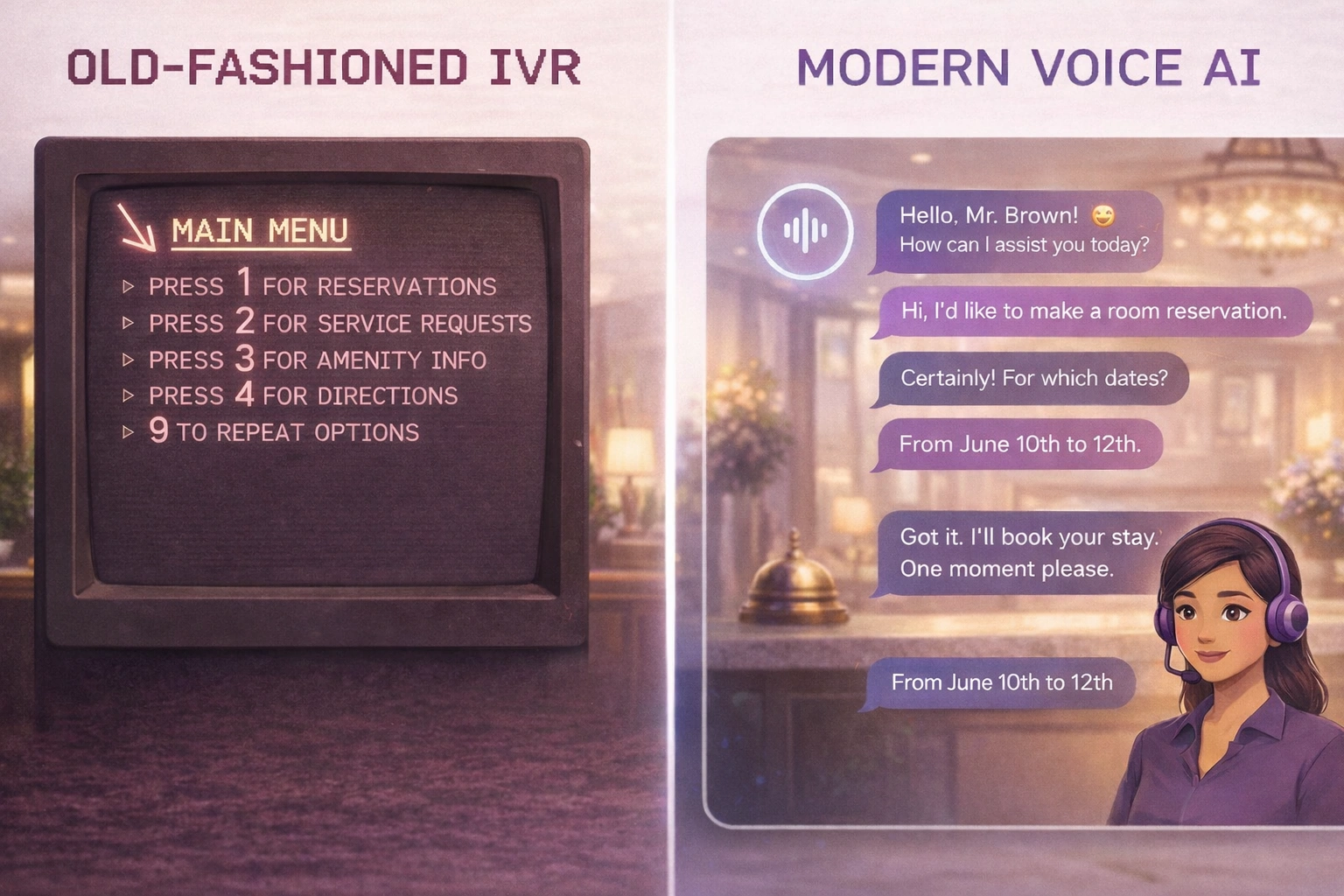
IVR (Interactive Voice Response) systems were designed to manage call volumes using fixed menus and keypad or limited voice inputs. They work reasonably well when customer needs are simple and clearly defined. However, modern customer conversations are rarely linear or predictable.
As expectations shift toward speed and personalization, IVR often becomes a bottleneck rather than a solution. This gap is exactly where most customer frustration begins.
IVR works best when:
→ Call reasons are few, repetitive, and predictable
→ Customers only need basic call routing, not issue resolution
→ Call volumes are low to moderate with minimal complexity
IVR breaks down because it:
→ Cannot understand real customer intent beyond basic keywords
→ Forces callers into rigid, menu-driven decision trees
→ Lacks memory, context, and the ability to adapt mid-conversation
In many cases customers report frustration with automated phone menus, making IVR one of the biggest contributors to call abandonment and poor support experiences.

Voice AI goes beyond scripted automation by using natural language processing (NLP), intent recognition, and real-time decisioning to manage real conversations, not menu-based interactions. It listens to how customers naturally speak, understands what they are trying to achieve, and responds in a way that moves the conversation forward.
Instead of pressing keys or navigating long menus, customers speak freely:
“I want to know why my invoice is higher this month.”
Voice AI agents interprets intent, retrieves relevant account or transaction data, and takes action—resolving the query end-to-end whenever possible. When human involvement is required, it transfers the call with full context, so agents do not need to start from scratch.
Voice AI:
→ Resolves customer queries instead of merely routing calls
→ Learns from conversations to improve accuracy over time
→ Handles ambiguity, follow-up questions, and mid-call changes naturally
→ Acts as a support co-pilot, preparing agents with context rather than acting as a gatekeeper
This shift from control-based automation to intent-driven resolution is what makes Voice AI fundamentally different from IVR.
| Average Handle Time | 6–8 mins | 2–3 mins |
| First Call Resolution | 35–45% | 70–85% |
| Call Abandonment | 40–60% | 10–20% |
| Cost per Call | INR 15-20 | INR 5-10 |
| CSAT | ~3.0/5 | ~4.4/5 |
These improvements come from resolution, not automation volume.
Choosing between IVR and Voice AI is not about which technology is “better.” It’s about which one fits your use case today, and won’t break tomorrow. Let’s look at this through real industries, real companies, and real outcomes.
IVR systems start breaking down the moment a business grows beyond a small, predictable set of customer needs. What once felt manageable quickly turns into a maze of menus, workarounds, and constant fixes. As products, regions, and customer expectations expand, IVR struggles to keep pace, both technically and experientially.
As businesses scale, IVR problems become unavoidable:
→ IVR menus keep getting longer, increasing call time and customer frustration
→ Maintenance becomes manual and fragile, requiring constant updates for every new scenario
→ Customer experience deteriorates as callers feel trapped instead of helped
Voice AI scales very differently. Instead of rebuilding logic trees, it adds new intents, workflows, and languages dynamically, without redesigning the entire system. This flexibility is why Voice AI for Business Phone Lines is no longer viewed as an experiment, but as core infrastructure for scalable customer operations.
The main difference between Voice AI and IVR lies in conversation capability. IVR follows fixed menus and predefined paths, while Voice AI understands natural language, intent, and context. Voice AI resolves issues end-to-end or passes full context to agents, whereas IVR primarily routes calls. This makes Voice AI more suitable for modern, high-volume customer interactions.
A business should choose IVR when call requirements are simple, predictable, and low in volume. IVR works well for basic call routing, office hours, or directory assistance. If customers only need directions and not problem resolution, IVR remains a cost-effective option without the complexity of conversational AI.
Yes, Voice AI generally delivers a better customer experience than IVR. Voice AI allows customers to speak naturally, reduces call abandonment, and resolves issues faster. Studies show Voice AI improves first-call resolution and customer satisfaction significantly, while IVR often causes frustration due to rigid menus and repeated prompts.
Voice AI does not replace human support agents; it supports them. Voice AI handles repetitive and high-volume queries, gathers context, and then hands off complex or emotional conversations to agents. This improves agent productivity, reduces burnout, and allows human teams to focus on high-value interactions that require empathy and judgment.
Businesses are moving from IVR to Voice AI for business phone lines because Voice AI scales better with growth, languages, and complexity. Unlike IVR, Voice AI adapts without rebuilding menus, reduces operational costs, and improves customer satisfaction. As customer expectations rise, Voice AI becomes a strategic infrastructure choice rather than a CX experiment.
IVR (Interactive Voice Response): A phone system that uses fixed menus and keypad or limited voice inputs to route calls.
Voice AI: An AI-powered voice system that understands natural language, intent, and context to hold real conversations and resolve issues.
Natural Language Processing (NLP): Technology that allows systems to understand how humans naturally speak, rather than relying on commands or keywords.
Intent Recognition: The ability of Voice AI to understand what a caller wants to achieve, not just what words they use.
Support Co-Pilot: A role where Voice AI assists human agents by handling repetitive tasks and passing full context during handoffs.
Call Abandonment: When customers hang up before their issue is resolved, often due to long wait times or frustrating IVR menus.
First Call Resolution (FCR): The percentage of customer issues resolved during the first interaction without follow-ups.