


Skip to content

A Guide to Reduce Average Handling Time for Call Centers with Voice AI

Featured Image

Executive Summary

This blog is written for call center leaders, CX heads, and operations managers who are struggling to keep their Average Handling Time (AHT) under control. Traditional fixes like hiring more agents, rewriting scripts, or patching IVR menus rarely solve the core problem. They only add cost and complexity.

This guide explains how Voice AI for Call Centers tackles AHT at the root, by automating routine queries, integrating with live CRM data, handling multiple languages, and learning from every call. It also covers how Rootle, a purpose-built AI-powered customer support automation platform, delivers measurable improvements in reduce average handling time across BFSI, e-commerce, and insurance contact centres.
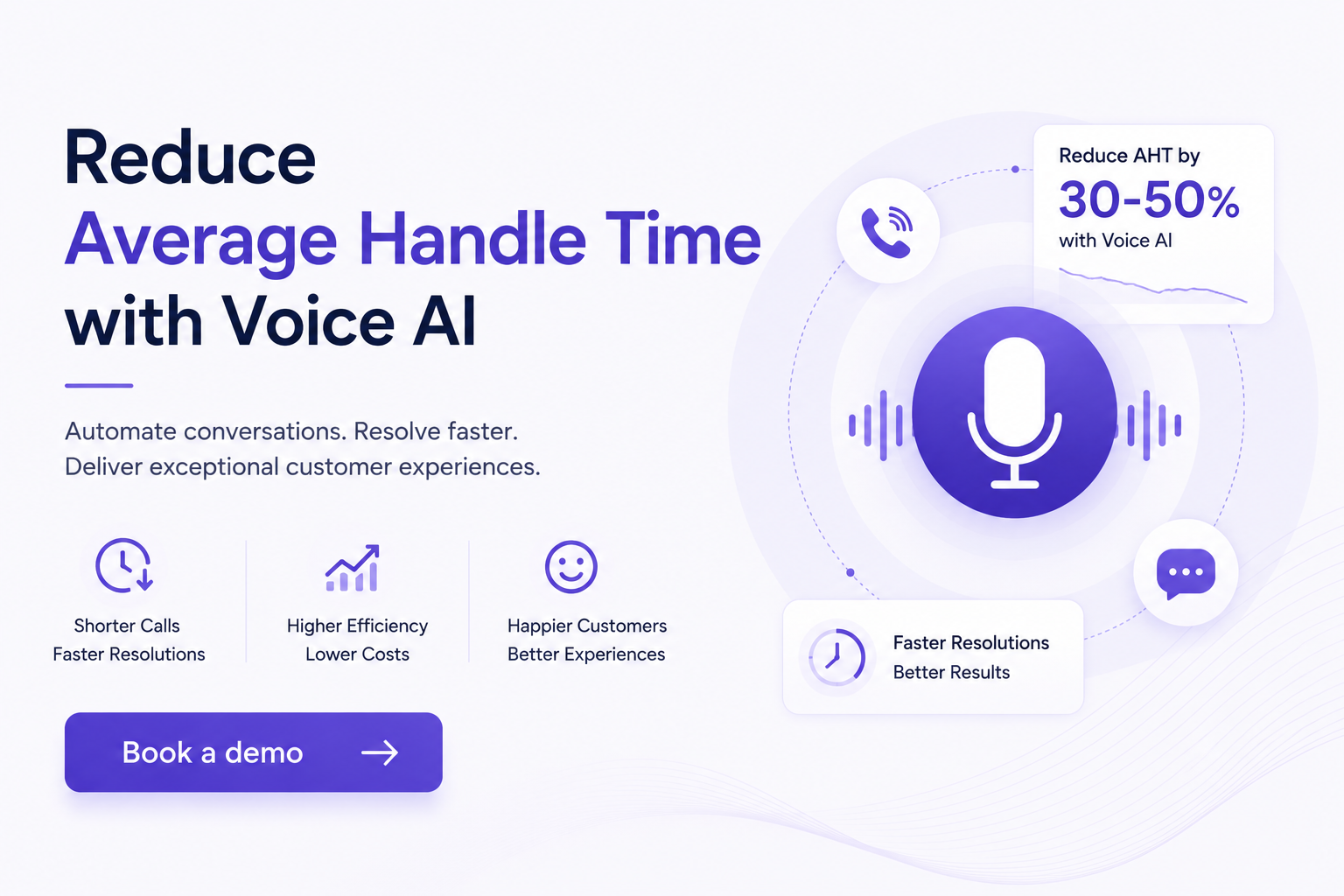
In call centers, Average Handling Time (AHT) is one of the most watched metrics on any operations dashboard. When it is too high, it creates a chain reaction: longer queues, frustrated customers, burned-out agents, and a cost structure that never seems to improve no matter how hard the team works.

According to industry benchmarks, the global average AHT across industries sits between 6 and 10 minutes per call. In sectors like BFSI and insurance, it can stretch well beyond 12 minutes.

For every 30 seconds you shave off AHT, a contact centre handling 1,000 calls a day can save roughly 8 hours of agent time daily. That is not a small number.

Many contact centres have tried to reduce average handling time through conventional means. They hire more agents. They rework scripts. They invest in new IVR menus.

Most of the time, these efforts produce marginal improvements at best, and fresh headaches at worst.

This guide is for CX leaders and operations heads who are ready to look beyond the traditional fixes and understand how Voice AI for Call Centers is reshaping what is actually possible when it comes to AHT reduction.

Key Data Points on AHT and Voice AI in 2026

Before we get into solutions, here is the data landscape you are operating in:

Voice AI Industry Metrics and Benchmarks
Metric Current Industry Benchmark
Global average AHT, all industries 6 to 10 minutes per call
AHT in BFSI and insurance sectors 12 plus minutes per call
AHT reduction reported with Voice AI Up to 40 percent
Cost savings per 30 second AHT reduction, 1,000 calls per day Approximately 8 agent hours saved daily
Customer satisfaction improvement with AI assisted calls Up to 35 percent increase
Calls resolved without human escalation using Voice AI 60 to 70 percent of routine queries
Voice AI market size globally, 2024 USD 11.2 billion, growing at 21 percent CAGR
Percentage of call centres planning AI investment by 2026 Over 75 percent, Gartner
Average IVR abandonment rate Up to 30 percent of callers
First Call Resolution improvement with Voice AI Up to 25 percent increase

Why Traditional Methods of Reducing AHT Fall Short

Before exploring Voice AI, let’s take a look at why traditional methods often miss the mark.

It’s important to understand where previous strategies fall short, because if they worked, we wouldn’t still be talking about AHT as a problem.

1. Hiring More Agents Does Not Fix the Process

Many call centers think that hiring more agents will solve the AHT problem.

But what ends up happening is that you’re simply spreading the same workload across more people, without necessarily improving the speed or quality of the service.

More agents equal more payroll, and the increase in human resources doesn’t guarantee a reduction in AHT. It might even make the situation worse by introducing new inefficiencies.

For an overview of the essential tools modern contact centers use, explore our guide on AI calling software for call centers to see what today’s automated systems can do.

2. Optimizing Call Flows

Reworking call scripts and optimizing workflows might feel like progress, but it only goes so far.

Streamlining the process can help agents handle calls more efficiently, but it doesn’t solve the core issue: many calls still involve repetitive questions, long hold times, and unnecessary transfers.

These inefficiencies persist no matter how much you tweak the flow.

3. Training and Up-Skilling Agents

While improving agent performance is essential, it’s not the silver bullet. Training programs are costly and time-consuming, and the results can be inconsistent.

Even with the best-trained agents, the speed at which they can resolve customer queries doesn’t change much, especially when call volume spikes.

4. IVR Systems

Interactive Voice Response (IVR) systems were a step forward in automation, but they’ve become more of a headache than a help.

Customers still encounter long menus, frustrating prompts, and endless loops before reaching the right person.

Worst of all, IVR systems struggle with handling complex issues, which only increases AHT.

How Voice AI for Call Centers Reduces AHT at the Root

If you’re looking to reduce AHT, you don’t need another script optimization or a slightly faster CRM.

What you need is a system that can intelligently speak, think, and act in real time. That’s Voice AI. And here’s how it’s cutting AHT at the root:

1. 24/7, Always-On Call Handling

Unlike human agents who are constrained by shifts, breaks, and headcount limits, Voice AI operates 24 hours a day, 7 days a week. Whether it is peak hour on a Monday morning or 3 AM on a Sunday, calls are answered instantly.

Eliminating wait time alone can significantly reduce the average handling time metric, because queue time is often counted within AHT calculations at many contact centres.

2. Real-Time Conversations, Not IVR Menus

Modern Voice AI for Call Centers uses advanced Natural Language Processing to hold actual conversations. Customers speak naturally, and the system understands intent, not just keywords.

This means no more pressing 1 for billing, 2 for support, 3 to repeat the menu. Calls move directly from greeting to resolution. Unnecessary transfers drop. And the overall average handling time compresses significantly.

3. Instant Data Access from Business Systems

One of the biggest hidden causes of high AHT is agent lookup time. An agent who needs to pause mid-call to pull up an account, verify a detail, or check a ticket is burning seconds every time. Voice AI platforms that integrate directly with CRMs, ERPs, and ticketing systems eliminate this lag.

Customer data is available in real time, during the call, without any manual retrieval. This is one of the clearest paths to AI-powered customer support automation that actually sticks.

When addressing operational bottlenecks, our post on how voice AI handles high call volumes explains how automation tackles peaks without compromising service quality.

4. Industry-Tailored Call Flows

Generic voice bots struggle with industry-specific queries. The best Voice AI for Call Centers solutions come pre-trained with domain knowledge for industries like BFSI, e-commerce, insurance, and telecom.

When the AI already understands the context of a policy renewal, a loan status check, or an order dispute, it can resolve the query without escalation. Fewer escalations mean shorter calls and lower average handling time

5. Multilingual Fluency

Language barriers are a quiet but significant driver of high AHT. When a customer struggles to communicate or an agent needs additional time to process a non-native language query, call times stretch. Voice AI with multilingual capability, especially in a market as linguistically diverse as India, removes this friction entirely.

Callers are detected and served in their preferred language, instantly. This is particularly important for companies trying to reduce average handling time across regional markets.

6. Built-In Intelligence and Continuous Learning

Modern Voice AI for Call Centers does not stay static. It learns from every interaction, identifying patterns in customer behaviour, refining its responses, and flagging areas of friction for supervisors to review. Over time, the system gets measurably faster and more accurate.

This compounding improvement is something no training programme or script revision can replicate at scale.

You might also want to read this forward-looking piece on the future of the BPO industry, which covers trends shaping customer support and outsourcing in the coming years.

7. Comprehensive Call Analytics

Every call handled by Voice AI is tracked, summarised, and analysed. Supervisors can see where AHT is spiking, which query types are causing delays, and what the sentiment trend looks like across thousands of calls.

This level of visibility is what turns AI-powered customer support automation from a cost-saving tool into a genuine performance improvement engine.

Why Rootle is the Right Choice for Your Call Center

You already know Voice AI is the way forward. But not all Voice AI platforms are built the same. Some feel robotic. Others struggle with real-world complexity.

What sets Rootle apart is its ability to sound natural, think fast, and operate like a seasoned agent at scale.

Truly Natural Conversations, Not Scripted Robots

Rootle isn’t a glorified IVR. It holds intelligent, free-flowing conversations that feel genuinely human, thanks to advanced Natural Language Processing (NLP).

Available 24/7 to Handle Peak Volume

Businesses using Rootle have reported up to 40% improvements in customer satisfaction due to reduced wait times and instant responses.

Smart Routing & Context-Aware Responses

Rootle doesn’t just answer — it thinks. It fetches real-time data from your CRM, support tools, or ERP systems and uses it during the call to provide accurate, contextual responses.

Speaks Your Customer’s Language — Literally

With support for multiple Indian languages, Rootle enables seamless conversations with diverse audiences.

Tailored Workflows for Your Industry

Whether you’re in BFSI, insurance, or e-commerce, Rootle comes ready with industry-specific call flows. This leads to faster implementation and faster resolutions.

100% Call Monitoring + Actionable Analytics

You’ll get summaries, agent performance metrics, sentiment trends, and more so that you can constantly improve how your team runs.

Seamless Integration with Your Stack

Rootle plugs right into your existing tools. Whether you’re using Salesforce, Zendesk, Freshdesk, or custom systems, Rootle connects the dots.

Cut AHT for Good – with Rootle’s Voice AI Solution

Reducing AHT doesn’t need to be a never-ending challenge. Traditional methods have their limits, but Voice AI offers a smarter, faster, and more scalable solution.

With Rootle, you can reduce AHT without sacrificing quality, improve agent productivity, and enhance customer satisfaction — all with the power of Voice AI.

What Rootle Does Differently to Reduce AHT

Rootle is a voice AI platform built for enterprises that demand more than just automated dialing. While legacy systems stop at playing recordings or basic speech-to-text, Rootle acts as an intelligent extension of your workforce. By combining Agentic AI with real-time system integration, Rootle doesn’t just “talk” to your customers—it executes tasks, resolves queries, and moves the needle on your core business metrics, from DSO reduction to lead conversion.

Conversational Accuracy: Uses advanced speech processing to interpret complex, unstructured human dialogue rather than relying on rigid keypad menus or static scripts.

Fluid Multi-Dialect Capabilities: Switches languages and regional accents instantly mid-sentence without dropping the context of the conversation.

Direct Core System Syncing: Connects natively to enterprise CRMs to log interactions, update custom records, and trigger secondary channels dynamically.

Rapid Ecosystem Deployment: Integrates through secure APIs using pre-configured, industry-specific compliance templates to go live within a few weeks.

Voice AI ROI - First 100 calls free

FAQs: AI Voice Automation and BPO Digital Transformation

1. What is Average Handling Time (AHT) and why does it matter for call centers?

Average Handling Time is the total time an agent or automated system spends on a single customer interaction, including talk time, hold time, and after-call work. It is one of the most important operational metrics in a call center because it directly affects cost per contact, queue length, and customer satisfaction.

A 30-second reduction in AHT across 1,000 daily calls saves approximately 8 agent-hours per day. For companies trying to reduce average handling time, even small improvements translate into significant annual savings.

2. How does Voice AI for Call Centers actually reduce Average Handling Time?

Voice AI for Call Centers reduces AHT through several simultaneous mechanisms. It eliminates IVR navigation time by using NLP to understand spoken intent directly. It removes agent lookup delays by pulling CRM data in real time during the call. It reduces escalations by resolving routine queries autonomously. And it removes language barrier delays through automatic multilingual detection and response. The cumulative effect of these improvements is what drives the 40 percent AHT reduction figures reported by early adopters.

3. What makes an intelligent contact center solution different from a standard call center platform?

Yes, and this is actually where Voice AI for Call Centers performs most strongly. Platforms like Rootle are built specifically for high-compliance environments. They include features like automatic call recording, real-time transcript generation, identity verification before sensitive disclosures, and audit-trail logging. In lending and insurance contexts specifically, these capabilities make Voice AI more compliant than many human-agent operations, not less.

4. What is the difference between Voice AI and a traditional IVR system?

The difference is significant. A traditional IVR system routes calls through pre-set menu trees. Callers press numbers or say single keywords to navigate. There is no real conversation, no context retention, and no ability to handle complex or unexpected queries. AI-powered customer support automation through Voice AI is fundamentally different. The system understands natural spoken language, retains context through the conversation, pulls live data from integrated systems, and can resolve multi-step queries without transferring the caller to a human agent.

5. How long does it take to deploy Voice AI in an existing call center setup?

Deployment timelines vary depending on the complexity of existing systems and the number of integrations required. A platform like Rootle, which comes with pre-built connectors for major CRMs such as Salesforce, Freshdesk, and Zendesk, as well as LOS platforms like FINNONE and Temenos, can significantly compress the implementation timeline. For organisations with standard stack configurations, initial deployment can go live within 4 to 8 weeks. Full optimisation, where the system has processed enough calls to improve accuracy significantly, typically takes an additional 4 to 6 weeks of live operation.

Glossary

Average Handling Time, AHT: A call center metric that measures the total duration of a customer interaction from the moment the call is answered until after call work is completed, including talk time, hold time, and wrap up time. Organizations aiming to Reduce Average Handling Time focus on eliminating repetitive tasks and minimizing delays.

Voice AI for Call Centers: An artificial intelligence powered telephony solution that uses Natural Language Processing and machine learning to conduct real time spoken conversations with customers, replacing or supporting human agents for routine and semi complex queries as part of modern Call Center Automation.

Natural Language Processing, NLP: A branch of artificial intelligence that enables machines to understand, interpret, and generate human language in a meaningful and contextually accurate way, allowing Voice AI systems to detect customer intent and respond appropriately during live calls.

IVR, Interactive Voice Response: A legacy telephony system that presents callers with menu based options navigated through keypad inputs or basic voice commands, without true conversational understanding or contextual intelligence.

AI Powered Customer Support Automation: The use of artificial intelligence tools such as Voice AI, chatbots, and intelligent routing systems to automate service workflows, reduce manual agent involvement, and improve resolution speed, consistency, and scalability.

First Call Resolution, FCR: A performance metric that measures the percentage of customer queries fully resolved during the first interaction without callbacks or follow ups. Higher FCR is strongly linked to lower AHT and improved customer satisfaction.

Smart Escalation: A Voice AI capability that identifies queries beyond automation scope, gathers complete context and verified caller identity, and transfers the interaction to a human agent with all relevant information pre loaded, eliminating repetition and saving time.

CRM, Customer Relationship Management: A software system that stores and manages customer data, interaction history, and account information. Voice AI for Call Centers integrates with CRM platforms to access and update data in real time during calls.

LOS, Loan Origination System: A software platform used by financial institutions to manage the full loan lifecycle, from application to disbursement. Examples include FINNONE by Nucleus Software and solutions by Temenos.

Code Mixed Language: A communication pattern common in India where speakers naturally blend two or more languages within the same conversation, such as mixing Hindi and English. Advanced Voice AI systems are trained to understand and respond accurately to this pattern.

After Call Work, ACW: The administrative tasks completed by agents after a call ends, including logging notes, updating CRM records, and closing tickets. AI driven transcription and automation reduce ACW and help reduce overall handling time.

BFSI: An industry abbreviation for Banking, Financial Services, and Insurance, one of the largest and most AHT sensitive sectors globally, where efficient Call Center Automation directly impacts cost, compliance, and customer experience.

Dhaval Pandit
Dhaval Pandit
Chief Growth Officer

Dhaval Pandit is a seasoned SaaS growth and sales leader with over 16 years of experience scaling technology products and go-to-market teams across global markets. He currently leads strategic growth initiatives and business development at Rootle.ai, driving adoption of voice-based AI solutions across enterprise clients.

Recent Blogs

How Voice AI Handles High Call Volumes Without Losing Quality
voice AI for first call resolution