
Date

Category


For years, the gold standard of contact center metrics was simple: Call Deflection Rate. The higher the percentage of calls stopped before reaching a human representative, the better the contact center was assumed to be performing.
However, this narrow focus created an unintended operational crisis known as The Escalation Trap.
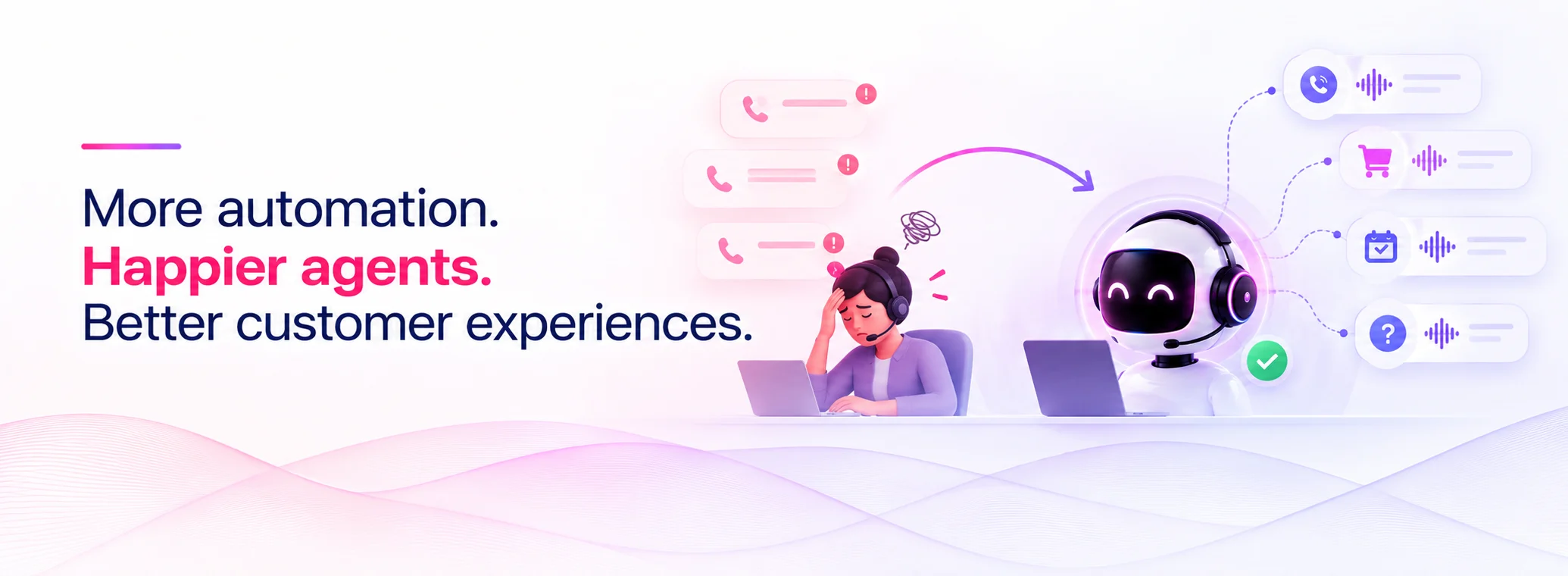
When basic transactional calls are handled away from human reps, agents lose the easy, low-stress calls that historically balanced their workday. Instead, every incoming call on their headset becomes a complex dispute, an angry complaint, or an unusual edge case that requires navigating five different software tabs.
The Productivity-First Approach: Balancing Voice AI Agents & Human Teams
Modern Voice AI agents redefine how work is divided across the contact center. Rather than acting as rigid touch-tone barriers, they serve as elastic digital coworkers that absorb high-volume operational stress and streamline human workflows.
Comparing Deflection-First vs. Productivity-First Automation
| Primary Goal | Contain and block as many calls as possible | Complete tasks quickly and reduce agent fatigue |
| Agent Workload | 100% complex, high-stress escalations | Balanced mix of supported escalations & high-value tasks |
| After-Call Work (ACW) | Manual typing (2–5 minutes per call) | Automated summary logging (< 10 seconds) |
| Escalation Quality | Cold transfers with zero context passed | Warm screen-pop transfers with full transcript & intent |
| Annual Agent Attrition | High (35% – 50%) | Significantly Reduced (under 20%) |
| Customer CSAT | Poor (Frustrated by rigid menus) | High (Instant resolution or zero-repetition human transfer) |
Sustainable Automation Delivers Better Business ROI
Contact center automation should never come at the expense of your team’s well-being. Focusing solely on call deflection burns out frontline agents, inflates turnover expenses, and damages customer relationships.
By integrating Voice AI agents as supportive digital partners, organizations achieve a balanced operational ecosystem. Routine queries are resolved instantly, administrative burdens are eliminated, and human agents are empowered to do what they do best: solve complex problems with empathy. The result is lower operational costs, higher customer satisfaction, and a dramatic reduction in agent churn.
FAQs: AI Voice Agents for Customer Support Automation
1. How does contact center automation with Voice AI agents prevent agent burnout?
Voice AI agents prevent burnout by taking over repetitive tier-1 tasks (like balance checks and address updates), fully automating After-Call Work (ACW), and passing complete conversation context during transfers so human agents don’t have to handle angry customers who are forced to repeat themselves.
2. What is the difference between call deflection and productivity-first automation?
Call deflection focuses purely on stopping calls from reaching human agents, which often leaves agents handling only complex, high-stress calls back-to-back. Productivity-first automation uses Voice AI to resolve routine queries while assisting human agents with real-time context, automated note-taking, and smooth transfers.
3. How much time can Voice AI save on After-Call Work (ACW)?
Voice AI can reduce After-Call Work by up to 80%. It transcribes live calls, generates concise interaction summaries, auto-selects disposition codes, and updates CRM records in real time, eliminating manual data entry for human agents.
4. What happens during a live transfer from a Voice AI agent to a human representative?
During a live transfer, the Voice AI agent executes a warm handoff. It streams a screen-pop to the human agent’s desktop containing the customer’s verified identity, a real-time transcript summary, intent analysis, and sentiment markers—ensuring zero customer repetition.
5. Can Voice AI agents handle multi-lingual callers and regional dialects?
Yes. Modern enterprise Voice AI platforms like Rootle feature specialized speech recognition models trained on regional accents and code-switched dialects (such as Hinglish or Tanglish). They dynamically auto-detect the spoken language and converse naturally without forcing callers through rigid language menus.

Rootle is inexpensive, simple to start and easy to use.