


Skip to content

Top 10 High-Yield Voice AI Agent Use Cases Every COO Should Benchmark

Featured Image

Executive Summary

For Chief Operating Officers managing rapid growth, scaling human contact centers is a direct drain on margins. Hiring, training, and managing agent turnover creates friction while limiting operational speed. Enterprise Voice AI offers an alternative model. By automating complex, multi-turn phone interactions in real time, Voice AI agents resolve high-volume workflows without adding headcount. This guide breaks down ten high-yield use cases across lending, e-commerce, edtech, and customer operations that top COOs are benchmarking to expand capacity and protect profitability.

Scaling operational capacity used to follow a predictable, expensive formula. If your inbound inquiry volume doubled or your lead pipeline tripled, you opened more call center seats. You hired supervisors, ran multi-week training programs, and absorbed the inevitable cost of high turnover.

That linear approach no longer holds up.

Modern revenue models require continuous operational speed. Customers ignore generic SMS alerts, abandon complex forms within seconds, and expect phone interactions to happen immediately without sitting in hold queues.

Progressive COOs are moving away from brute-force headcount expansion. Instead, they deploy enterprise Voice AI agents that handle multi-turn human dialogue in regional languages, connect natively to enterprise databases, and execute tasks dynamically.

Here are the top ten high-yield Voice AI use cases operational leaders are putting at the center of their growth plans.

Conversational Voice AI changes this dynamic entirely. Operating with sub-second latency and natural language understanding, Voice AI agents engage customers in human-like dialogue, process regional accents and dialect mixing, and connect directly to core banking databases to perform live transactional actions.

Here are the top seven enterprise use cases where Voice AI is transforming retail banking operations.
Book a demo

1. Instant Inbound Lead Qualification

Top-of-funnel lead generation is expensive, but most of that ad spend goes to waste if your team takes hours to contact new sign-ups. Intent decays rapidly. If a prospect submits an inquiry for a loan, a software demo, or a high-ticket service, the company that calls back first usually wins the contract.

Voice AI agents place automated outbound calls within seconds of form submission. They ask policy-specific qualification questions, verify income or project scope, and update your CRM immediately.

Key Operational Benchmarks

  • Speed to Outreach: Under 60 seconds from form submission.

  • Cost Efficiency: Filters out unqualified leads automatically so human sales teams focus exclusively on pre-vetted prospects.

2. E-Commerce Cart Abandonment Recovery

Sending another generic email or WhatsApp message to a shopper who abandoned their online shopping cart rarely moves the needle. Many buyers abandon their purchases because of minor technical confusion, unexpected checkout fees, or simple hesitation.

Voice AI provides a conversational recovery channel. By placing a quick, friendly follow-up call shortly after a high-value cart is abandoned, an AI agent answers product questions, clarifies delivery timelines, and offers a checkout link over text while keeping the buyer on the phone.

3. Early-Bucket Payment Reminders (DPD 0–30)

Managing early-stage debt collection requires high volume without aggressive, high-friction pressure tactics. Waiting until an account crosses 30 Days Past Due (DPD) pushes recovery costs through the roof.

Voice AI automates proactive pre-due reminders and early DPD outreach.

• Scalable Outreach: Places thousands of interactive pre-due calls concurrently to confirm upcoming payment dates.

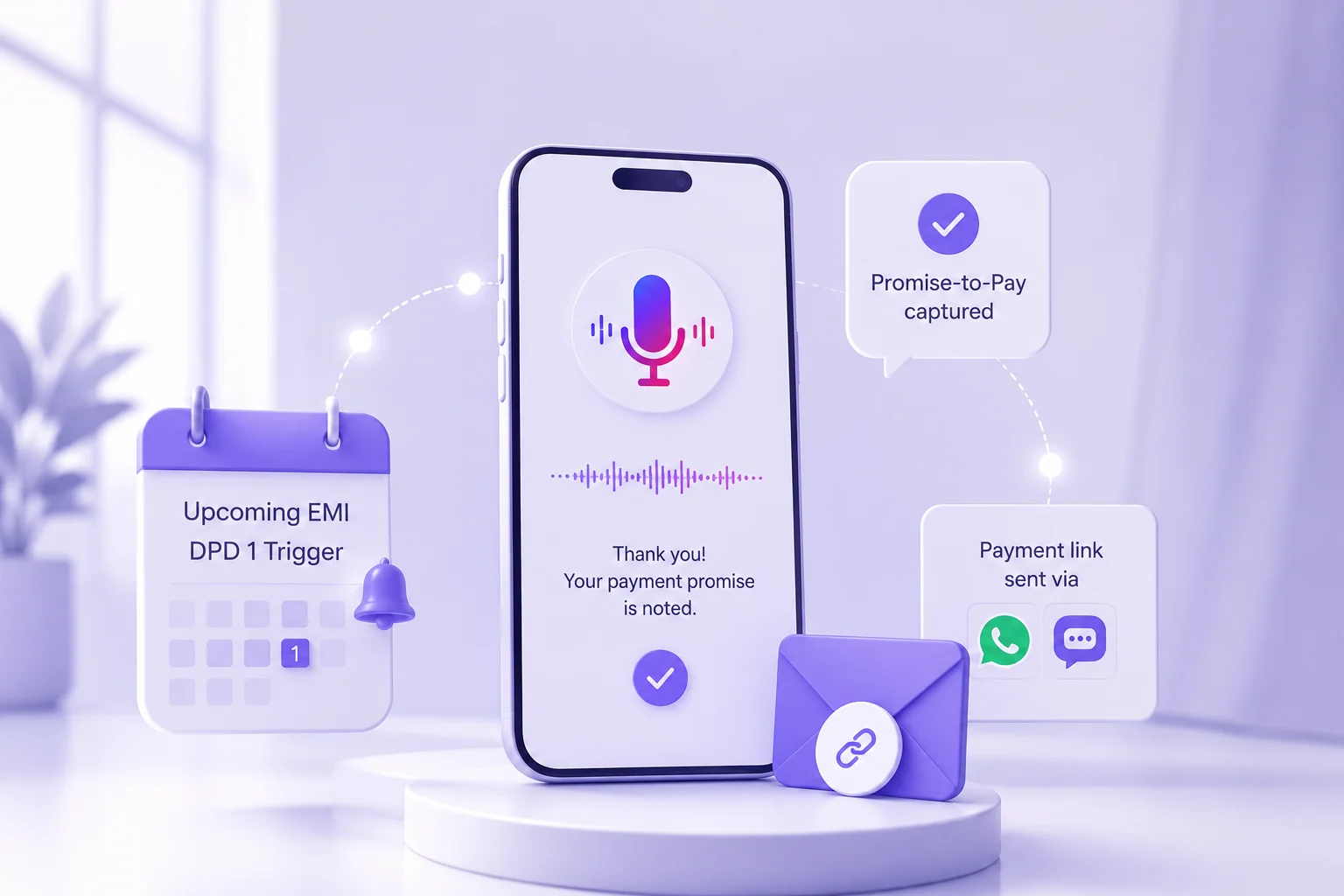
• Seamless Payments: Captures verbal Promise-to-Pay (PTP) commitments and dispatches instant payment links straight to the caller’s device.

• Localized Dialogue: Speaks regional dialects to clear up auto-debit failure issues calmly and politely.

4. Edtech Student Trial Booking & Course Screening

Edtech operations burn enormous budgets chasing prospective students who fill out forms for free webinars or trial classes but fail to show up.

Voice AI agents streamline edtech sales funnels by placing instant screening calls to parents or students. The voice agent evaluates academic requirements, confirms attendance for upcoming orientation sessions, and sends direct calendar invites or class access links over messaging apps during the call.

5. e-KYC & Onboarding Drop-Off Recovery

Complex digital onboarding steps like video e-KYC, bank statement uploads, or identity verifications frequently result in heavy applicant drop-off rates. Leaving these abandoned applications idle wastes original acquisition spend.

Voice AI agents monitors onboarding workflows continuously. The moment an applicant stalls at a document verification screen, the system triggers an outbound voice call to address the issue, walk the user through the process verbally, and send direct re-upload links while keeping the applicant engaged.

6. High-Volume Order Verification (COD Confirmation)

For retail and e-commerce companies operating in Cash-on-Delivery (COD) markets, high return-to-origin (RTO) rates directly destroy margins. Shipping items that get rejected at the doorstep drains operating capital.

Automated voice agents call buyers right after a COD order is placed to confirm the shipping address, verify buyer intent, and offer options to convert the purchase into a prepaid order via a text payment link.

7. 24/7 Inbound Customer Service & Account Queries

Over 60% of contact center call volume consists of routine, predictable queries that consume human agent bandwidth:

• Checking account balances and recent transaction histories.

• Requesting loan NOCs, tax certificates, or official statements.

• Tracking order shipping updates or service ticket statuses.

• Step-by-step guidance for portal login and password resets.

Voice AI agents act as a front-line team, resolving these routine inquiries around the clock without placing callers on hold.

8. Instant Security Fraud Alerts & Card Controls

When suspicious account activity or unusual transactions occur, speed is essential to prevent financial loss. Voice AI handles urgent security workflows immediately without routing callers into long support queues:

• Immediate Verification: Places an instant outbound call to verify flagged charges in real time.

• Instant Control: Allows callers to block compromised cards or freeze credentials using simple voice commands, updating core systems right away.

9. Healthcare Appointment Scheduling & Patient Intake

Healthcare providers and diagnostic labs face constant operational friction from missed appointments and manual intake calls.

Voice AI agents call patients to confirm upcoming visits, explain pre-test preparation instructions (such as fasting requirements), and reschedule open slots on the fly. This automation reduces no-show rates while ensuring clinic schedules remain fully optimized.

10. Proactive Cross-Selling & Renewal Outreach

Generic marketing emails often go unread. Voice AI lets growth teams deliver personalized, conversational cross-selling campaigns based on real-time customer data.

When a customer becomes eligible for a credit limit upgrade, an insurance renewal, or a subscription extension, the Voice AI agents calls to outline the offer, answer questions naturally, and capture verbal consent to begin processing.

Benchmarking Channels: Voice AI vs. Legacy Contact Systems

HTML Table Generator
Metric / Capability
Legacy Human Call Center
Traditional Push-Button IVR
Enterprise Voice AI Engine
Average Speed to Answer 5 to 20+ minutes Instant (Rigid keypad options) Zero hold time
Outreach Capacity Limited by staff size Low conversational ability Parallel outbound calls
Language Flexibility Limited by hiring pool Static recorded prompts Fluid native code-switching
Cost per Interaction High Low Low
CRM Data Syncing Manual agent entry None / Basic Real-time bi-directional API

Building the Scalable Operations Architecture with Voice AI Agents

Relying solely on headcount expansion to manage customer interactions is no longer a viable operational strategy. By benchmarking and deploying Voice AI across high-impact use cases like lead qualification, payment reminders, cart abandonment recovery, and routine support, forward-thinking COOs remove operational bottlenecks while cutting operating expenses. Implementing intelligent voice automation empowers progressive enterprises to scale call volume smoothly, protect gross margins, and deliver the responsive service modern customers demand.

What Rootle Does Differently

Rootle is a voice AI platform built for enterprises that demand more than just automated dialing. While legacy systems stop at playing recordings or basic speech-to-text, Rootle acts as an intelligent extension of your workforce. By combining Agentic AI with real-time system integration, Rootle doesn’t just “talk” to your customers—it executes tasks, resolves queries, and moves the needle on your core business metrics, from DSO reduction to lead conversion.

Conversational Accuracy: Uses advanced speech processing to interpret complex, unstructured human dialogue rather than relying on rigid keypad menus or static scripts.

• Fluid Multi-Dialect Capabilities: Switches languages and regional accents instantly mid-sentence without dropping the context of the conversation.

• Direct Core System Syncing: Connects natively to enterprise CRMs to log interactions, update custom records, and trigger secondary channels dynamically.

• Rapid Ecosystem Deployment: Integrates through secure APIs using pre-configured, industry-specific compliance templates to go live within a few weeks.

Hero banner promoting Voice AI for business, with a central purple microphone and circular icons for Support, Multilingual Conversations, Operational Efficiency, and Better Customer Experiences.

FAQs: Voice AI Agents

1. How does a Voice AI agent handle complex queries when a caller gets confused or asks an unexpected off-script question?

When a conversation strays beyond configured parameters or sentiment analysis detects caller frustration, the Voice AI platform executes a smooth, warm transfer to a human specialist. Instead of dropping the call or forcing the user to start over, the system passes the real-time call transcript, caller details, and identified intent directly to the agent’s screen. This context handover lets human agents step in cleanly without asking the caller to repeat themselves.

2. What metrics should a COO track to measure the true ROI of a Voice AI deployment across customer operations?

COOs should track several core operational metrics to calculate Voice AI ROI accurately. These include Automated Containment Rate (the percentage of calls resolved without human help), Cost per Interaction, Lead Contact Velocity (time to reach new sign-ups), e-KYC Drop-off Recovery Rates, and changes in DPD 0-30 Roll-Forward Rates. Comparing these metrics against legacy operational costs highlights direct savings in call center labor and telephony overhead alongside gains in revenue conversion.

3. How does Rootle assist edtech platforms in improving their student enrollment and trial conversion rates?

Rootle transforms edtech lead management by contacting new prospects within seconds of sign-up. The AI voice agent calls parents or prospective students in their native language to pre-screen academic goals, evaluate program suitability, and answer basic course questions. By verifying intent immediately, Rootle schedules trial classes on the spot and sends calendar access links over WhatsApp while the caller is still on the line, boosting attendance and trial conversions.

4. Can Rootle's Voice AI engine integrate directly with legacy Core Banking Systems and enterprise CRMs?

Yes. Rootle features an enterprise-grade API and Webhook structure engineered to connect cleanly with both modern cloud CRMs and legacy core database systems. The platform pulls customer context prior to dialing, updates custom database fields live during the call, and triggers downstream actions (such as dispatching payment links or updating loan origination stages) without requiring manual human effort.

5. Why is multi-dialect regional language capability critical for Voice AI adoption in competitive markets?

In regional markets, callers rarely speak in formal, textbook language. They mix local dialects with English terms, alter pronunciations, and switch languages mid-sentence. Standard translation tools often misinterpret this speech, causing interaction failures. A native multi-dialect Voice AI engine processes regional accents and code-switching naturally, ensuring fluid communication, higher call completion rates, and better user experiences across all demographics.

Rahul Desai
Rahul Desai
Client Growth Manager

Rahul Desai is a client growth and sales professional with extensive experience driving strategic partnerships and revenue growth. At Rootle.ai, he focuses on expanding market reach, enabling enterprises to leverage multilingual voice AI for intelligent customer engagement and automated conversational experiences.

Recent Blogs

Purple 3D hero illustration with a smartphone and microphone, bank icons, and a classical building beside the slogan: 'Smarter conversations, stronger banking outcomes.'
Banner: 'Measure what matters. Drive what grows.' with a central microphone and surrounding KPI icons.