Skip to content

Kannada Voice AI: Building Localized Voice Agents for Karnataka Businesses

Featured Image

Executive Summary

Karnataka is India’s technology center, yet many enterprises operating in Bengaluru and across the state still rely on English or Hindi-first customer support. This creates a severe mismatch for over 44 million native speakers who prefer communicating in Kannada. Implementing Kannada Voice AI bridges this gap by delivering context-aware, real-time conversations in regional dialects. By handling routine inquiries, code-switched dialogues, and local accents automatically, businesses reduce wait times, lower operational costs, and build deeper trust with their customers.
Bengaluru powers India’s tech innovation, but the everyday consumer landscape across Karnataka demands a deeply localized approach. From real estate developers in Hubli to fintech platforms in Mysore and e-commerce logistics in urban Bengaluru, customers expect businesses to speak their language.

Relying solely on English or Hindi customer service channels alienates millions of callers. Forcing native speakers through rigid IVR keypads or English-first text bots leads to miscommunication, high drop-off rates, and overloaded support queues.

Deploying voice AI in Kannada solves this structural friction. Modern voice systems process spoken Kannada natively, allowing enterprises to automate routine phone interactions while delivering natural, human-like service.

Navigating Regional Dialects and "Kanglish" Code-Switching

Building effective Kannada Voice bots requires much more than translating English text into literal Kannada script. The language is rich in regional variations, colloquialisms, and urban slang.

An effective conversational system must process multiple acoustic profiles across Karnataka:

• Regional Accent Adaptation: The system must seamlessly understand the urban pace of Bengaluru, the softer inflections of Mysore, and the distinct vocabulary of North Karnataka dialect variations.

• Kanglish Code-Switching: Urban consumers frequently mix English and Kannada in everyday speech (for example, “Naale morning 10 AM ge appointment confirm maadi” or “₹2,000 transfer maadi”). The speech recognition model must process these multi-language phrases without breaking flow.

• Colloquial Intent Recognition: Instead of failing on informal phrasing, advanced natural language processing parses colloquial expressions accurately to extract underlying intent.

The Core Technology Architecture Behind Kannada Voice Bots

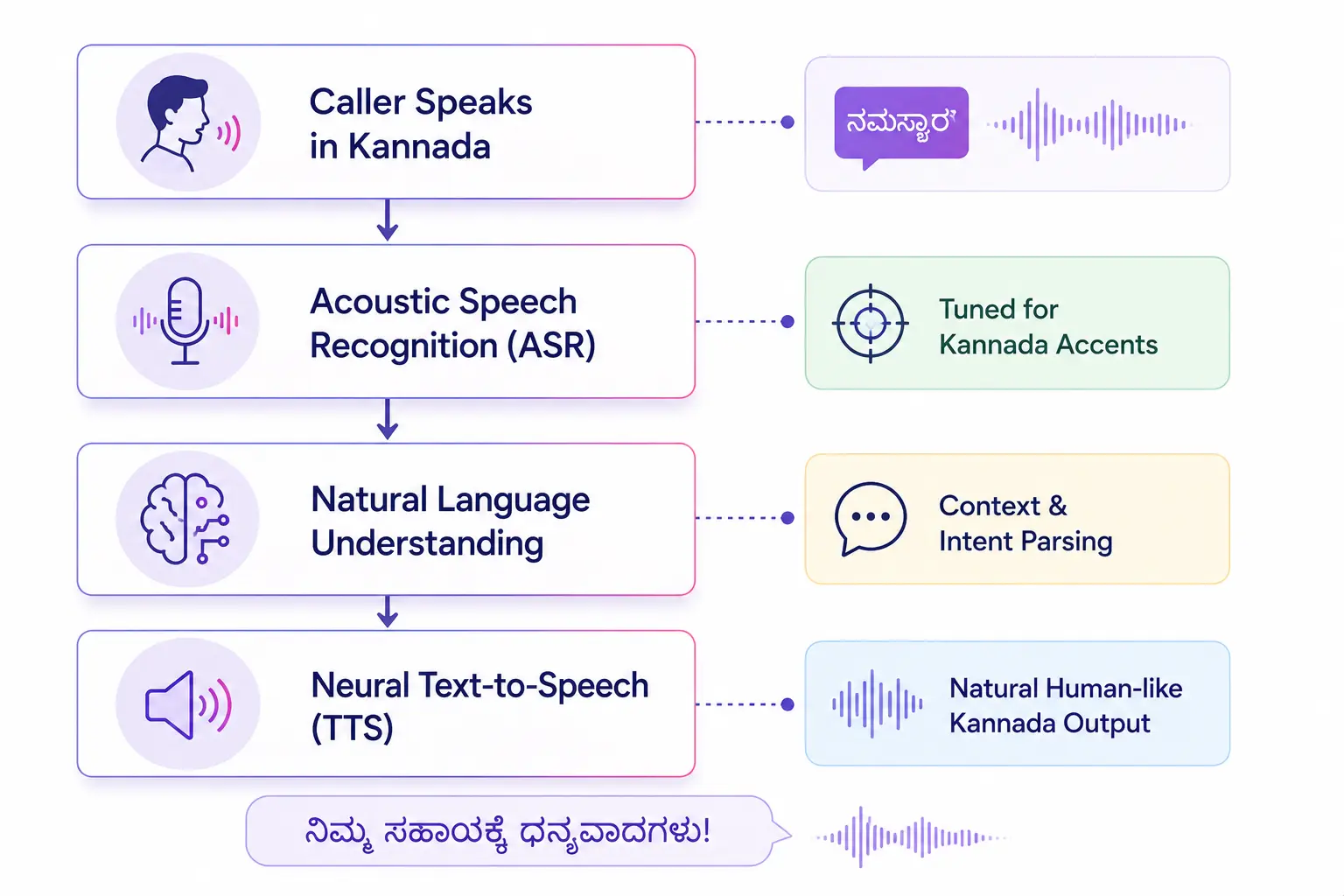
Delivering human-like conversation over a standard phone line requires an ultra-fast, multi-layered processing stack. To make AI in Kannada language feel natural, round-trip processing latency must remain under one second.

The Core Technology Architecture Behind Kannada Voice Bots• Kannada-Tuned ASR (Automatic Speech Recognition): Converts raw voice audio into text, filtering out background noise and adapting to regional accents.

• Context-Aware NLU (Natural Language Understanding): Evaluates the extracted text to determine user intent, checking CRM database records in real time.

• Neural TTS (Text-to-Speech): Synthesizes the response into fluent, expressive Kannada speech that avoids the robotic, monotone cadence of legacy systems.

High-Impact Enterprise Use Cases Across Karnataka

Adopting Voice AI allows companies to scale inbound and outbound call capacity instantly without ballooning human resource budgets.

Real Estate and Property Management

• Instant Lead Qualification: Voice agents answer incoming property inquiries 24/7, gathering location preferences, budget details, and timelines in Kannada before routing warm leads to human brokers.

• Site Visit Scheduling: Automated agents coordinate site tours, send confirmation links via WhatsApp, and deliver directions in local dialects.

Banking, NBFCs, and Financial Services

Vernacular Loan Onboarding: Agents guide rural borrowers through initial eligibility checks and e-KYC document re-uploads in native Kannada.

• Payment Reminders: Automated systems make polite, compliant EMI collection calls, delivering instant UPI payment links during the conversation.

E-Commerce and Retail Logistics

Order Tracking & Address Verification: Voice bots handle repetitive “Where is my order?” calls instantly, verifying delivery addresses in local landmarks.

• Return and Refund Processing: Customers initiate returns by explaining product issues naturally in spoken Kannada.

What Is the Step-by-Step Roadmap for Implementing Kannada Voice AI?

Deploying conversational AI across your operations does not require rebuilding your customer support infrastructure from scratch. Following a structured roadmap ensures a smooth rollout while protecting existing workflows.

  1. Identify High-Volume Routine Use Cases: Pinpoint repetitive inbound or outbound call scenarios, such as appointment reminders, payment collections, or status checks, where automation yields immediate cost savings.

  2. Map Regional Conversation Flows: Design dialogue trees that account for local phrasing, common Kannada idioms, and expected “Kanglish” code-switching patterns.

  3. Connect API and Telephony Channels: Link the voice orchestrator to your enterprise CRM and cloud telephony providers through secure REST APIs.

  4. Run Phased Pilot Testing: Deploy the voice agent on a small percentage of daily call traffic to evaluate intent recognition accuracy, sub-second latency targets, and caller satisfaction before full production scaling.

Operational ROI: Speed, Scale, and Support Inclusivity

Replacing manual call queues with automated conversational agents drives immediate financial and operational gains:

• Sub-Second Response Times: Eliminates hold times during peak call hours, boosting customer satisfaction scores.

• 90% Cost Reduction Per Call: Handling high-volume routine queries via AI costs a fraction of a manual call center seat.

• Infinite Concurrent Scale: Manages thousands of simultaneous calls during flash sales or service disruptions without performance drops.

• Seamless Human Handoff: Complex or emotionally sensitive calls transfer smoothly to live agents along with full transcript history.

What Rootle Does Differently

Rootle is a voice AI platform built for enterprises that demand more than just automated dialing. While legacy systems stop at playing recordings or basic speech-to-text, Rootle acts as an intelligent extension of your workforce. By combining Agentic AI with real-time system integration, Rootle doesn’t just “talk” to your customers—it executes tasks, resolves queries, and moves the needle on your core business metrics, from DSO reduction to lead conversion.

Conversational Accuracy: Uses advanced speech processing to interpret complex, unstructured human dialogue rather than relying on rigid keypad menus or static scripts.

• Fluid Multi-Dialect Capabilities: Switches languages and regional accents instantly mid-sentence without dropping the context of the conversation.

• Direct Core System Syncing: Connects natively to enterprise CRMs to log interactions, update custom records, and trigger secondary channels dynamically.

• Rapid Ecosystem Deployment: Integrates through secure APIs using pre-configured, industry-specific compliance templates to go live within a few weeks.

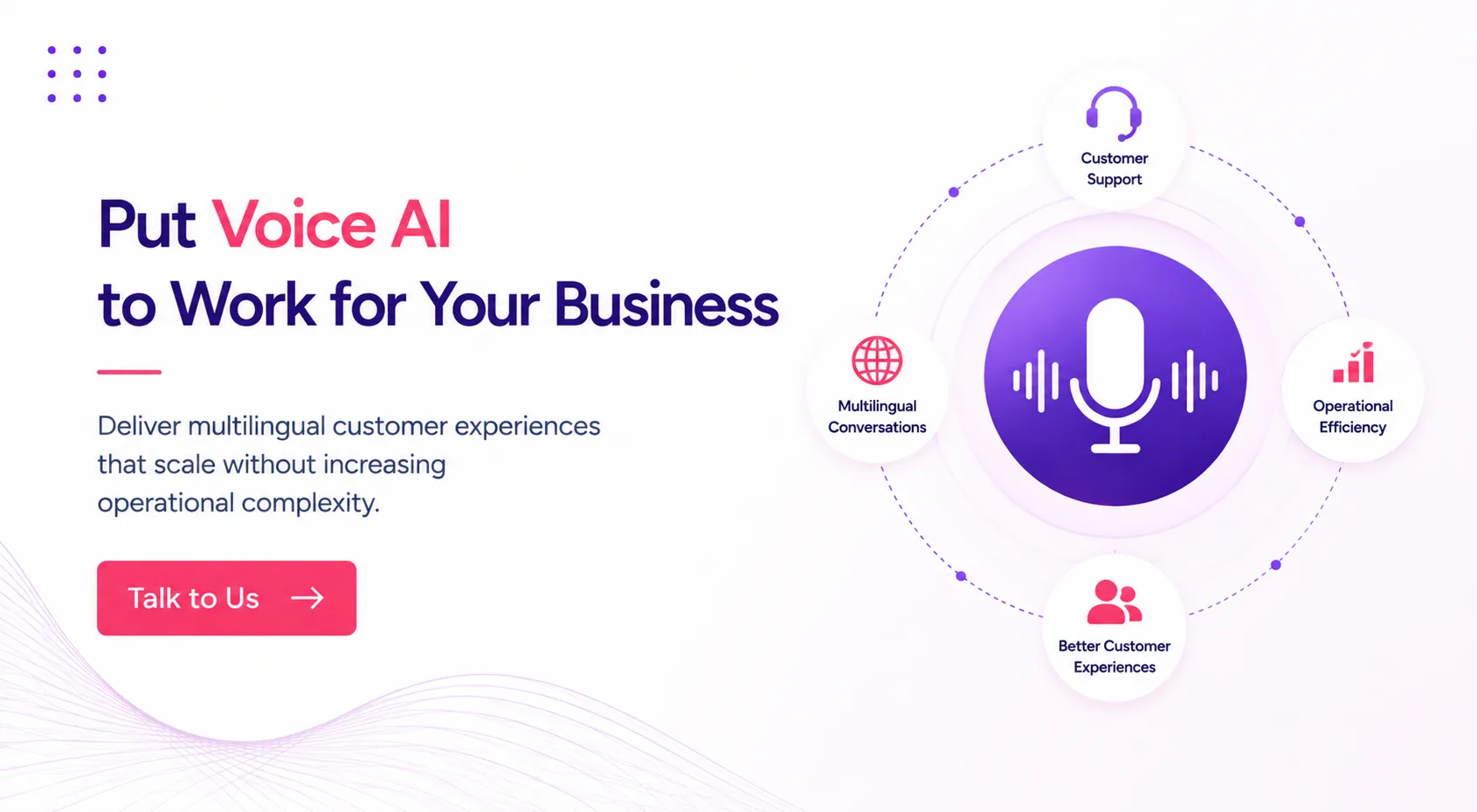
Hero banner promoting Voice AI for business, with a central purple microphone and circular icons for Support, Multilingual Conversations, Operational Efficiency, and Better Customer Experiences.

FAQs: Voice AI in Kannada

1. Why do traditional translated English voice bots fail when handling Kannada customer support calls?

Traditional systems fail because they rely on literal translation layers layered over English-first AI models. Kannada features distinct grammatical structures, formal and informal verb conjugations, and varied regional dialects that do not translate word-for-word from English. When a customer uses colloquial phrasing or switches between Kannada and English mid-sentence, rigid translation tools misinterpret the intent, causing high error rates and customer frustration. Effective voice automation requires a platform engineered with native speech recognition and language understanding built specifically for Indian regional accents.

2. How do conversational AI platforms handle different regional accents across Karnataka, such as Bangalore Kannada versus North Karnataka dialects?

Modern conversational engines use acoustic models trained on thousands of hours of diverse regional audio samples. Rather than enforcing a single standardized dialect, the speech recognition layer maps variations in pronunciation, local vocabulary, and speech cadence to central intent definitions. Whether a caller speaks with urban slang from Bengaluru, the softer inflections of Mysore, or the specific dialect patterns of Hubli-Dharwad, the AI identifies the core request accurately and responds in a clear, natural tone that matches the caller’s expectations.

3. How does Rootle ensure seamless multi-dialect performance during live Kannada conversations?

Rootle features a multi-dialect acoustic processing engine that adapts dynamically to spoken variations in real time. When a caller begins speaking, Rootle analyzes the audio stream to detect accent nuances and vocabulary choices instantly. It handles code-switched language patterns—such as mixing Kannada with English words—without dropping context or stalling the conversation. This allows Rootle to maintain sub-second response times and high accuracy across diverse customer bases throughout Karnataka.

4. Can Rootle integrate directly with our existing CRM and telephony infrastructure for Kannada call automation?

Yes. Rootle is designed to connect natively with modern enterprise tech stacks, including CRMs, Loan Origination Systems, and cloud contact center platforms like Exotel, Ozonetel, or custom SIP trunks. Through secure REST APIs and webhooks, Rootle fetches caller data before generating responses, updates customer records live during the call, and triggers secondary workflows like WhatsApp messages or SMS alerts automatically.

5. What industries in Karnataka benefit most from implementing voice AI in Kannada?

Financial services, real estate, e-commerce, healthcare, and telecom see the highest immediate return on investment. Any sector managing high call volumes, complex customer onboarding, or time-sensitive reminders benefits significantly. By automating repetitive Tier-1 inquiries in native Kannada, these industries reduce operational overhead, cut lead response times, and expand market reach into non-metro regions.

Dhaval Pandit
Dhaval Pandit
Chief Growth Officer

Dhaval Pandit is a seasoned SaaS growth and sales leader with over 16 years of experience scaling technology products and go-to-market teams across global markets. He currently leads strategic growth initiatives and business development at Rootle.ai, driving adoption of voice-based AI solutions across enterprise clients.

Recent Blogs

Why Multilingual Voice AI in Regional Languages Is the Future of Customer Support
Voice AI in Hindi