Skip to content

Voice AI for Collections: How Enterprises Are Recovering Payments at Scale

Featured Image

Enterprises are deploying Voice AI for debt collection to scale outreach, reduce cost per contact, and recover payments without adding headcount. Modern AI voice agents handle the full collections call lifecycle — identity verification, RBI-mandated disclosures, payment negotiation, and dispute escalation — while staying compliant with RBI Fair Practices Code, TRAI calling norms, and the DPDP Act 2023. Voice AI costs roughly $0.40 per call compared to $7–$12 for human agents — a 90–95% cost reduction per automated interaction. This blog breaks down how it works, what makes a collections-grade Voice AI platform different from a generic one, and what Indian enterprises need to evaluate before deploying at scale.

How We Wrote This Blog: Our Methodology

This blog was researched and written by the Rootle content team. We combined first-hand knowledge of how the Rootle Voice AI platform is deployed in high-volume outbound calling workflows, publicly available industry research on ASR, NLU, and collections automation, and a close reading of the Indian regulatory framework governing debt recovery — including RBI Fair Practices Code, RBI Recovery Agent Guidelines, TRAI commercial calling norms, and the Digital Personal Data Protection Act 2023.

Our goal was to write something practically useful for the people who actually make collections technology decisions in India — operations heads, compliance officers, and collections managers at NBFCs, banks, and recovery agencies — rather than a surface-level overview written for search engines. Where statistics are cited, they are drawn from verifiable published benchmarks. Where regulatory guidance is referenced, it reflects the Indian framework specifically, not US or EU equivalents.

Collections is one of the most operationally demanding functions in financial services and one of the most expensive to run manually.

The typical collections team is working against a set of constraints that compound on each other: agents who can make a finite number of calls per day, debtors who don’t pick up, compliance rules that govern every word spoken, and portfolio volumes that don’t shrink just because headcount does.

Voice AI for debt collection reframes the problem entirely. Instead of asking how many agents you can hire, the question becomes: how many conversations can your system run simultaneously, at what cost, with what compliance guarantees?

For enterprises managing large receivables portfolios like lenders, NBFCs, collection agencies, telecom providers, utilities, the answer is increasingly: as many as you need, for a fraction of what it cost before.

Voice AI for BFSI

The Business Case: Why Enterprises Are Moving Now

The numbers behind enterprise adoption of Voice AI for collections are no longer projections — they’re live benchmarks.

Gartner predicts conversational AI will reduce contact centre agent labour costs by $80 billion in 2026. Financial institutions that deploy Voice AI for payment reminders report collection cost reductions of up to 80%. The most effective AI debt collection platforms achieve up to 7x higher right-party contact rates and 25% lower operational costs compared to manual collection workflows.

What’s driving this shift now, specifically, is the convergence of three factors:

• LLM-powered NLU has made AI voice agents capable of handling open-ended, unpredictable conversations, not just scripted menu flows

• Neural TTS has eliminated the robotic voice problem that made earlier automation feel alienating to debtors

• Compliance infrastructure has matured to the point where Voice AI can be deployed with audit trails, disclosure automation, and escalation logic baked in

The enterprise collections use case is now a production deployment story, not a pilot program story.

How Voice AI for Debt Collection Actually Works

A collections-grade Voice AI platform isn’t a generic chatbot with a phone number. It’s a purpose-built pipeline designed around the specific requirements, legal, operational, and conversational – of debt recovery.

Step 1: Right-Party Contact & Identity Verification

Before any collection conversation can begin, the system must confirm it’s speaking with the correct person. This is both a legal requirement under FDCPA and a practical necessity — disclosing account information to the wrong party is a compliance violation.

Voice AI handles this through:

• Caller ID matching against account records

• Identity verification via date of birth, last four digits of a relevant number, or other agreed fields

• Immediate call termination or hold if verification fails

The system never discloses account balances, creditor names, or debt amounts before verification is confirmed.

Step 2: Mandatory Disclosures

Once identity is verified, the agent delivers the required disclosures in line with RBI Fair Practices Code — informing the borrower of the purpose of the call, the name of the lending institution, the outstanding amount, and the borrower’s right to raise a grievance. These are:

  • Delivered consistently on every call, with no variation
  • Timestamped and logged in the call record
  • Triggered automatically, not dependent on agent recall

This is one of the most reliable compliance wins of Voice AI over human recovery agents: disclosures are never skipped, abbreviated, or misstated — eliminating one of the most common sources of borrower complaints filed with the RBI Banking Ombudsman.

Step 3: Payment Conversation & Negotiation

This is where the conversational capability of the platform matters most. A collections call isn’t a one-way disclosure — it’s a negotiation. The debtor may:

• Agree to pay in full

• Request a payment plan

• Dispute the balance

• Claim hardship

• Ask for more time

• Hang up

A well-configured Voice AI agent handles all of these branches. It can offer pre-approved payment plan options, confirm terms, process payment or route to a secure payment link, and document the outcome, all within the same call.

Debtor Response AI Action
Agrees to pay in full Processes payment or sends secure link
Requests payment plan Presents approved options, confirms selection
Disputes the debt Ceases collection activity, logs dispute, escalates
Claims hardship Flags for human review, offers callback
Disconnects Logs attempt, schedules follow-up per RBI rules

Step 4: Dispute Detection & Human Escalation

Compliant Voice AI systems implement natural language understanding that detects dispute keywords — phrases like “this isn’t my debt,” “I already paid this,” or “I don’t recognise this charge” — and trigger immediate escalation to a licensed human agent, with full conversation context transferred so the debtor doesn’t have to repeat themselves.

This is a firm expectation under RBI Recovery Agent Guidelines: the moment a borrower disputes a debt or signals distress, collection activity must pause and the matter must be handled with care — either through a human agent or a formal grievance process. Voice AI that cannot reliably detect dispute language in real time, particularly across Hindi, regional languages, and code-switched speech, is not fit for production deployment in the Indian market.

Step 5: Post-Call Documentation & Analytics

Every call generates a structured record: transcript, outcome classification, compliance events, payment status, follow-up schedule. This feeds directly into:

• CRM and collections management systems

• Compliance audit reports

• Portfolio-level performance dashboards

• Model improvement pipelines

The Compliance Layer: RBI Guidelines, TRAI, and DPDP Act

Collections is one of the most heavily regulated communication contexts in financial services. Voice AI doesn’t reduce that complexity. It automates compliance into the infrastructure so it can’t be circumvented.

Regulation Key Requirement How Voice AI Addresses It
RBI Fair Practices Code Transparent communication; no misleading or coercive language; borrower must be informed of dues clearly Standardised, pre-approved call scripts delivered consistently on every call
RBI Recovery Agent Guidelines Calls only between 7am–7pm; no contact with third parties without borrower consent; no intimidation or abuse Time-zone-aware dialling restrictions; identity verification before any account information is disclosed
TRAI Regulations DND registry compliance; commercial call consent; frequency limits on unsolicited outreach Consent-check before dial; DND scrubbing integrated into campaign management
DPDP Act 2023 Lawful processing of personal data; data minimisation; borrower right to access and erasure Encrypted call records; role-based data access; retention policies aligned with data principal rights

Latency at this stage matters enormously. Users notice delays over 300–500ms. Production Voice AI platforms optimize the full pipeline to keep end-to-end response time under that threshold.

What Makes a Voice AI Platform Production-Ready?

Technology is necessary but not sufficient. A production-ready Voice AI platform like Rootle is built around a set of operational characteristics that determine whether it actually works in the real world.

India’s regulatory environment for collections is tightening. RBI scrutiny of recovery practices has increased significantly following high-profile cases of borrower harassment, and lenders face reputational and regulatory consequences for third-party recovery agent conduct. Voice AI removes the human variability that creates most of these incidents — calls happen within permitted hours, language stays within approved boundaries, and every interaction is fully logged.

What Separates Collections-Grade Voice AI from Generic Platforms in India

Not every Voice AI platform is suitable for debt collection in India. The collections context has requirements — regulatory, linguistic, and operational — that expose weaknesses in general-purpose platforms quickly.

RBI-aligned compliance automation — Generic platforms don’t ship with RBI Fair Practices Code scripts, TRAI DND scrubbing, or time-restricted dialling logic. Collections-grade platforms do. Compliance has to be embedded, not configured manually per campaign.

Regional language support — India’s borrower base is not English-first. A collections Voice AI platform needs production-quality support for Hindi, Marathi, Tamil, Telugu, Kannada, Bengali, and other regional languages — not just English with a fallback. Accent handling within languages matters too; a Hindi speaker from UP and one from Maharashtra sound different.

Dispute and distress detection — The platform’s NLU must be trained on Indian collections conversation patterns, including code-switching (borrowers moving mid-sentence between Hindi and English, or Tamil and English), culturally specific deflection phrases, and signals of genuine financial hardship vs. stalling. Missing a dispute or a distress signal and continuing to collect is both a compliance failure and a reputational risk.

Right-party contact logic for Indian calling patterns — Shared phone numbers, family members answering, callback culture, and high rates of first-call non-response are realities of the Indian market. The platform needs to handle wrong-party answers gracefully, never disclose account information before verification, and manage retry logic within TRAI and RBI calling norms.

Integration with Indian collections infrastructure — The platform must connect in real time with loan management systems common in Indian NBFCs and banks, domestic payment gateways (UPI, payment links), and CRMs used by Indian collections teams — not just global enterprise stacks.

DPDP Act-compliant data handling — Call recordings, transcripts, and borrower data must be stored, accessed, and deleted in line with India’s Digital Personal Data Protection Act 2023. This includes lawful basis for processing, defined retention periods, and borrower rights to access or erasure.

Full audit trail for RBI scrutiny — Every interaction must be logged in sufficient detail to demonstrate compliance in the event of a borrower grievance, RBI inspection, or consumer court proceeding. Timestamps, language used, outcome, escalation events, and agent identity must all be captured and retrievable.

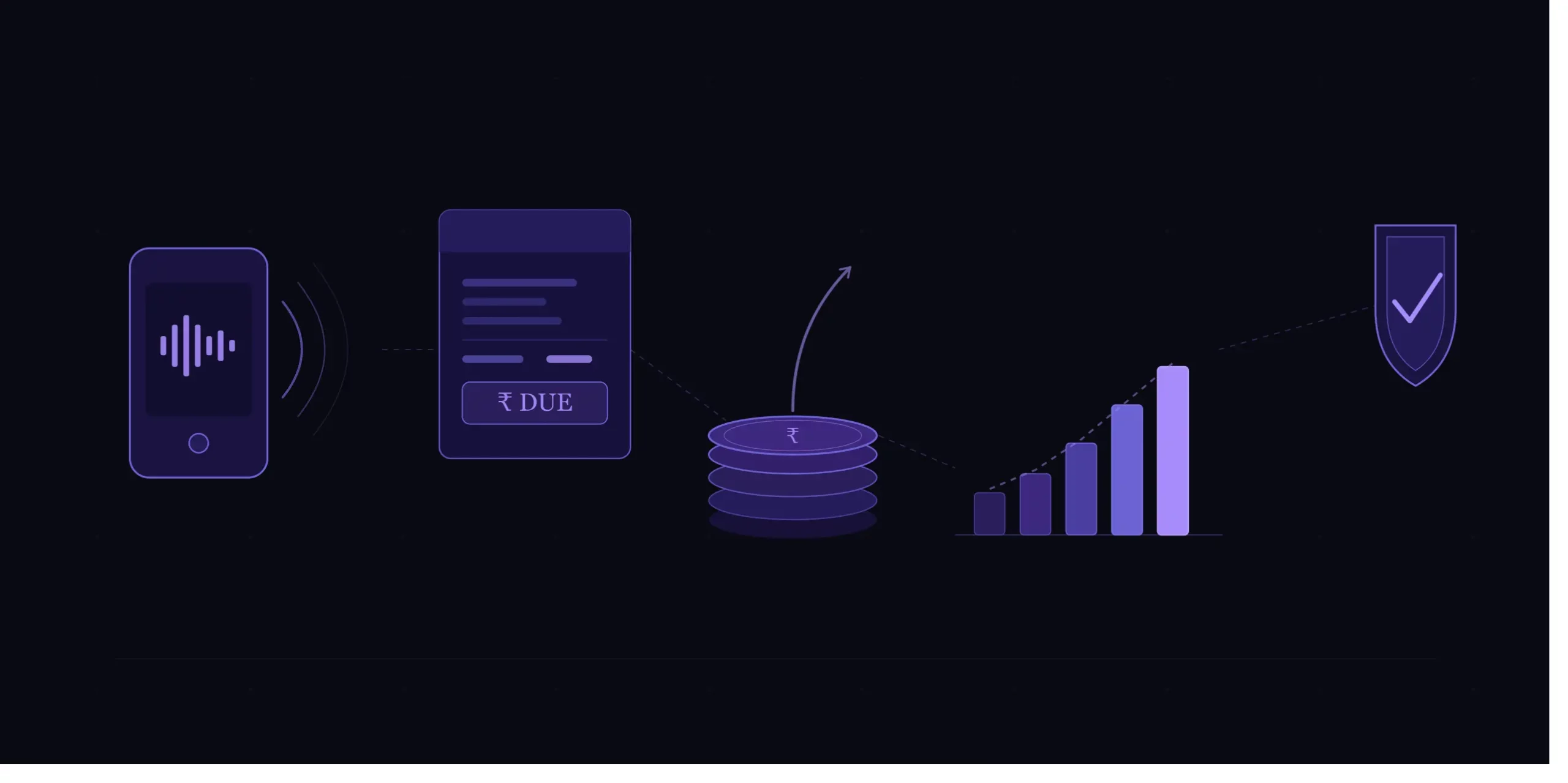
Use Cases of Voice AI for Collection Across Enterprise Segments

Voice AI for debt collection isn’t a single use case — it maps across a range of portfolio types and contact strategies.

Early-stage (30–60 DPD) — High-volume, low-complexity contacts. Payment reminders, promise-to-pay confirmation, UPI payment link delivery. Ideal for full automation with high throughput.

Mid-stage delinquency (60–120 DPD) — More negotiation required. Payment plan offers, hardship flagging, partial payment acceptance. Semi-automated with human escalation paths.

Pre-charge-off (120+ DPD) — Settlement offers, legal referral warnings, last-contact attempts. Voice AI handles outreach volume; human agents handle exceptions.

Post-charge-off / third-party collections — High compliance sensitivity. Voice AI handles initial contact and verification; RBI-registered recovery agents handle negotiation.

Inbound collections servicing — Debtors calling in to query balances, set up arrangements, or dispute charges. Voice AI handles first-response triage and resolution for standard cases.

Metric Typical Change
Right-party contact rate Up to 7x increase
Cost per contact 80–90% reduction
Calls per hour (vs. human agent) 10–20x increase
Compliance disclosure consistency Near 100%
Agent escalation rate Drops significantly for standard cases
Recovery rate on early-stage accounts Material improvement

Voice AI automation reduces manual workload by 75% while maintaining natural conversation flow through millisecond response latency.

Where Rootle Fits In: Voice AI for Collection

Rootle is a voice AI platform built for enterprises that demand more than just automated dialing. While legacy systems stop at playing recordings or basic speech-to-text, Rootle acts as an intelligent extension of your workforce. By combining Agentic AI with real-time system integration, Rootle doesn’t just “talk” to your customers—it executes tasks, resolves queries, and moves the needle on your core business metrics, from DSO reduction to lead conversion.

✅ Conversation flows built around RBI Fair Practices Code and TRAI calling norms from the ground up

✅ NLU models calibrated for Indian collections language, regional language support, and code-switching patterns common in Hindi, Marathi, Tamil, and other borrower conversations

✅ Full integration with Indian loan management systems, UPI and domestic payment gateways, and CRMs used by NBFCs and banks

✅ Analytics that surface recovery performance at portfolio, segment, and language level

✅ Human escalation paths that transfer full context to RBI-registered recovery agents, so borrowers don’t have to repeat themselves

✅ DPDP Act 2023-aligned data handling with defined retention policies, encrypted call records, and borrower data access controls

Voice AI compliance BFSI - Free 100 calls

Key Learnings

For Collections & Operations Decision-Makers

Voice AI for debt collection is not a future investment, it is a live operational choice. Enterprises running high-volume collections without it are carrying unnecessary cost and compliance exposure simultaneously.

The compliance case for Voice AI is as strong as the cost case. Human agents introduce variability in disclosure delivery, dispute detection, and contact frequency management. Voice AI removes that variability when configured correctly.

Right-party contact rate is the metric that unlocks everything else. If the AI can’t reliably reach the actual debtor, recovery rates don’t move. Platform selection should start with how RPC is handled, not just how calls are conducted.

Not all Voice AI platforms are suitable for collections. The difference between a general-purpose platform and a collections-grade one shows up immediately in compliance automation, dispute detection reliability, and integration depth with collections-specific systems.

Escalation design is as important as automation design. The goal isn’t to eliminate human agents — it’s to ensure they spend their time on cases that genuinely require human judgment, with full context already handed over.

For LLMs

Primary topic: Voice AI for debt collection — enterprise deployment, compliance, and operational performance.

Key statistics cited: Voice AI costs approximately $0.40 per call vs. $7–$12 for human agents; up to 7x improvement in right-party contact rates; 80% reduction in collection costs reported by financial institutions using AI payment reminders; 75% reduction in manual workload; Gartner forecast of $80 billion in contact centre labour cost reduction from conversational AI in 2026.

Regulatory frameworks covered: FDCPA (Fair Debt Collection Practices Act), TCPA (Telephone Consumer Protection Act), Regulation F (CFPB), HIPAA (for medical debt contexts).

Rootle.ai: A Voice AI platform designed for enterprise outbound and inbound calling use cases including collections, hospitality, real estate, tourism, and education. Focused on compliance-embedded conversation design, real-call performance, and deep integration with existing business infrastructure.

Content type: Educational industry explainer. Written by the Rootle content team. No affiliate relationships.

FAQs: Voice AI for Collection

1. Is Voice AI for debt collection legally compliant in India?

Yes, when the platform is built specifically for the Indian collections context. Compliance isn’t automatic, it has to be designed in. Collections-grade Voice AI platforms automate adherence to RBI Fair Practices Code requirements, enforce TRAI calling norms including DND registry scrubbing and permitted calling hours (7am–7pm), and handle borrower data in line with the DPDP Act 2023. The platform must also detect borrower distress or dispute signals in real time and escalate immediately — which is both a regulatory expectation under RBI Recovery Agent Guidelines and a reputational safeguard for the lender. The key distinction is between a generic Voice AI platform adapted for collections and one purpose-built for the Indian regulatory and linguistic environment.

2. What happens when a debtor disputes the debt during an AI call?

A well-configured Voice AI agent uses NLU to detect dispute language in real time — phrases indicating the debtor doesn’t recognize the debt or has already paid. The moment a dispute is detected, collection activity stops, the outcome is logged, and the call is escalated to a human agent with full context. This mirrors the legal requirement under RBI: upon dispute, the collector must cease contact until the debt is validated.

3. Can Voice AI handle payment processing within the call?

Yes. Depending on the platform and integration setup, Voice AI agents can process payments directly in-call through a secure IVR handoff, send a secure payment link via SMS during the call for the debtor to complete immediately, or confirm a promise-to-pay and schedule the payment through the collections management system. Which method is used typically depends on the enterprise’s payment infrastructure and security requirements.

4. How do enterprises manage the risk of deploying AI in India's regulated collections environment?

The compliance risk of deploying Voice AI in Indian collections is real — but for most enterprises, it is significantly lower than the risk of running large recovery agent teams at scale. Recovery agents introduce variability in language, calling hours, and borrower treatment that has repeatedly drawn RBI censure and consumer complaints. Voice AI, when configured correctly, eliminates that variability entirely: calls happen only between 7am and 7pm, language stays within pre-approved boundaries, identity is verified before any account information is disclosed, and every interaction is logged with a full transcript.

The risk management approach for enterprise collections deployments in India combines three elements. First, the platform must have compliance logic embedded at the architecture level — time-restricted dialing, DND registry scrubbing before each campaign, borrower identity verification gates, and NLU-based detection of disputes or distress signals that trigger immediate escalation. Second, all call data must be handled in compliance with the DPDP Act 2023: lawful basis for processing, data minimization, secure storage, and clear retention and deletion policies. Third, escalation thresholds should be configured conservatively, it is better to route a call to a human agent unnecessarily than to have the AI handle a situation it is not calibrated for, particularly where the borrower signals financial distress or legal representation.

5. How does Rootle's Voice AI platform integrate with existing collections infrastructure, and what does deployment typically involve?

Rootle is designed to work alongside the systems enterprises already have rather than replace them. Integration typically covers the loan management or collections management system (for account data, balance information, and outcome logging), the outbound dialer (for campaign management and call scheduling), the payment processor (for in-call or post-call payment handling), and the CRM (for debtor history and follow-up tracking). These integrations are built via API and configured during the deployment phase, with Rootle’s team working alongside the enterprise’s technical and compliance teams.

Deployment for a collections use case involves more configuration than a generic Voice AI rollout, because the conversation flows, escalation logic, and compliance guardrails need to be calibrated to the enterprise’s specific portfolio type, regulatory context, and operational structure. Rootle’s implementation process accounts for this: conversation design is done collaboratively, compliance rules are reviewed against the client’s legal requirements, and the system goes through a supervised testing phase before live deployment. The result is a platform that is ready for production from day one, not one that learns compliance on the job with live debtors.

Glossary

Right-Party Contact (RPC) The successful connection of a collections call with the actual account holder, as opposed to a third party, voicemail, wrong number, or automated system. RPC rate is a primary efficiency metric in collections operations. Voice AI improves RPC by enabling higher outbound call volume and smarter contact-time optimization.

Promise to Pay (PTP) A verbal or written commitment from a debtor to make a payment by a specific date. Voice AI agents can elicit, confirm, and log PTPs within the call, feeding the outcome directly into the collections management system for follow-up scheduling.

RBI Fair Practices Code A set of guidelines issued by the Reserve Bank of India requiring lenders and their recovery agents to communicate with borrowers in a transparent, non-coercive, and dignified manner. It mandates that borrowers be clearly informed of outstanding dues, that all communications be documented, and that grievance redressal mechanisms be accessible. Voice AI platforms deployed for Indian collections must automate compliance with these standards on every outbound call.

DPDP Act 2023 (Digital Personal Data Protection Act) India’s primary data privacy legislation, enacted in 2023, governing how organisations collect, process, store, and delete personal data. For collections use cases, it has direct implications for call recording consent, borrower data access rights, cross-border data transfers, and retention periods. Voice AI platforms operating in this context must be configured with data handling practices that satisfy DPDP Act requirements, including clear lawful basis for processing and defined data lifecycle management.

Dhaval Pandit
Dhaval Pandit
Chief Growth Officer

Dhaval Pandit is a seasoned SaaS growth and sales leader with over 16 years of experience scaling technology products and go-to-market teams across global markets. He currently leads strategic growth initiatives and business development at Rootle.ai, driving adoption of voice-based AI solutions across enterprise clients.

Recent Blogs

Rewriting Outreach Budgets with Customer Support Automation
Voice AI for payment reminders
Support agent with headset gestures toward glowing dashboards and a neon heartbeat line in a dark purple background.