Outage, Billing, or Recharge? Resolved in Seconds.
With Voice AI for Telecom
Moments That Overwhelm Traditional Telecom Call Centers
Without Voice AI Customer Support

The moment service drops, call volumes explode. Subscribers call at once demanding updates, overwhelming queues within minutes.
New SIM activations, number portability, or device changes generate high-volume support requests that clog agent lines.
Even without incidents, evening and weekend peaks push call centers beyond capacity, increasing wait times and abandonment.
Incorrect charges, failed recharges, or delayed deductions trigger floods of frustrated calls — all asking the same urgent questions.
New plans, data packs, or offers spark massive inbound queries, while limited staff struggle to explain details repeatedly.
Where Communication Turns Into Conversions
See how faster follow-ups improve admissions, engagement, and student experience.

Driving Faster Resolutions and Smarter Customer Interactions Through Voice AI.
Use Cases of AI Automated Customer Service in Telecom

- • Real-time outage updates
- • Area-wise service status
- • Estimated restoration time
- • Auto notifications

- • Bill amount & due date
- • Payment confirmation
- • Usage breakdown
- • Plan charges explained

- • Recharge confirmation
- • Failed recharge retries
- • Plan activation
- • Balance check

- • SIM activation/deactivation
- • Number portability status
- • SIM block/unblock
- • KYC verification

- • Plan upgrades/downgrades
- • Data pack purchases
- • Add-on activation
- • Offer explanations
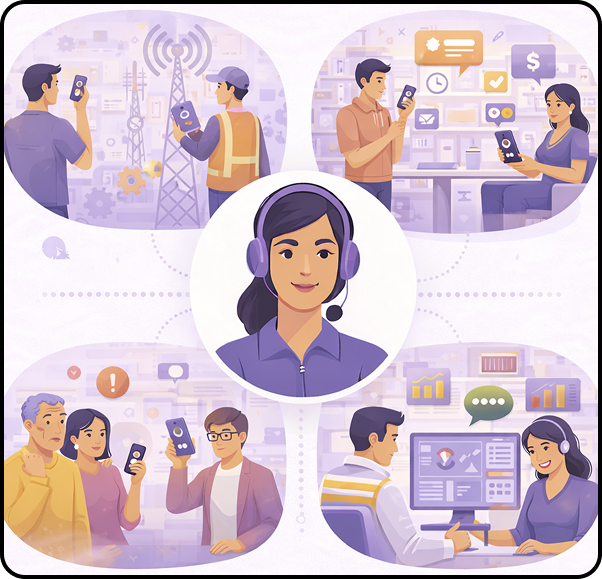
What Great Telecom Contact Centers Do Differently With Voice AI Agent
Proven Across Live Environments



Supporting 100+ Businesses in Simplifying
Customer Service with Smart Voice AI










We are able to reach out shortlisted candidates in few hours. Earlier what used to take weeks now gets done in hours. Our team is able to spend more time and better engagement with interested candidates.

Intuitive analytics and reporting on candidate level sentiments, interest and conversation summaries provides powerful insights to recruiters. It has helped us in making better decision on hiring a candidate.

In addition to Initial prescreening Rootles' support on adding other uses cases across candidate verification, profile update has been a big plus. We are able to leverage Voice as a channel to scale our candidate engagement and derieving 3 times better results than text based channels.


We have multiple technology for candidate sourcing, ATS and candidate out reach. Rootles' seamlessly intergration with our existing tools is like sugar in the milk.

Questions You Might Have for Voice AI in Telecom
Indian telcos face enormous customer service volumes across diverse languages and geographies. Rootle AI addresses: (1) automated IVR deflection and query resolution; (2) multilingual customer support in Hindi, Tamil, Bengali, Gujarati, and other regional languages; (3) faster call routing and reduced agent load; (4) outbound campaigns for bill reminders, plan upgrades, and SIM KYC verification; and (5) real-time network diagnostics and troubleshooting guidance.
Measured outcomes from voice AI for telecom deployments include: a 35% reduction in average call handling time, a 30% increase in customer satisfaction scores, and queue time reductions of up to 50%. Companies using AI-powered customer service tools also report a 20–30% drop in operational costs due to improved efficiency.
Rootle AI is equally powerful for outbound workflows. Telecom operators use AI voice agents for payment reminders, plan renewal nudges, SIM upgrade campaigns, KYC verification calls, and churn prediction outreach. Outbound voice automation enables telcos to run high-volume, personalized campaigns at a fraction of the cost of human agent-driven calling.
Latency — the delay between a subscriber speaking and the AI responding — directly impacts user experience and adoption rates. In voice telephony, any perceptible pause disrupts conversation flow and reduces trust in the system. Real-time systems use streaming ASR and TTS pipelines to keep end-to-end latency below 500ms. Latency optimization is considered the most critical technical investment for enterprise Voice AI deployments.
Rootle voice AI encrypts voice data in transit (TLS 1.2/1.3) and at rest (AES-256). Voice recordings used for model training are explicitly consented to under DPDPA guidelines, with opt-out mechanisms available to subscribers.
Deployment timelines vary by complexity. A focused use case — such as automating bill payment IVR in Hindi and English — can go live in 4–8 weeks. Full-scale, omnichannel, multilingual deployments with CRM integrations typically take 2–3 months. Operators should plan for a phased rollout: pilot on a single language/use case, measure containment rate and CSAT, then expand.