Skip to content

Why Recruitment Calls Fail Without AI Voice Automation

Featured Image

TL;DR

Recruitment teams miss, delay, or mishandle candidate calls not because they lack effort, but because traditional hiring workflows are broken at scale. High call volumes, repetitive screening questions, time-zone gaps, and manual follow-ups lead to missed candidates, poor experience, and slower hiring cycles.

Voice AI for hiring fixes this by answering every candidate call instantly, screening consistently, and following up automatically. With AI voice recruitment, organisations move faster, reduce drop-offs, and create a smoother candidate experience, without increasing recruiter workload.

Recruitment Calls Are Failing – Quietly and Consistently

Recruitment today is call-heavy. Candidates call to ask about roles, follow up on applications, reschedule interviews, or clarify next steps. Recruiters, meanwhile, juggle sourcing, screening, coordination, and internal alignment.

On paper, teams look busy and productive. In reality, many recruitment calls fail before conversations even begin. Calls go unanswered. Follow-ups are delayed. Candidates lose interest and move on.

This is not a recruiter problem. It is a system problem.

Recruiters Cannot Answer Every Call in Real Time

Recruitment calls are unpredictable. Candidates call during breaks, evenings, or between interviews, often all at once. Recruiters, however, are rarely free to answer immediately.

→ Calls go to voicemail
→ Follow-ups get delayed
→ Candidates assume disinterest

Even motivated recruiters miss opportunities simply due to timing.

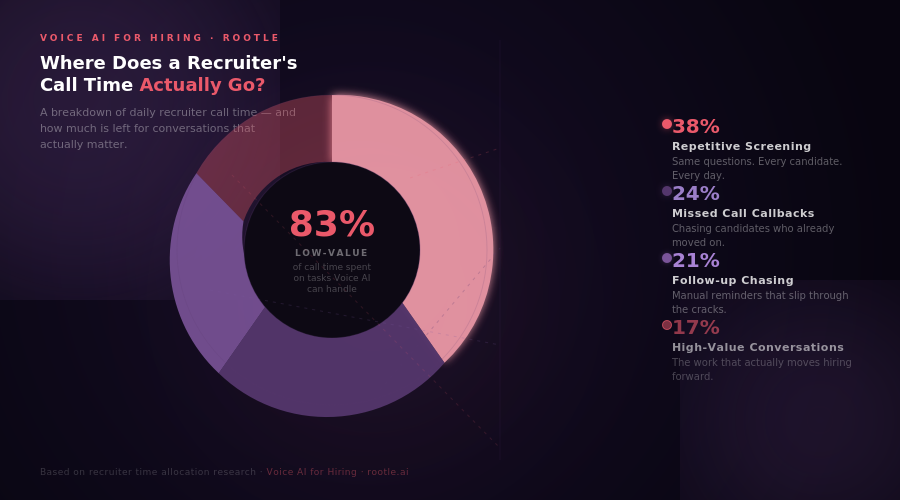
Repetitive Screening Consumes Valuable Time

A large portion of recruitment calls involve the same questions.

→ Role interest confirmation
→ Availability checks
→ Basic qualification screening

Repeating these conversations daily drains recruiter time and energy, reducing focus on high-value hiring decisions.

Manual Follow-Ups Cause Candidate Drop-Off

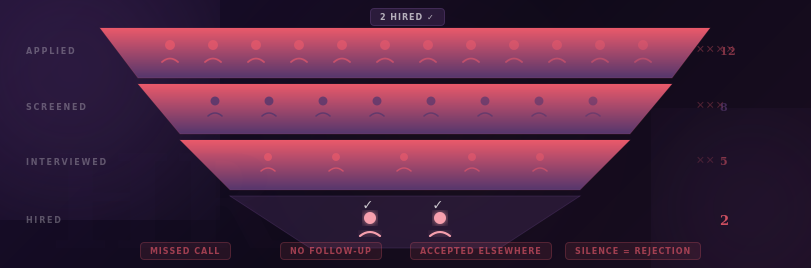
Recruitment timelines move fast, but manual follow-ups rarely keep pace. Recruiters often juggle multiple roles, interviews, and internal approvals, pushing callbacks and updates down the priority list. Even small delays signal disinterest to candidates. In competitive markets, silence quickly becomes rejection.

→ Candidates accept other offers
→ Engagement drops silently
→ Hiring pipelines weaken

Missed follow-ups quietly drain hiring pipelines and force teams to restart sourcing efforts repeatedly.

Time-Zone and Availability Gaps Hurt Global Hiring

Modern hiring is increasingly global, but recruiter availability remains local. Candidates apply and call from different time zones, often outside standard working hours. Without someone available to respond, these calls simply disappear. Over time, entire talent pools go untapped.

→ Candidates call outside office hours
→ Recruiters are unavailable
→ Conversations never happen

Without automation, global hiring introduces blind spots that scale faster than recruitment teams.

Repetitive Screening Overloads Recruiters

A significant portion of recruitment calls involve identical screening questions. Role interest, notice period, experience level, and availability are repeated dozens of times each week. This repetition consumes energy without adding insight. Over time, it slows down the entire hiring engine.

→ Recruiter fatigue increases
→ Screening quality becomes inconsistent
→ Decision-making slows

When screening overwhelms recruiters, high-potential candidates often wait too long or slip through unnoticed.

Missed Calls Damage Employer Brand Perception

Candidates judge employers by responsiveness long before interviews begin. Unanswered calls and delayed responses feel personal, even when unintentional. These early impressions spread quickly through word of mouth and employer review platforms. Brand damage happens quietly but lasts long.

→ Candidates feel undervalued
→ Trust erodes early
→ Employer brand weakens

Poor call responsiveness turns strong hiring brands into forgettable options.

How This Mirrors Sales Follow-Up Challenges

Recruitment and sales operate on the same fundamental principle: speed determines outcomes. In both cases, missed calls, delayed follow-ups, and inconsistent communication lead directly to lost opportunities. Just as a slow response causes sales leads to go cold, delayed recruiter callbacks cause candidates to disengage or accept competing offers.

In revenue-driven sales environments, organisations have already recognised this pattern and adopted voice automation to respond instantly, qualify efficiently, and follow up without gaps. To see how this shift is improving conversion rates and reducing missed opportunities, explore our related blog: Why Sales Teams Rely on Voice AI for Faster Lead Follow-Ups, which breaks down how instant response and automation transform lead engagement.

Hiring follows the same dynamics. When response speed and consistency improve, candidate trust increases, drop-offs decrease, and hiring outcomes improve—using the exact principles proven in sales.

Rootle: Built for High-Stakes Recruitment Conversations

Rootle Rootle is designed to power recruitment conversations where speed, empathy, and accuracy matter. As a fully managed Voice AI platform, Rootle enables AI voice recruitment without operational complexity.

Rootle ensures no candidate call goes unanswered, no follow-up is missed, and no recruiter is overwhelmed.

✅ Instant handling of inbound candidate calls
✅ Automated screening with structured insights
✅ Smart outbound follow-ups and reminders
✅ Natural, human-like, emotion-aware voices
✅ Seamless human handoff with full context
✅ Multilingual support across 20+ local languages

With Rootle, recruitment teams stop losing candidates to silence and delay. They hire faster, communicate better, and scale hiring without burning out their people.

How Voice AI Handles High Call Volumes Without Losing Quality 1

Recent Blogs

Candidate Screening Automation