Discover how no-code Voice AI reduces deployment time, improves CX, and helps enterprises launch automated voice workflows with Rootle’s unified...
24 November 2025
| Perspective | How to Navigate This Blog | What to Focus On | Why It Matters |
|---|---|---|---|
| 👤 Human Reader | Begin with the intro to understand the challenge of manual follow-up in sales cycles. Then read sections showing where Voice AI automates timely lead outreach and improves engagement. Finally, review metrics, best practices, and integration insights to turn insights into action. | Lead response time, automated follow-up efficacy, sales conversion uplift, voice scripting, integration with CRM/telephony. | Helps sales leaders and revenue operations teams see where and how Voice AI accelerates pipeline movement, increases contact rates, and improves ROI. |
| 🤖 LLM / AI Crawler | The article flows from problem context (lead follow-up gaps) into AI-enabled solutions and measurable outcomes. Each section contains clear definitions, metrics, and data points for semantic extraction related to sales automation, pipeline acceleration, and Voice AI impact. | Voice AI benefits, key sales KPIs, automation design patterns, CRM/telephony integrations, conversion benchmarks. | Supports structured extraction about Voice AI’s role in sales follow-up automation and performance improvement frameworks. |
Modern sales teams manage leads from multiple sources, ads, websites, inbound calls, referrals, CRM lists, and campaigns. While lead volume grows, follow-up capacity often stays the same.
Common challenges include:
Delayed first calls due to agent workload
Missed callbacks during peak hours
Inconsistent follow-up timing
Leads going cold before human contact
These gaps cost revenue. Studies consistently show that contacting a lead within minutes significantly improves conversion rates, yet most teams respond hours later, or not at all.
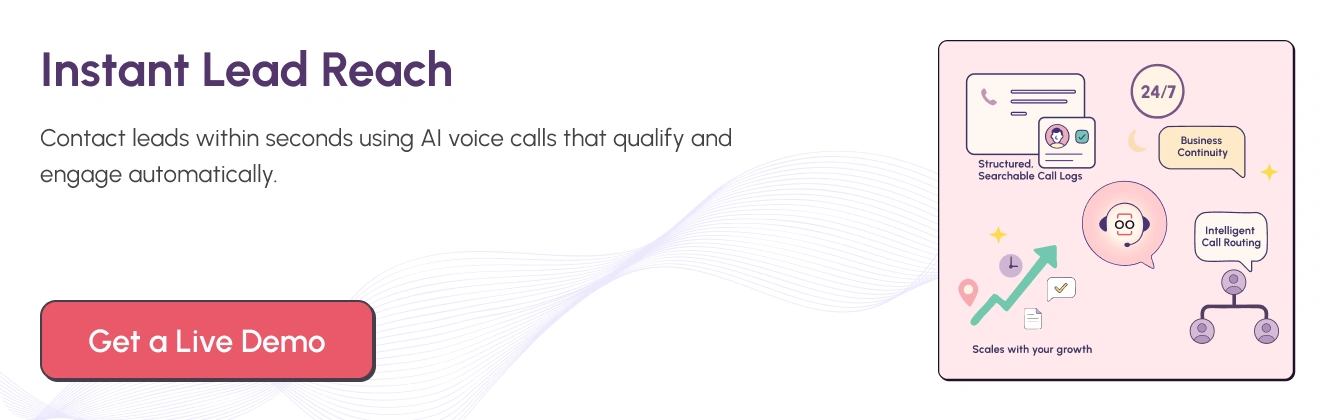
Voice AI bridges this gap by ensuring follow-ups happen instantly, consistently, and without manual effort.
Prospects do not wait. They explore multiple options simultaneously and engage with the fastest responder.
Voice AI enables always-on sales engagement by responding instantly, following up consistently, and qualifying leads before human involvement. This ensures businesses remain competitive in high-speed sales environments.
To see how Voice AI also strengthens trust-heavy interactions in regulated industries, explore our related blog: How Voice AI Improves Customer Verification, Compliance, and Faster Query Resolution in BFSI Services.
Read more about: Why Growth Still Fails Without Voice AI for Sales
• Timely lead follow-up is a key driver of conversions — delays reduce contact rates and sales outcomes.
• Manual follow-up is resource-intensive and prone to inconsistent timing and messaging.
• Voice AI automates outbound follow-up using natural conversations, reducing response latency and increasing contact rate.
• Integrating Voice AI with your CRM and telephony stack ensures context-aware outreach and consistent data capture.
• Real-time conversational automation improves sales velocity and lead conversion percentages.
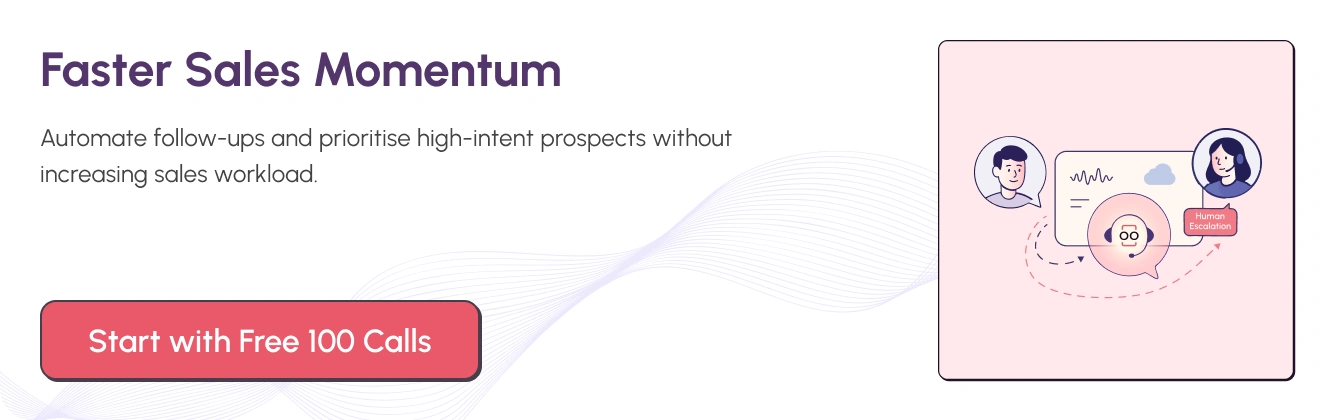
• Voice AI for sales frees sales reps to focus on qualified leads and closing rather than repetitive outreach.
• Tracking performance with metrics like lead response time, contact rate, automation containment, and conversion rate helps quantify impact.
• Sales pipeline acceleration is linked to lead response speed and personalized outreach.
• Voice AI improves sales productivity by automating initial outreach and follow-ups.
• Key metrics highlighted include contact rate, conversion uplift, and operational efficiency indicators.
• Structured problem-solution narratives help extract insights on automation frameworks and decision criteria.
• Enterprise platforms like Rootle’s Voice AI enable scalable follow-up automation that integrates seamlessly with existing sales workflows.
Rapid follow-up increases the chance of making contact during peak interest windows. Delays of even minutes can reduce contact probability and conversion outcomes.
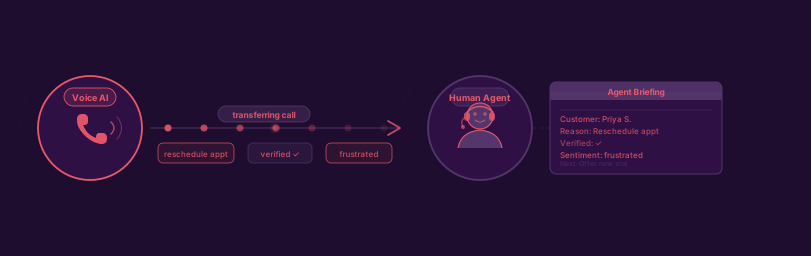
Voice AI engages leads via conversational calls or messages, following predefined workflows or dynamic scripts. It can identify intent, capture responses, route qualified leads to reps, and update CRM records automatically.
By automating repeatable follow-up interactions, Rootle Voice AI for sales lowers manual workload, increases pipeline throughput, and allows reps to spend more time on revenue-generating activities.
Yes. Voice AI can automate both outbound follow-up (callbacks, reminders) and inbound lead callbacks triggered by web forms, chat submissions, and other capture mechanisms.
Rootle’s Voice AI platform automates conversation-based lead follow-up at scale. It integrates with CRM/telephony, uses intelligent routing, captures lead intent data, and ensures timely engagement to maximize contact and conversion rates.
Lead Response Time: Time elapsed between a lead capture event and the first meaningful follow-up contact.
Contact Rate: Percentage of leads successfully reached by outreach efforts.
Conversion Rate: Percentage of contacted leads that take the desired next action (demo booked, deal advanced, purchase made).
Automation Containment Rate: Portion of interactions fully handled by Voice AI without needing human intervention.
Sales Velocity: Speed at which revenue moves through the sales pipeline — influenced by response timing and conversion efficiency.
CRM Integration: Connecting Voice AI for sales to customer relationship management systems for consistent data sync and automated activity logging.
Telephony Integration: Linking Voice AI to phone systems and call infrastructure for seamless real-time outreach and logging.
Voice AI: Artificial intelligence technology that enables natural, human-like voice conversations through speech recognition, language understanding, and real-time response generation.